## Photograph: Historical Classroom/Laboratory Interior
### Overview
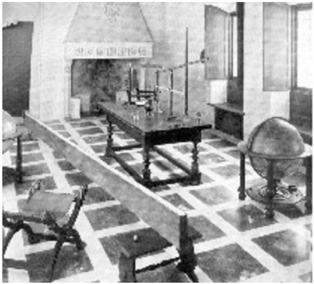
The image depicts a black-and-white photograph of a historical academic or scientific workspace, likely from the 18th or 19th century. The room features a checkered floor (black and white tiles), a central wooden table with scientific instruments, a globe on a stand, a fireplace with a mantel, and a chair with a cushion. Windows with shutters and exposed ceiling beams are visible. The atmosphere suggests a blend of educational and experimental use.
### Components/Axes
- **Central Table**: Wooden, with a dark finish. Positioned at the center of the room.
- **Instruments**: Includes a telescope mounted on a tripod, a microscope on a stand, and other unidentifiable apparatus (possibly glassware or mechanical devices).
- **Globe**: Spherical, mounted on a three-tiered stand. Located to the right of the table.
- **Fireplace**: Stone or brick construction with a decorative mantel. Positioned on the left wall.
- **Chair**: Wooden, with a cushion. Situated near the fireplace.
- **Windows**: Tall, rectangular, with wooden shutters. Allow natural light into the room.
- **Ceiling**: Exposed wooden beams, suggesting a traditional architectural style.
### Detailed Analysis
- **Textual Elements**: No legible text, labels, or axis markers are visible in the image. The fireplace mantel appears to have inscriptions, but they are too small or blurred to decipher.
- **Spatial Layout**:
- The central table is the focal point, flanked by the globe (right) and fireplace (left).
- The chair is positioned near the fireplace, facing the table.
- Windows are evenly spaced along the back wall, with shutters partially open.
- **Material and Design**:
- The checkered floor uses alternating black and white tiles, creating a geometric pattern.
- The table and instruments reflect a utilitarian design, prioritizing function over ornamentation.
### Key Observations
1. **Historical Context**: The room’s design (fireplace, wooden furniture, globe) aligns with pre-industrial or early industrial-era educational institutions.
2. **Scientific Focus**: The presence of a telescope and microscope indicates a dual emphasis on astronomy and microscopy, common in 18th-century natural philosophy.
3. **Ambiguity in Text**: The mantel’s inscriptions remain unreadable, leaving the room’s specific institutional purpose (e.g., university, observatory) open to interpretation.
### Interpretation
The room likely served as a multipurpose space for teaching and experimentation. The globe and instruments suggest a curriculum centered on natural sciences, while the fireplace and seating imply a lecture or discussion environment. The absence of modern equipment (e.g., electrical devices) reinforces its historical context. The unreadable text on the mantel could denote the institution’s name or a motto, but without clearer imagery, this remains speculative. The spatial arrangement prioritizes accessibility to tools and natural light, critical for observational and experimental work.
**Note**: No numerical data, charts, or diagrams are present. The image provides contextual clues about historical pedagogy and scientific practice but lacks quantifiable metrics.