## Problem Solving Examples: Model Input and Output
### Overview
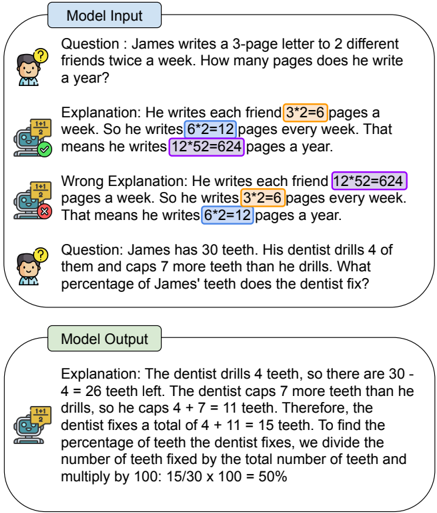
The image presents two examples of problem-solving scenarios, one labeled "Model Input" and the other "Model Output." The "Model Input" section shows two word problems and a correct and incorrect explanation for the first problem. The "Model Output" section shows a word problem and its explanation.
### Components/Axes
**Model Input:**
* **Header:** "Model Input" in a rounded rectangle.
* **Problem 1:**
* **Question:** "James writes a 3-page letter to 2 different friends twice a week. How many pages does he write a year?"
* **Correct Explanation:**
* "He writes each friend 3*2=6 pages a week." (3*2=6 is highlighted in orange)
* "So he writes 6*2=12 pages every week." (6*2=12 is highlighted in blue)
* "That means he writes 12*52=624 pages a year." (12*52=624 is highlighted in purple)
* **Wrong Explanation:**
* "He writes each friend 12*52=624 pages a week." (12*52=624 is highlighted in purple)
* "So he writes 3*2=6 pages every week." (3*2=6 is highlighted in orange)
* "That means he writes 6*2=12 pages a year." (6*2=12 is highlighted in blue)
* **Problem 2:**
* **Question:** "James has 30 teeth. His dentist drills 4 of them and caps 7 more teeth than he drills. What percentage of James' teeth does the dentist fix?"
**Model Output:**
* **Header:** "Model Output" in a rounded rectangle.
* **Problem 1:**
* **Explanation:** "The dentist drills 4 teeth, so there are 30 - 4 = 26 teeth left. The dentist caps 7 more teeth than he drills, so he caps 4 + 7 = 11 teeth. Therefore, the dentist fixes a total of 4 + 11 = 15 teeth. To find the percentage of teeth the dentist fixes, we divide the number of teeth fixed by the total number of teeth and multiply by 100: 15/30 x 100 = 50%"
### Detailed Analysis or ### Content Details
**Model Input:**
* The first problem involves calculating the number of pages James writes in a year. The correct explanation breaks down the problem into steps: pages per friend per week, total pages per week, and total pages per year. The incorrect explanation mixes up the order of calculations, leading to a wrong answer.
* The second problem involves calculating the percentage of teeth fixed by the dentist.
**Model Output:**
* The explanation for the teeth problem clearly outlines the steps to arrive at the solution. It calculates the number of teeth remaining after drilling, the number of teeth capped, the total number of teeth fixed, and finally, the percentage of teeth fixed.
### Key Observations
* The "Model Input" section demonstrates a problem-solving approach with both a correct and incorrect solution, highlighting the importance of the correct order of operations.
* The "Model Output" section provides a clear and concise explanation of the solution to the teeth problem.
* The use of color-coding in the "Model Input" section helps to visually connect the numbers in the problem with their corresponding calculations.
### Interpretation
The image illustrates the process of problem-solving, showcasing both the correct and incorrect approaches. The "Model Input" section emphasizes the importance of understanding the problem and applying the correct steps to arrive at the solution. The "Model Output" section demonstrates a clear and logical explanation of the solution. The color-coding in the "Model Input" section is a useful technique for visually representing the calculations and making the problem easier to understand.