\n
## Document: Math Problem Explanations
### Overview
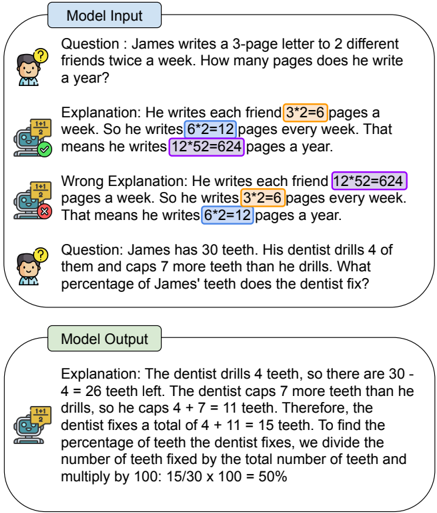
The image presents a document showcasing examples of math problem explanations, contrasting correct and incorrect reasoning. It's structured as a "Model Input" section with a question, followed by a "Model Output" section providing the explanation. Two examples are given, one involving letter writing and the other involving dental work. The correct steps in the explanation are highlighted in green, while incorrect steps are highlighted in red.
### Components/Axes
The document is divided into sections labeled "Model Input" and "Model Output". Within each section, there are questions and explanations. Visual cues (checkmarks and X marks) indicate whether the explanation is correct or incorrect. Numbers within the explanations are color-coded to highlight the calculation steps.
### Detailed Analysis or Content Details
**Example 1: Letter Writing**
* **Question:** James writes a 3-page letter to 2 different friends twice a week. How many pages does he write a year?
* **Correct Explanation:**
* He writes each friend 3\*2=6 pages a week.
* He writes 6\*2=12 pages every week.
* He writes 12\*52=624 pages a year.
* **Incorrect Explanation:**
* He writes each friend 12\*52=624 pages a week.
* He writes 3\*2=6 pages every week.
* He writes 6\*2=12 pages a year.
**Example 2: Dental Work**
* **Question:** James has 30 teeth. His dentist drills 4 of them and caps 7 more teeth than he drills. What percentage of James' teeth does the dentist fix?
* **Explanation:**
* The dentist drills 4 teeth, so there are 30 - 4 = 26 teeth left.
* He caps 4 + 7 = 11 teeth.
* Therefore, the dentist fixes a total of 4 + 11 = 15 teeth.
* To find the percentage of teeth the dentist fixes, we divide the number of teeth fixed by the total number of teeth and multiply by 100: 15/30 x 100 = 50%.
### Key Observations
The document focuses on demonstrating the importance of correct order of operations in problem-solving. The color-coding effectively highlights the critical steps and where errors occur. The second example demonstrates a multi-step problem requiring several calculations to arrive at the final answer.
### Interpretation
This document serves as an educational tool to illustrate common mistakes in mathematical reasoning. By presenting both correct and incorrect solutions side-by-side, it allows learners to identify and understand the flaws in the incorrect approach. The use of color-coding and clear step-by-step explanations enhances comprehension. The examples are designed to be simple enough to grasp the underlying principles of problem-solving without being overwhelmed by complex calculations. The document emphasizes the importance of following the correct sequence of operations and accurately interpreting the problem statement. The document is not presenting data, but rather demonstrating a pedagogical approach to teaching math.