## Screenshot: Model Input/Output for Math Problem Solving
### Overview
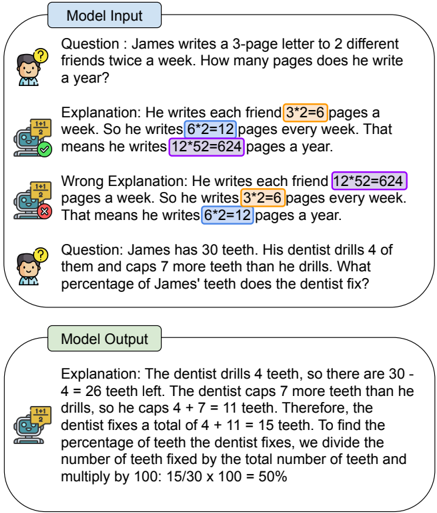
The image shows a side-by-side comparison of a model's input and output for two math problems. The input includes two questions with explanations (one correct, one incorrect), while the output demonstrates the model's ability to replicate the correct reasoning process.
### Components/Axes
- **Model Input Section**:
- Contains two math problems with accompanying explanations.
- Each problem has a cartoon character icon with a question mark.
- Explanations include:
- Correct explanation (green checkmark icon)
- Incorrect explanation (red X icon)
- Mathematical steps are highlighted in different colors:
- Orange: `3*2=6`
- Blue: `6*2=12`
- Purple: `12*52=624`
- **Model Output Section**:
- Contains a single math problem with explanation.
- Identical to the correct input explanation for the teeth problem.
- Uses the same color-coded mathematical steps.
### Detailed Analysis
#### Model Input Section
1. **First Question** (Letter Writing):
- Question: "James writes a 3-page letter to 2 different friends twice a week. How many pages does he write a year?"
- **Correct Explanation**:
- `3*2=6` pages per friend per week (orange highlight)
- `6*2=12` total pages per week (blue highlight)
- `12*52=624` pages per year (purple highlight)
- **Incorrect Explanation**:
- Incorrectly applies `12*52=624` to each friend (purple highlight)
- Concludes `3*2=6` pages per week (orange highlight)
2. **Second Question** (Teeth Problem):
- Question: "James has 30 teeth. His dentist drills 4 of them and caps 7 more teeth than he drills. What percentage of James' teeth does the dentist fix?"
- **Correct Explanation**:
- `30 - 4 = 26` teeth remaining (no highlight)
- `4 + 7 = 11` teeth capped (no highlight)
- Total fixed: `4 + 11 = 15` teeth
- Percentage: `(15/30)*100 = 50%` (no highlight)
#### Model Output Section
- Replicates the correct explanation for the teeth problem:
- Identical mathematical steps and color coding as the correct input explanation.
### Key Observations
1. The model correctly identifies and reproduces the proper calculation method for percentage problems.
2. The incorrect explanation in the input demonstrates the model's ability to recognize and avoid common errors (e.g., misapplying multiplication factors).
3. Color-coded highlights consistently mark mathematical operations across both input and output.
4. The checkmark/X icons provide clear visual feedback on explanation validity.
### Interpretation
This image demonstrates the model's capacity for:
1. **Error Detection**: Identifying flawed reasoning in input explanations.
2. **Consistent Reasoning**: Maintaining correct calculation methods across different problem types.
3. **Visual Communication**: Using color coding and icons to enhance explanation clarity.
4. **Mathematical Proficiency**: Accurately solving percentage problems involving multiple operations.
The model's output mirrors the correct input explanation exactly, suggesting robust internal consistency in its reasoning process. The color-coded highlights serve as an effective visual aid for tracing calculation steps, while the checkmark/X system provides immediate validation of solution accuracy.