## Diagram: Olfactory Receptor (OR) Activation System
### Overview
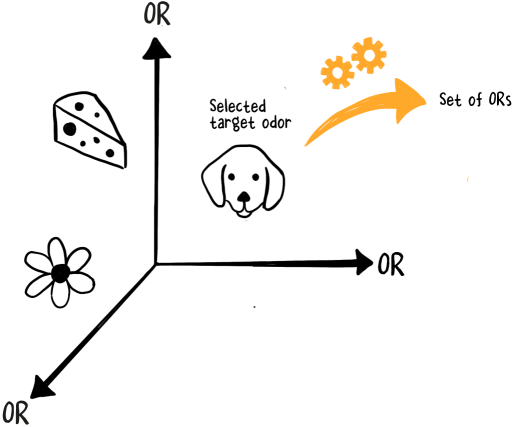
The diagram illustrates a conceptual model of olfactory receptor (OR) activation, depicting relationships between a "Selected target odor," a "Set of ORs," and sensory stimuli (cheese, flower). Arrows and gears suggest a process flow, while icons represent stimuli and biological components.
### Components/Axes
- **Axes**: Three axes labeled "OR" (all identical, possibly a typo or intentional abstraction).
- **Icons**:
- **Cheese wedge**: Positioned on the left axis, labeled "OR."
- **Flower**: Located on the bottom axis, labeled "OR."
- **Dog head**: Central icon, labeled "Selected target odor."
- **Arrows**:
- **Black arrows**: Connect the dog head to the cheese and flower, indicating directional relationships.
- **Orange arrow**: Points from the dog head to a "Set of ORs," with two orange gears above it.
- **Text Labels**:
- "Selected target odor" (above the dog head).
- "Set of ORs" (right side of the diagram).
### Detailed Analysis
- **Axes**: All three axes are labeled "OR," suggesting a three-dimensional space or repeated emphasis on olfactory receptors. The repetition may indicate a conceptual or symbolic representation rather than a literal spatial model.
- **Icons**:
- The cheese and flower are positioned on separate axes, implying they are distinct stimuli or odor sources.
- The dog head is centrally placed, acting as the "Selected target odor" input.
- **Arrows**:
- Black arrows from the dog head to the cheese and flower suggest the dog's olfactory system processes these stimuli.
- The orange arrow from the dog head to "Set of ORs" implies a transformation or activation of multiple ORs in response to the selected odor.
- The orange gears above the orange arrow symbolize a mechanistic process (e.g., signal transduction, computational modeling) converting the target odor into a set of ORs.
### Key Observations
- The diagram emphasizes the **transformation** of a single "Selected target odor" (dog) into a **Set of ORs**, mediated by a process (gears).
- The cheese and flower are positioned as **distinct stimuli** but are not directly connected to the "Set of ORs," suggesting they may represent alternative inputs or outputs in the system.
- The repetition of "OR" on all axes is ambiguous but may indicate a focus on olfactory receptors as the central theme.
### Interpretation
This diagram likely represents a **biological or computational model** of olfactory processing. The "Selected target odor" (dog) is processed through a system (gears) to activate a **Set of ORs**, which could correspond to specific olfactory receptor responses. The cheese and flower may symbolize alternative odorants or stimuli that the system can detect. The use of gears suggests a **mechanistic or algorithmic framework**, possibly for simulating how olfactory receptors respond to different stimuli. The repetition of "OR" on all axes might reflect a simplified or abstracted representation of a complex biological system, prioritizing conceptual clarity over anatomical accuracy.