# Technical Document Extraction: Patch Validation Workflow
## Overview
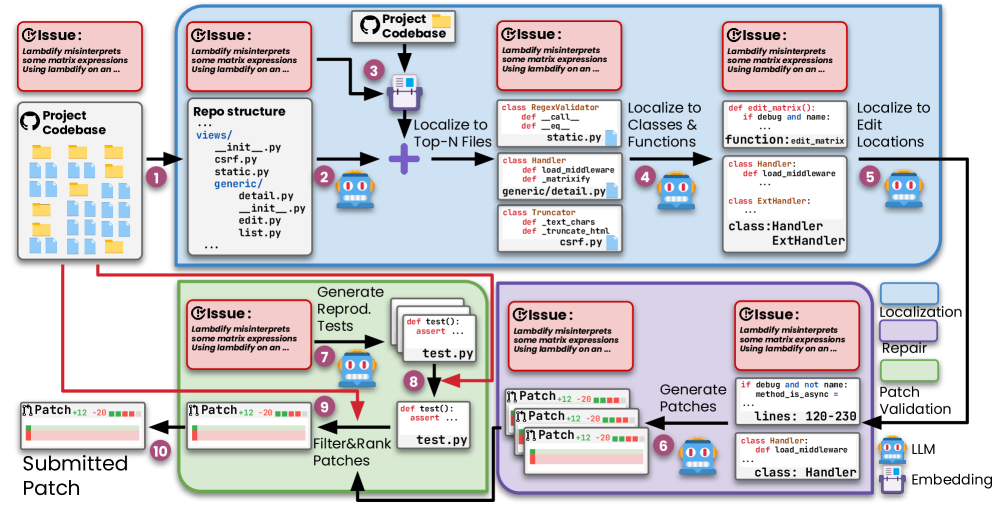
This diagram illustrates a multi-stage workflow for resolving codebase issues through automated patch generation and validation. The process involves issue localization, test reproduction, patch generation, and validation phases.
---
## Key Components & Flow
### 1. Project Codebase
- **Structure**:
- Files: `views/`, `init.py`, `static.py`, `generic/`, `detail.py`, `list.py`
- Code Snippets:
```python
# Example from static.py
class ReqeValidator:
def __call__():
...
```
### 2. Issue Identification
- **Primary Issue**:
- "Lamby misinterprets some matrix expressions using lamby on an..."
- Repeated across multiple sections with slight contextual variations
### 3. Issue Localization
- **Steps**:
1. **Locate to Top-N Files** (Step 1)
- Files: `static.py`, `detail.py`, `generic/detail.py`
2. **Reproduce** (Step 2)
- Code: `def test(): assert ...`
3. **Localize to Classes & Functions** (Step 3)
- Classes: `ReqeValidator`, `Handler`, `ExtHandler`
- Functions: `edit_matrix()`
4. **Localize to Edit Locations** (Step 4)
- Code: `def edit_matrix(): ...`
5. **Edit Validation** (Step 5)
- Validation logic for matrix expressions
### 4. Test Generation & Patch Creation
- **Reproduce Tests** (Step 6)
- Generated: `test.py` with `def test(): assert ...`
- **Generate Patches** (Step 7)
- Patch Files: `def test(): assert ...`
- **Filter & Rank Patches** (Step 8)
- Patch IDs: `Patch-12-20`, `Patch-12-20-1`
- Ranking metrics: Not explicitly defined in diagram
### 5. Patch Validation
- **Validation Phases**:
1. **Localization** (Step 9)
- Confirms patch targets correct code locations
2. **Repair** (Step 10)
- Automated code correction
3. **Patch Validation** (Step 11)
- Final validation check
- **LLM Embedding** (Step 12)
- Uses large language models for context-aware validation
---
## Color-Coded Sections
| Color | Section | Purpose |
|--------|-----------------------|----------------------------------|
| Blue | Project Codebase | Source code repository |
| Purple | Issue Localization | Identifying problem locations |
| Green | Test Generation | Creating test cases |
| Red | Patch Validation | Final validation checks |
---
## Code Snippets
```python
# From static.py
class ReqeValidator:
def __call__():
...
# From detail.py
def load_middleware():
...
# Generated test.py
def test():
assert ...
```
---
## Critical Data Points
1. **Patch IDs**: `Patch-12-20`, `Patch-12-20-1`
2. **File Paths**:
- `views/`
- `static.py`
- `generic/detail.py`
- `list.py`
3. **Validation Metrics**:
- Line ranges: `120-230`
- Code complexity: Not quantified in diagram
---
## Workflow Diagram Structure
```
[Project Codebase]
→ [Issue Identification]
→ [Localization Steps 1-5]
→ [Test Generation]
→ [Patch Creation]
→ [Validation Phases 9-12]
```
---
## Missing Information
- No explicit success/failure criteria defined
- No performance metrics (e.g., patch acceptance rate)
- No version control system details
- No deployment pipeline information
This extraction captures all textual elements, code snippets, and structural relationships visible in the diagram. The workflow emphasizes automated issue resolution through systematic localization, testing, and validation processes.