\n
## Diagram: System Architecture for Task Curation and Experience Shaping
### Overview
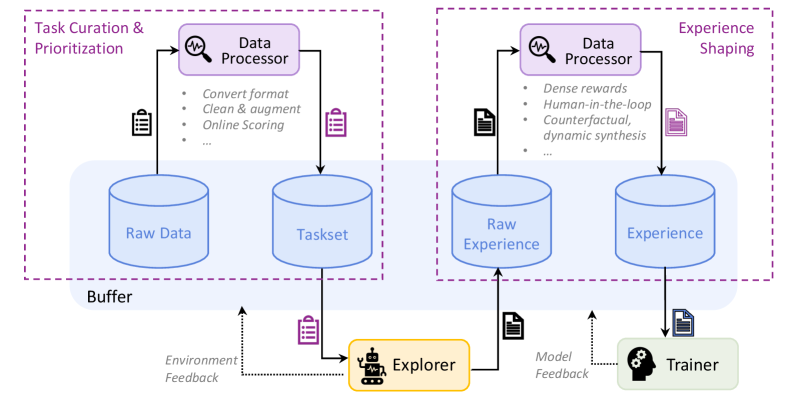
The image depicts a system architecture diagram illustrating a process for task curation & prioritization and experience shaping. The diagram shows a flow of data between several components, including Data Processors, databases (Raw Data, Taskset, Raw Experience, Experience), an Explorer agent, and a Trainer. The diagram is divided into two main sections, visually separated by color and function.
### Components/Axes
The diagram consists of the following components:
* **Task Curation & Prioritization** (Purple Box): This section handles raw data processing and task creation.
* **Experience Shaping** (Light Purple Box): This section processes experience data and provides feedback to the trainer.
* **Data Processor** (Two instances, Purple): Processes data, performs conversions, cleaning, augmentation, and online scoring.
* **Raw Data** (Blue Cylinder): Stores initial raw data.
* **Taskset** (Blue Cylinder): Stores curated tasks.
* **Raw Experience** (Blue Cylinder): Stores raw experience data.
* **Experience** (Blue Cylinder): Stores processed experience data.
* **Explorer** (Yellow Hexagon): An agent that interacts with the environment and generates feedback.
* **Trainer** (Green Head): Receives model feedback and updates the model.
* **Buffer** (Text Label): Indicates a buffer between the Raw Data and Taskset.
* **Environment Feedback** (Text Label): Feedback from the environment to the Explorer.
* **Model Feedback** (Text Label): Feedback from the model to the Trainer.
* **Experience Shaping** (Text Label): Connection between Data Processor and Trainer.
### Detailed Analysis or Content Details
The diagram illustrates a data flow as follows:
1. **Task Curation & Prioritization:**
* Raw Data is fed into a Data Processor.
* The Data Processor performs operations: "Convert format", "Clean & augment", "Online Scoring".
* The processed data is stored in a Taskset.
* The Taskset is connected to the Explorer via a dotted line.
* The Explorer sends "Environment Feedback" back to the Taskset.
2. **Experience Shaping:**
* Raw Experience is fed into a Data Processor.
* The Data Processor performs operations: "Dense rewards", "Human-in-the-loop", "Counterfactual, dynamic synthesis", and "..." (indicating more operations).
* The processed data is stored in Experience.
* Experience is connected to the Trainer.
* The Trainer receives "Model Feedback".
3. **Interaction:**
* The Explorer interacts with both the Taskset and the Experience.
* The Trainer receives feedback from the Experience.
The dotted lines indicate feedback loops. The solid lines indicate data flow.
### Key Observations
* The diagram highlights a clear separation between task creation and experience processing.
* The Data Processor plays a central role in both sections, performing data transformations.
* The Explorer acts as a bridge between the system and the environment.
* The Trainer is responsible for learning from the processed experience.
* The "..." notation in the Experience Shaping Data Processor suggests that the list of operations is not exhaustive.
### Interpretation
This diagram represents a reinforcement learning or similar iterative system. The "Task Curation & Prioritization" section focuses on generating tasks for an agent (the Explorer) to learn from. The "Experience Shaping" section focuses on processing the agent's experiences to provide meaningful feedback for learning. The separation of these two sections suggests a modular design, allowing for independent optimization of task generation and experience processing. The feedback loops indicate a continuous learning process, where the agent's performance influences the tasks it receives and the feedback it gets. The use of "Dense rewards" and "Human-in-the-loop" in the Experience Shaping section suggests a focus on providing rich and informative feedback signals to the agent. The "Counterfactual, dynamic synthesis" operation suggests an attempt to learn from hypothetical scenarios and adapt to changing environments. The overall architecture appears designed to facilitate efficient and effective learning in a complex environment.