## Diagram: System Architecture for Task Curation and Experience Shaping
### Overview
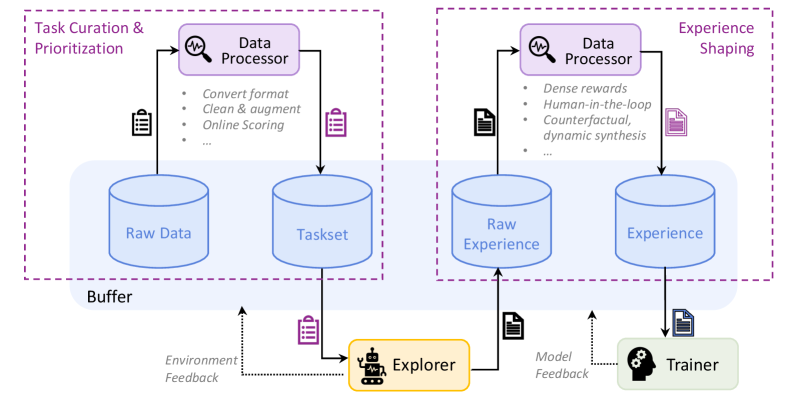
The diagram illustrates a two-phase system architecture for processing data and shaping experiences. It features interconnected components for task curation, data processing, exploration, and model training, with feedback loops between exploration and training phases.
### Components/Axes
1. **Left Section (Task Curation & Prioritization):**
- **Data Processor**: Contains sub-tasks:
- Convert format
- Clean & augment
- Online Scoring
- **Raw Data** (blue cylinder) → **Taskset** (blue cylinder)
- **Buffer** (gray rectangle) acts as intermediary storage
2. **Right Section (Experience Shaping):**
- **Data Processor**: Contains sub-tasks:
- Dense rewards
- Human-in-the-loop
- Counterfactual
- Dynamic synthesis
- **Raw Experience** (blue cylinder) → **Experience** (blue cylinder)
3. **Central Components:**
- **Explorer** (yellow robot icon): Receives Environment Feedback and sends Model Feedback
- **Trainer** (green brain icon): Receives Model Feedback and sends Experience Shaping outputs
4. **Feedback Loops:**
- Environment Feedback → Explorer → Model Feedback → Trainer
- Model Feedback → Experience Shaping
### Detailed Analysis
- **Task Curation Flow**: Raw Data undergoes preprocessing (format conversion, cleaning, augmentation) and online scoring before becoming Taskset. The Buffer manages data flow between these stages.
- **Experience Shaping Flow**: Raw Experience is processed through human-centric methods (dense rewards, counterfactual analysis) and dynamic synthesis to create refined Experience outputs.
- **Exploration-Training Interaction**: The Explorer interacts with the environment, receives feedback, and shares Model Feedback with the Trainer. This creates a closed-loop system for iterative improvement.
### Key Observations
1. Dual Data Processors handle distinct but complementary workflows (task preparation vs. experience refinement)
2. Buffer acts as a critical synchronization point between raw data and taskset generation
3. Human-in-the-loop components appear in both processing phases, emphasizing human-AI collaboration
4. Feedback loops suggest continuous system improvement through environmental interaction
### Interpretation
This architecture represents a hybrid AI system where:
1. **Task Curation** focuses on preparing structured data for specific applications
2. **Experience Shaping** emphasizes human-AI interaction quality through:
- Reward design
- Counterfactual analysis (what could have been)
- Dynamic adaptation
3. The Explorer-Trainer loop mirrors reinforcement learning paradigms, with the key difference being explicit human feedback integration at multiple stages
4. The system prioritizes both data quality (through rigorous preprocessing) and experience quality (through human-centric shaping)
The architecture suggests a framework for developing AI systems that balance automated processing with human oversight, particularly in applications requiring nuanced understanding of human preferences and contextual adaptation.