\n
## Diagram: Numbered Tile Arrangement
### Overview
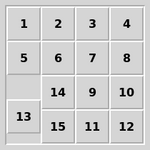
The image depicts a grid of numbered tiles, resembling a sliding puzzle or a partially completed arrangement. The grid is not fully populated, with a missing tile in the top-left corner. The tiles are arranged in a 4x4 grid, except for the missing tile, making it a 3x4 arrangement.
### Components/Axes
The diagram consists of 15 numbered tiles, labeled 1 through 15. Tile 1 is missing. The tiles are arranged in a rectangular grid. There are no explicit axes or scales.
### Detailed Analysis or Content Details
The tiles are numbered as follows:
* Row 1: 2, 3, 4 (Tile 1 is missing)
* Row 2: 5, 6, 7, 8
* Row 3: 13, 14, 9, 10
* Row 4: 15, 11, 12
The tiles are arranged in a grid-like structure. The tile numbers do not appear to follow a specific order or pattern beyond sequential numbering.
### Key Observations
The tile numbered '1' is missing from the top-left corner of the grid. The arrangement suggests a puzzle where the goal might be to arrange the tiles in numerical order.
### Interpretation
The image represents a classic sliding puzzle scenario. The missing tile indicates an incomplete state, and the arrangement of the remaining tiles suggests a challenge to restore the numerical order. The puzzle likely involves sliding tiles into the empty space to achieve the desired arrangement. The image does not provide any information about the puzzle's difficulty or the number of moves required to solve it. It is a static representation of a dynamic problem.