# Technical Diagram Analysis: Agent Architecture
## Overview
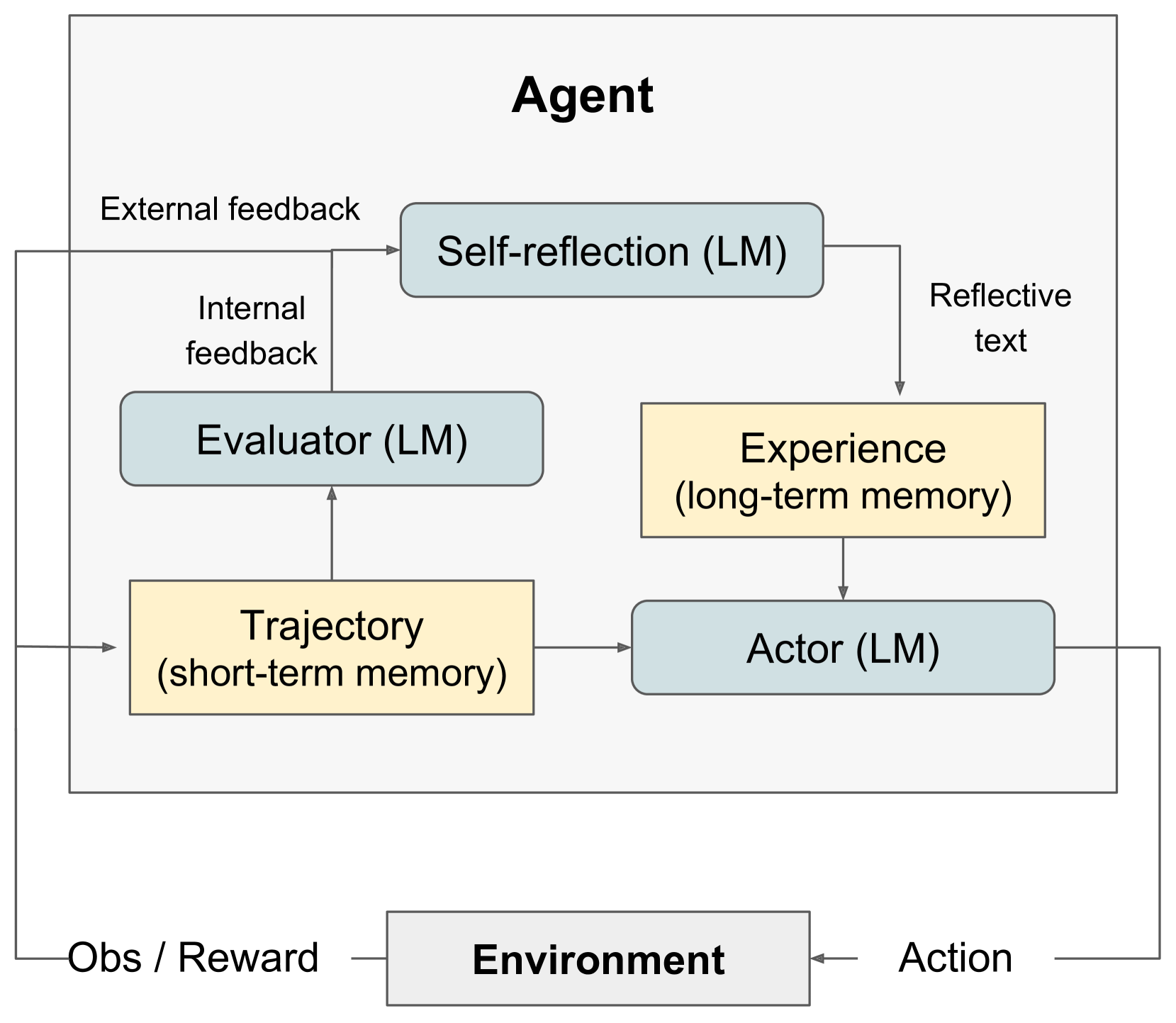
The diagram illustrates a hierarchical agent architecture with internal feedback loops and memory systems. The agent interacts with an external environment through observation/reward signals and actions.
## Key Components
### Agent Subsystems
1. **Self-reflection (LM)**
- Type: Large Model (LM)
- Inputs:
- External feedback (dashed arrow from environment)
- Outputs:
- Reflective text (dashed arrow to Experience)
2. **Evaluator (LM)**
- Type: Large Model (LM)
- Inputs:
- Internal feedback (solid arrow from Self-reflection)
- Outputs:
- Trajectory (solid arrow to Trajectory)
3. **Trajectory (short-term memory)**
- Type: Short-term memory
- Inputs:
- Output from Evaluator
- Outputs:
- Actor (solid arrow)
4. **Experience (long-term memory)**
- Type: Long-term memory
- Inputs:
- Reflective text from Self-reflection
- Outputs:
- Actor (solid arrow)
5. **Actor (LM)**
- Type: Large Model (LM)
- Inputs:
- Trajectory (short-term memory)
- Experience (long-term memory)
- Outputs:
- Action (solid arrow to environment)
### Environment Interface
- **Inputs to Agent**:
- Obs/Reward (solid arrow from environment)
- **Outputs to Environment**:
- Action (solid arrow to environment)
## Memory System
- **Short-term memory**: Trajectory (yellow block)
- **Long-term memory**: Experience (yellow block)
## Feedback Loops
1. **External feedback loop**:
- Environment → Self-reflection (dashed)
- Self-reflection → Reflective text → Experience
2. **Internal feedback loop**:
- Self-reflection → Evaluator → Trajectory
## Color Coding
- **Light blue blocks**: Large Models (LM components)
- **Yellow blocks**: Memory systems (short/long-term)
## Flow Diagram
```
Environment
│
├─ Obs/Reward → Agent
│
Agent
├─ Self-reflection (LM)
│ ├─ External feedback (dashed)
│ └─ Reflective text (dashed) → Experience
├─ Evaluator (LM)
│ └─ Internal feedback → Trajectory
├─ Trajectory (short-term memory)
└─ Actor (LM)
├─ Inputs: Trajectory + Experience
└─ Action (solid) → Environment
```
## Critical Connections
1. **Self-reflection** processes both external and internal feedback
2. **Evaluator** converts feedback into trajectory data
3. **Actor** integrates short-term (trajectory) and long-term (experience) memory
4. **Experience** serves as persistent memory repository
This architecture demonstrates a recursive learning system where environmental interactions inform both immediate actions (through trajectory) and long-term behavioral adaptations (through experience).