## Line Chart: MUSHRA Score vs. Bitrate (kbps)
### Overview
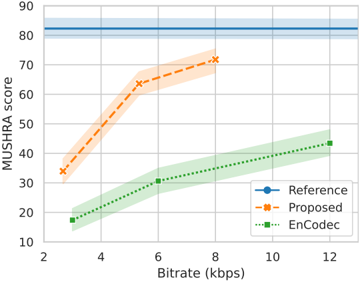
The chart compares three audio encoding methods (Reference, Proposed, EnCodec) across bitrates (2–12 kbps) using MUSHRA scores (10–90). The Reference method maintains a constant score, while Proposed and EnCodec show increasing trends with varying confidence intervals.
### Components/Axes
- **X-axis**: Bitrate (kbps), ranging from 2 to 12 in increments of 2.
- **Y-axis**: MUSHRA score (10–90), with gridlines at 10-unit intervals.
- **Legend**: Located in the bottom-right corner, mapping colors to methods:
- **Blue**: Reference (solid line)
- **Orange**: Proposed (dashed line)
- **Green**: EnCodec (dotted line)
### Detailed Analysis
1. **Reference (Blue)**:
- Flat line at **80 MUSHRA score** across all bitrates.
- No variability (no shaded region).
2. **Proposed (Orange)**:
- Starts at **~30 MUSHRA score** at 2 kbps, rising sharply to **~70 MUSHRA score** at 8 kbps.
- Shaded region (confidence interval) widens from 2–8 kbps, narrowing slightly afterward.
- Peaks at **~70 MUSHRA score** at 8 kbps, then plateaus.
3. **EnCodec (Green)**:
- Begins at **~20 MUSHRA score** at 2 kbps, increasing steadily to **~40 MUSHRA score** at 12 kbps.
- Shaded region (confidence interval) widens consistently across bitrates.
### Key Observations
- **Proposed** outperforms **EnCodec** at higher bitrates (6–8 kbps) but has higher variability (wider shaded region).
- **Reference** remains constant, suggesting it may represent an ideal or benchmark.
- **EnCodec** shows the most consistent improvement but remains below Proposed at all bitrates.
### Interpretation
The data suggests the **Proposed method** achieves higher MUSHRA scores than **EnCodec** at moderate-to-high bitrates (6–8 kbps), though with greater uncertainty. The **Reference**’s flat line implies it may represent a theoretical maximum or standardized benchmark. The widening confidence intervals for Proposed and EnCodec indicate increasing variability in performance at lower bitrates, possibly due to encoding instability or subjective listener differences. At 12 kbps, EnCodec approaches Proposed’s performance but still lags, highlighting a trade-off between bitrate efficiency and quality. The Reference’s constancy raises questions about its practicality, as real-world systems rarely maintain perfect scores across all bitrates.