# Technical Document Extraction: Line Graph Analysis
## **Graph Components**
- **Title**: Not explicitly labeled in the image.
- **Legend**:
- **Blue Line**: "Raw Monitoring KPI"
- **Red Line**: "SAX Representation"
## **Axes**
- **X-Axis**:
- **Label**: Not explicitly labeled.
- **Range**: 0 to 1400 (numerical increments).
- **Key Observations**:
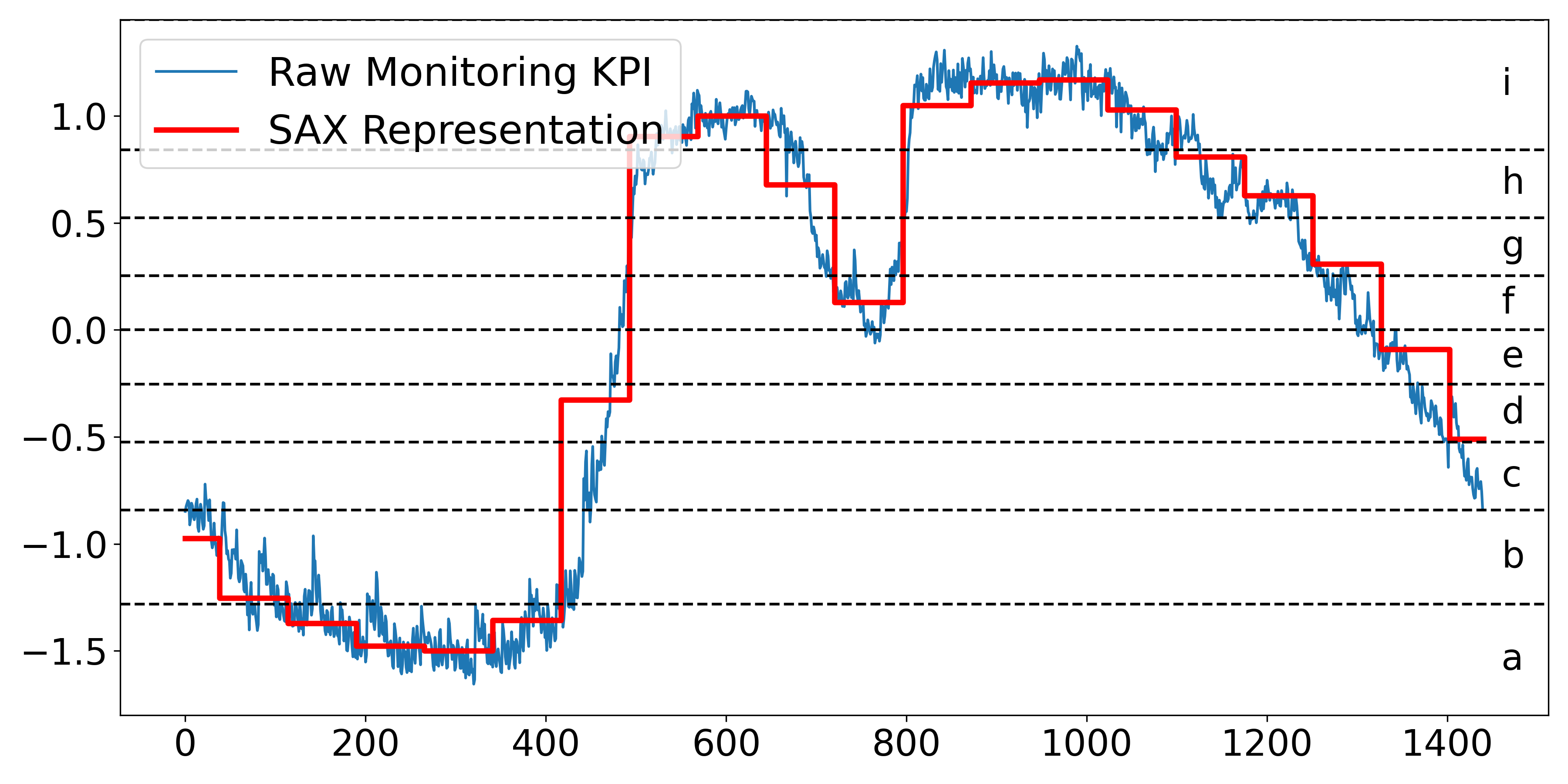
- The red line ("SAX Representation") exhibits stepwise behavior, aligning with critical points in the blue line's trajectory.
- Steps occur at approximate x-values: 100, 300, 500, 700, 900, 1100, and 1300.
- **Y-Axis**:
- **Label**: Not explicitly labeled.
- **Range**: -1.5 to 1.0 (dashed horizontal lines).
- **Markers**:
- Dashed lines labeled **a** to **i** (from bottom to top):
- **a**: -1.5
- **b**: -1.0
- **c**: -0.5
- **d**: 0.0
- **e**: 0.5
- **f**: 1.0
- **g**: 1.5 (not reached by either line)
- **h**: 2.0 (not reached by either line)
- **i**: 2.5 (not reached by either line)
## **Key Trends**
1. **Blue Line ("Raw Monitoring KPI")**:
- **Initial Behavior**: Starts near **b** (-1.0), dips to **a** (-1.5) around x=200, then rises sharply.
- **Mid-Range Fluctuations**: Peaks near **f** (1.0) around x=500, followed by volatility between **e** (0.5) and **f** (1.0).
- **Final Behavior**: Declines to **d** (0.0) by x=1400.
2. **Red Line ("SAX Representation")**:
- **Stepwise Approximation**: Mirrors the blue line's peaks and troughs with horizontal/vertical steps.
- **Critical Steps**:
- **Downward Step**: From **b** (-1.0) to **a** (-1.5) at x≈100.
- **Upward Step**: From **a** (-1.5) to **f** (1.0) at x≈500.
- **Downward Step**: From **f** (1.0) to **d** (0.0) at x≈1300.
## **Cross-Reference**
- **Legend Alignment**:
- Blue line ("Raw Monitoring KPI") matches the raw, noisy fluctuations.
- Red line ("SAX Representation") captures the blue line's extrema via stepwise transitions, confirming alignment with the SAX (Symbolic Aggregate Approximation) method.
## **Summary**
The graph compares a noisy time-series signal ("Raw Monitoring KPI") with its SAX-transformed representation. The SAX line simplifies the raw data into discrete steps, preserving key trends while reducing complexity.