## Flowchart: Hierarchical Categorization of Shapes
### Overview
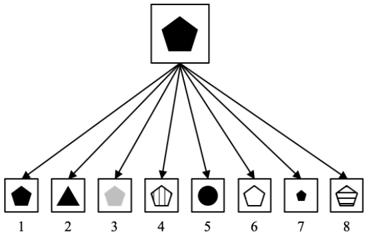
The image depicts a hierarchical flowchart with a central pentagon at the top, connected via arrows to eight labeled boxes below. Each box contains a distinct geometric shape, color, or pattern, suggesting a classification system. The flowchart lacks numerical data but emphasizes categorical relationships.
### Components/Axes
- **Central Node**: A black pentagon labeled "Pentagon" (top-center).
- **Eight Boxes**: Arranged in a horizontal row below the central node, each connected by an arrow.
- **Box 1**: Black pentagon (matches the central node's shape).
- **Box 2**: Black triangle.
- **Box 3**: Gray pentagon.
- **Box 4**: Black pentagon with vertical stripes.
- **Box 5**: Black circle.
- **Box 6**: White pentagon.
- **Box 7**: Small black pentagon.
- **Box 8**: Black pentagon with horizontal stripes.
- **Legend**: The central pentagon serves as the legend, explicitly labeled "Pentagon."
### Detailed Analysis
- **Labels**: All boxes are numbered 1–8, with no additional textual labels.
- **Shapes/Colors**:
- Boxes 1, 4, 7, and 8 feature pentagons (matching the legend).
- Boxes 2 (triangle), 5 (circle), and 6 (white pentagon) deviate from the pentagon theme.
- Color variations include black, gray, and white, with patterns (stripes) in Boxes 4 and 8.
- **Arrows**: All arrows originate from the central pentagon, indicating a top-down hierarchical relationship.
### Key Observations
1. **Categorization**: The flowchart groups shapes under a "Pentagon" category, with subcategories differentiated by color, size, and patterns.
2. **Anomalies**: Box 6 (white pentagon) and Box 5 (circle) break the pentagon-centric theme, suggesting possible exceptions or alternative classifications.
3. **Hierarchy**: The central pentagon acts as the root node, with all other shapes as direct descendants.
### Interpretation
The flowchart likely represents a classification system where the pentagon is the primary category. Subcategories (Boxes 1–8) may reflect variations in attributes such as color, size, or pattern. The inclusion of non-pentagon shapes (e.g., triangle, circle) implies a broader taxonomy or potential errors in categorization. The hierarchical structure emphasizes the pentagon as the foundational element, with other shapes serving as specialized or modified instances. This could model a decision tree, taxonomy, or data categorization framework.