## Diagram: Deductive vs. Inductive Learning
### Overview
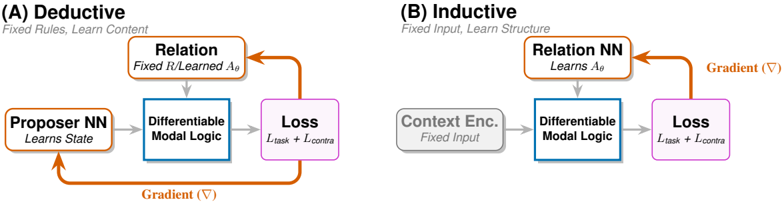
The image presents two diagrams illustrating deductive and inductive learning approaches. Diagram (A) depicts the deductive approach, where fixed rules are used to learn content. Diagram (B) illustrates the inductive approach, where a fixed input is used to learn structure. Both diagrams show a flow of information between components, with feedback loops indicated by "Gradient (∇)".
### Components/Axes
**Diagram (A) - Deductive:**
* **Title:** (A) Deductive
* **Subtitle:** Fixed Rules, Learn Content
* **Components:**
* Proposer NN (Learns State) - Located on the left, in a blue box.
* Differentiable Modal Logic - Located in the center, in a blue box.
* Loss (Ltask + Lcontra) - Located on the right, in a purple box.
* Relation (Fixed R/Learned Aθ) - Located at the top-right, in an orange box.
* **Flow:**
* Proposer NN -> Differentiable Modal Logic -> Loss -> Relation
* Gradient (∇) - An orange arrow from Loss back to Proposer NN, and from Relation back to Differentiable Modal Logic.
**Diagram (B) - Inductive:**
* **Title:** (B) Inductive
* **Subtitle:** Fixed Input, Learn Structure
* **Components:**
* Context Enc. (Fixed Input) - Located on the left, in a gray box.
* Differentiable Modal Logic - Located in the center, in a blue box.
* Loss (Ltask + Lcontra) - Located on the right, in a purple box.
* Relation NN (Learns Aθ) - Located at the top-right, in an orange box.
* **Flow:**
* Context Enc. -> Differentiable Modal Logic -> Loss -> Relation NN
* Gradient (∇) - An orange arrow from Loss to Context Enc., and from Relation NN back to Differentiable Modal Logic.
### Detailed Analysis or Content Details
**Diagram (A) - Deductive:**
* The Proposer NN learns the state and feeds it into the Differentiable Modal Logic.
* The Differentiable Modal Logic processes the state and calculates a loss.
* The Loss is calculated as Ltask + Lcontra.
* The Relation component has fixed rules (R) but learns Aθ.
* The Gradient (∇) provides feedback from the Loss to the Proposer NN and from Relation to Differentiable Modal Logic.
**Diagram (B) - Inductive:**
* The Context Enc. takes a fixed input and feeds it into the Differentiable Modal Logic.
* The Differentiable Modal Logic processes the input and calculates a loss.
* The Loss is calculated as Ltask + Lcontra.
* The Relation NN learns Aθ.
* The Gradient (∇) provides feedback from the Loss to the Context Enc. and from Relation NN to Differentiable Modal Logic.
### Key Observations
* Both diagrams share similar components: Differentiable Modal Logic and Loss.
* The main difference lies in the input and the learning objective. Deductive learning starts with fixed rules and learns content, while inductive learning starts with a fixed input and learns structure.
* The feedback loop (Gradient (∇)) is present in both diagrams, indicating an iterative learning process.
* The Loss function is the same in both approaches (Ltask + Lcontra).
### Interpretation
The diagrams illustrate two fundamental approaches to machine learning: deductive and inductive. Deductive learning is akin to applying known rules to new data, while inductive learning involves inferring rules from data. The diagrams highlight the flow of information and the role of feedback in both approaches. The use of "Differentiable Modal Logic" suggests a specific type of learning model is being employed. The "Loss" component represents the error signal that drives the learning process. The "Gradient (∇)" indicates the direction and magnitude of adjustments made to the model's parameters during training. The diagrams suggest that both approaches involve iterative refinement of the model based on the feedback from the loss function.