\n
## Document: Frequently Asked Questions (FAQ)
### Overview
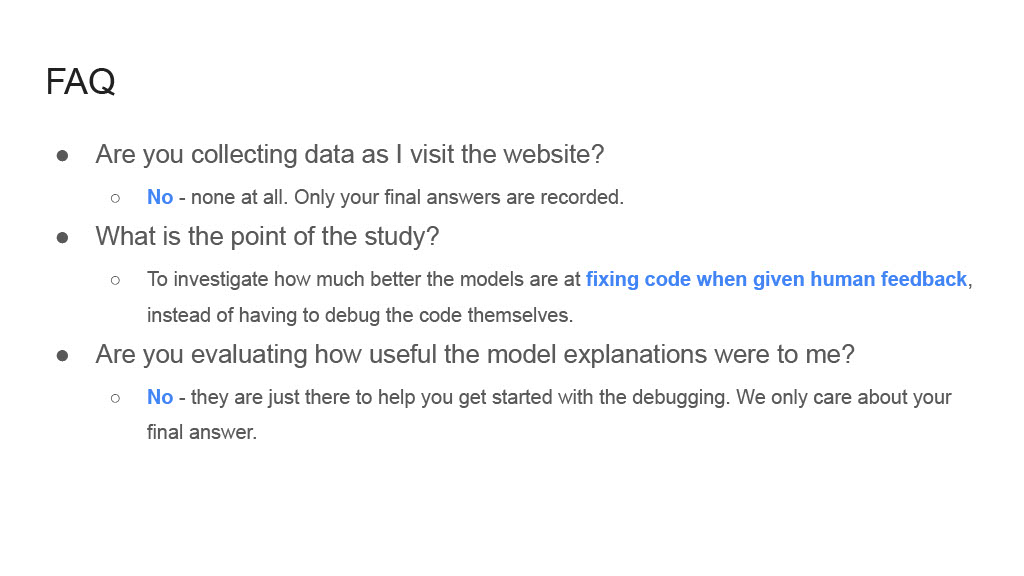
The image presents a screenshot of a Frequently Asked Questions (FAQ) document. The document consists of three questions and their corresponding answers, formatted as a bulleted list with nested sub-bullets for the answers. The overall theme revolves around data collection, the purpose of a study, and the evaluation of model explanations.
### Components/Axes
The document is structured with a main title "FAQ" at the top. Each question is presented as a bullet point, followed by a sub-bullet containing the answer. There are no axes or scales present, as this is a text-based document.
### Content Details
Here's a transcription of the FAQ content:
* **Are you collecting data as I visit the website?**
* **No** - none at all. Only your final answers are recorded.
* **What is the point of the study?**
* To investigate how much better the models are at fixing code when given human feedback, instead of having to debug the code themselves.
* **Are you evaluating how useful the model explanations were to me?**
* **No** - they are just there to help you get started with the debugging. We only care about your final answer.
### Key Observations
The answers consistently emphasize that only final answers are recorded and that the study focuses on model performance with human feedback, not on evaluating the usefulness of model explanations. The word "No" is bolded in the answers to the first and third questions, highlighting a negative response.
### Interpretation
The FAQ aims to reassure users that their browsing data is not being collected and that the study's primary goal is to assess the effectiveness of models when aided by human input. The emphasis on final answers suggests that the process is focused on outcomes rather than the user's thought process or interaction with the model's explanations. The document is designed to address potential privacy concerns and clarify the study's objectives. The study appears to be focused on improving code debugging through a collaborative human-AI approach.