\n
## Diagram: Evolutionary Robotics Control Cycle
### Overview
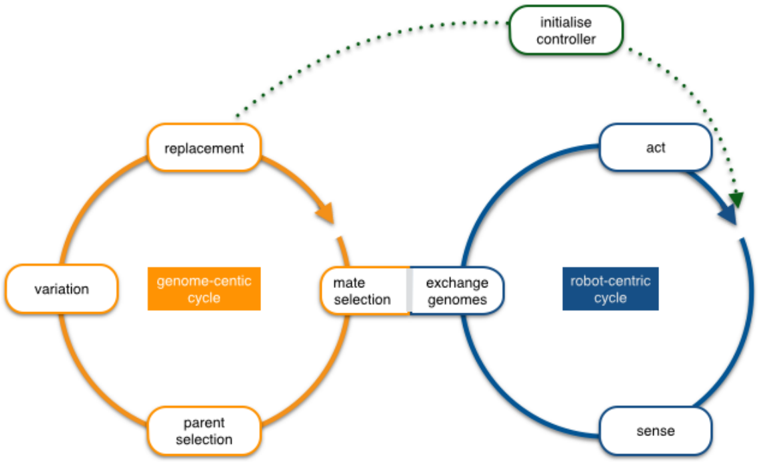
The image depicts a diagram illustrating the interaction between a "genome-centric cycle" and a "robot-centric cycle" in the context of evolutionary robotics. The diagram uses interconnected loops and arrows to represent the flow of information and control. It appears to model a feedback loop where robot actions influence genome evolution, and vice versa.
### Components/Axes
The diagram consists of the following components:
* **Genome-centric Cycle (Orange):** This cycle includes the stages: "variation", "parent selection", "mate selection", "exchange genomes", and "replacement". The central element of this cycle is labeled "genome-centric cycle" and is filled with a light orange color.
* **Robot-centric Cycle (Blue):** This cycle includes the stages: "sense", "act". The central element of this cycle is labeled "robot-centric cycle" and is filled with a light blue color.
* **Initialization (Green):** A separate box labeled "initialise controller" initiates the process.
* **Arrows:** Solid arrows indicate the primary flow within each cycle. A dotted green arrow connects the "initialise controller" to the "act" stage of the robot-centric cycle, and a dotted arrow connects the "replacement" stage of the genome-centric cycle to the "initialise controller".
* **Labels:** Each stage within the cycles is clearly labeled with descriptive text.
### Detailed Analysis or Content Details
The diagram illustrates a cyclical process.
1. **Initialization:** The process begins with "initialise controller" (top center).
2. **Robot-centric Cycle:** The controller initiates the "act" stage, which leads to "sense". This completes the robot-centric cycle.
3. **Genome-centric Cycle:** The "sense" data feeds into the "replacement" stage of the genome-centric cycle. This cycle then proceeds through "variation", "parent selection", "mate selection", and "exchange genomes" before returning to "replacement".
4. **Feedback Loop:** The "replacement" stage then feeds back to "initialise controller" via a dotted arrow, completing the overall feedback loop.
The diagram does not contain numerical data or specific values. It is a conceptual representation of a process.
### Key Observations
* The robot-centric cycle is a simpler loop than the genome-centric cycle.
* The dotted arrows indicate a less direct or more complex relationship than the solid arrows.
* The genome-centric cycle appears to drive the evolution of the controller, while the robot-centric cycle represents the robot's interaction with its environment.
* The "initialise controller" stage acts as a starting point and a receiver of evolutionary changes.
### Interpretation
This diagram represents a control architecture commonly used in evolutionary robotics. The robot-centric cycle embodies the robot's interaction with its environment – sensing and acting. The genome-centric cycle represents the evolutionary process, where genomes are varied, selected, and recombined to improve the robot's performance. The feedback loop ensures that the robot's experiences (sensed data) influence the evolution of its controller (genome).
The use of cycles suggests a continuous process of adaptation and improvement. The dotted arrows indicate that the influence between the cycles is not necessarily direct or immediate, but rather a more complex relationship. The "initialise controller" stage is crucial as it represents the starting point for evolution and the point where new genomes are implemented.
The diagram highlights the interplay between the physical robot and its underlying control system, demonstrating how evolutionary algorithms can be used to design intelligent and adaptive robots. The diagram is a high-level conceptual model and does not provide specific details about the algorithms or implementation used.