# Technical Document Extraction: Rational-ANOVA and Structural Resonance
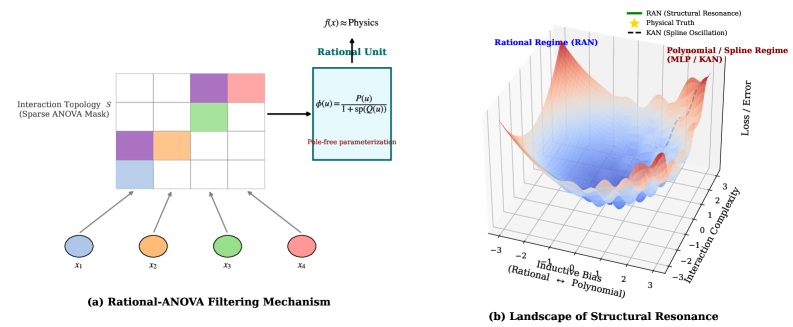
This document provides a detailed technical extraction of the provided image, which consists of two primary components: a schematic diagram of a filtering mechanism and a 3D visualization of a loss landscape.
---
## Component (a): Rational-ANOVA Filtering Mechanism
This diagram illustrates the architectural flow of a data processing unit designed to approximate physical laws.
### 1. Input Layer
* **Components:** Four circular nodes labeled $x_1, x_2, x_3, x_4$.
* **Visual Mapping:** Each node is color-coded:
* $x_1$: Light Blue
* $x_2$: Orange
* $x_3$: Green
* $x_4$: Red/Pink
* **Flow:** Arrows point from these input nodes toward a grid structure.
### 2. Interaction Topology $S$ (Sparse ANOVA Mask)
* **Structure:** A $4 \times 4$ grid representing a sparse mask.
* **Data Mapping:** Specific cells in the grid are colored to match the input nodes, indicating active interactions:
* **Row 1:** Column 3 (Purple), Column 4 (Red/Pink)
* **Row 2:** Column 3 (Green)
* **Row 3:** Column 1 (Purple), Column 2 (Orange)
* **Row 4:** Column 1 (Light Blue)
* **Function:** This grid acts as a filter for the input variables before they enter the processing unit.
### 3. Rational Unit
* **Header Text:** $f(x) \approx \text{Physics}$
* **Title:** **Rational Unit** (displayed in teal)
* **Mathematical Formula:**
$$\phi(u) = \frac{P(u)}{1 + \text{sp}(Q(u))}$$
* **Subtext:** "Pole-free parameterization" (displayed in red).
* **Flow:** An arrow indicates the output of the Sparse ANOVA Mask serves as the input $u$ for this rational function.
---
## Component (b): Landscape of Structural Resonance
This is a 3D surface plot illustrating the optimization landscape of different modeling regimes.
### 1. Axis Definitions
* **X-Axis (Horizontal/Depth):** **Inductive Bias (Rational $\leftrightarrow$ Polynomial)**. Scale ranges from $-3$ to $3$.
* **Y-Axis (Horizontal/Width):** **Interaction Complexity**. Scale ranges from $-3$ to $3$.
* **Z-Axis (Vertical):** **Loss / Error**.
### 2. Legend and Key Markers
* **Location:** Top right $[x \approx 0.8, y \approx 0.9]$
* **Green Solid Line:** RAN (Structural Resonance)
* **Yellow Star:** Physical Truth
* **Black Dashed Line:** KAN (Spline Oscillation)
### 3. Surface Analysis and Trends
* **Overall Topology:** The surface is a complex "bowl" with multiple local minima and ripples. It is colored with a gradient where blue represents lower loss/error and red represents higher loss/error.
* **Rational Regime (RAN):**
* **Location:** Labeled at the top left peak area.
* **Trend:** The text "Rational Regime (RAN)" points toward a deep, stable-looking valley in the blue region.
* **Polynomial / Spline Regime (MLP / KAN):**
* **Location:** Labeled at the top right.
* **Trend:** This region is characterized by high-frequency "ripples" or oscillations on the surface.
* **Visual Check:** A grey/black dashed line (representing KAN) is seen traversing these oscillatory ridges, indicating "Spline Oscillation" which leads to higher or more unstable error.
* **Structural Resonance:** The "Physical Truth" (Yellow Star) is positioned at the absolute global minimum of the blue valley, coinciding with the "Rational Regime."
---
## Summary of Technical Findings
| Feature | Description |
| :--- | :--- |
| **Primary Objective** | Approximating physics $f(x)$ using rational functions. |
| **Mechanism** | Uses a Sparse ANOVA Mask to define interaction topology $S$ between inputs $x_n$. |
| **Mathematical Innovation** | A pole-free rational parameterization $\phi(u)$ to prevent numerical instability. |
| **Comparative Performance** | The "Rational Regime" (RAN) aligns with the "Physical Truth" at the global minimum of the loss landscape, whereas "Spline Regimes" (KAN/MLP) suffer from oscillations and higher error. |