TECHNICAL ASSET FINGERPRINT
5ff877a3d43a48eb65c29116
Click to view fullscreen
Press ESC or click to close
FOUND IN PAPERS
EXPERT: gemini-2.0-flash VERSION 1
RUNTIME: nugit/gemini/gemini-2.0-flash
INTEL_VERIFIED
## User Interface Analysis: FlowForge Task Management
### Overview
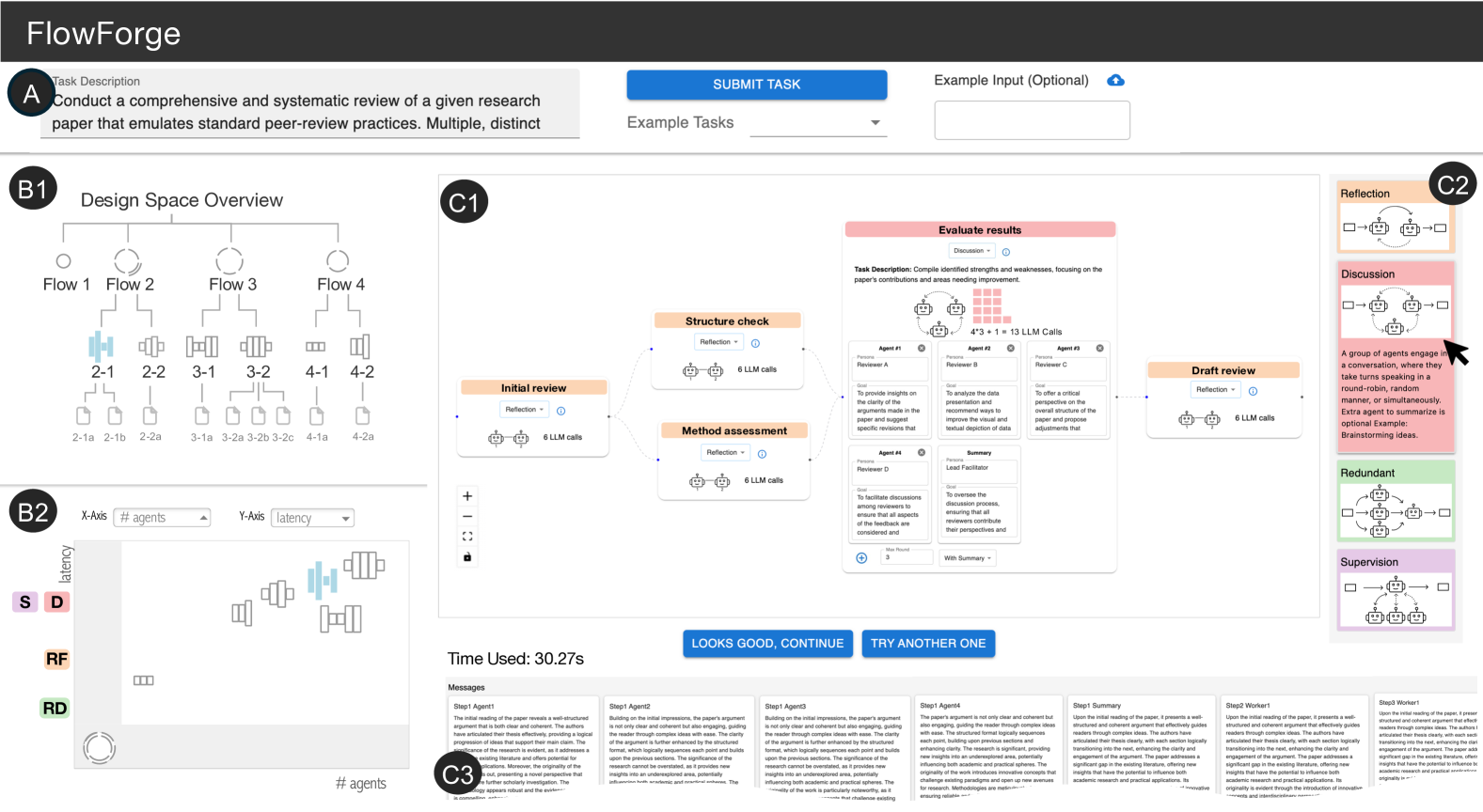
The image presents a user interface for a task management system called "FlowForge." It appears to be designed for conducting and reviewing research papers, emulating peer-review practices. The UI includes task descriptions, workflow visualizations, interactive elements, and message logs.
### Components/Axes
* **Header:**
* "FlowForge" title.
* Task Description (Section A): "Conduct a comprehensive and systematic review of a given research paper that emulates standard peer-review practices. Multiple, distinct."
* "SUBMIT TASK" button.
* "Example Input (Optional)" field.
* "Example Tasks" dropdown menu.
* **Design Space Overview (B1):**
* Title: "Design Space Overview"
* Flows: Flow 1, Flow 2, Flow 3, Flow 4
* Nodes: 2-1, 2-2, 3-1, 3-2, 4-1, 4-2
* Sub-nodes: 2-1a, 2-1b, 2-2a, 3-1a, 3-2a, 3-2b, 3-2c, 4-1a, 4-2a
* **Scatter Plot (B2):**
* X-Axis: "# agents"
* Y-Axis: "latency"
* Data Series:
* S (color not clear, but likely blue)
* D (pink/red)
* RF (orange)
* RD (green)
* **Workflow Diagram (C1):**
* Nodes:
* Initial review: "Reflection" dropdown, "6 LLM calls"
* Structure check: "Reflection" dropdown, "6 LLM calls"
* Method assessment: "Reflection" dropdown, "6 LLM calls"
* Evaluate results: "Discussion" dropdown, Task Description: "Compile identified strengths and weaknesses, focusing on the paper's contributions and areas needing improvement.", "4*3 + 1 = 13 LLM Calls"
* Sub-nodes: Agent #1 (Reviewer A), Agent #2 (Reviewer B), Agent #3 (Reviewer C), Agent #4 (Reviewer D), Summary (Lead Facilitator)
* Draft review: "Reflection" dropdown, "6 LLM calls"
* **Agent Interaction Examples (C2):**
* Reflection: Diagram showing a simple loop.
* Discussion: "A group of agents engage in a conversation, where they take turns speaking in a round-robin, random manner, or simultaneously. Extra agent to summarize is optional Example: Brainstorming ideas."
* Redundant: Diagram showing a more complex loop.
* Supervision: Diagram showing a simple sequence.
* **Messages (C3):**
* Title: "Messages"
* Step 1 Agent 1: "The initial reading of the paper reveals a well-structured argument that is both clear and coherent. The authors have articulated their thesis effectively, providing a logical progression of ideas that support their main claim. The significance of the research is evident, as it addresses a significant gap in the existing literature and offers potential for future scholarly investigation. Moreover, the originality of the work introduces innovative concepts that set it apart, presenting a novel perspective that further scholarly investigation. The methodology appears robust and the evidence appears reliable."
* Step 1 Agent 2: "Building on the initial impressions, the paper's argument is not only clear and coherent but also engaging, guiding the reader through complex ideas with ease. The clarity of the argument is further extended by the structured format, which logically sequences each point and builds upon the previous sections. The significance of the research cannot be overstated, as it provides new insights into an underexplored area, potentially influencing both academic and practical spheres. The methodology appears robust and the evidence appears reliable."
* Step 1 Agent 3: "Building on the initial impressions, the paper's argument is not only clear and coherent but also engaging, guiding the reader through complex ideas with ease. The clarity of the argument is further extended by the structured format, which logically sequences each point and builds upon the previous sections. The significance of the research cannot be overstated, as it provides new insights into an underexplored area, potentially influencing both academic and practical spheres. The methodology appears robust and the evidence appears reliable."
* Step 1 Agent 4: "The paper's argument is not only clear and coherent but also engaging, guiding the reader through complex ideas with ease. The clarity of the argument is further extended by the structured format, which logically sequences each point and builds upon the previous sections. The significance of the research cannot be overstated, as it provides new insights into an underexplored area, potentially influencing both academic and practical spheres. The methodology appears robust and the evidence appears reliable."
* Step 1 Summary: "Upon the initial reading of the paper, it presents a well-structured and coherent argument that effectively guides readers through complex ideas with ease. The authors have articulated their thesis clearly, with each section logically transitioning into the next, enhancing the clarity and engagement of the reader. The paper addresses a significant gap in the existing literature, offering new insights that have the potential to influence both academic research and practical applications. It is particularly noteworthy, as it challenges existing paradigms and open up new avenues for research. Methodologies are meshing well."
* Step 2 Worker 1: "Upon the initial reading of the paper, it presents a well-structured and coherent argument that effectively guides readers through complex ideas. The authors have articulated their thesis clearly, with each section logically transitioning into the next, enhancing the clarity and engagement of the reader. The paper addresses a significant gap in the existing literature, offering new insights that have the potential to influence both academic research and practical applications. It is particularly noteworthy, as it challenges existing paradigms and open up new avenues for research. Methodologies are meshing well."
* Step 3 Worker 1: "Upon the initial reading of the paper, it presents a well-structured and coherent argument that effectively guides readers through complex ideas. The authors have articulated their thesis clearly, with each section logically transitioning into the next, enhancing the clarity and engagement of the reader. The paper addresses a significant gap in the existing literature, offering new insights that have the potential to influence both academic research and practical applications. It is particularly noteworthy, as it challenges existing paradigms and open up new avenues for research. Methodologies are meshing well."
* **Footer:**
* "Time Used: 30.27s"
* "LOOKS GOOD, CONTINUE" button.
* "TRY ANOTHER ONE" button.
### Detailed Analysis
* **Design Space Overview (B1):** This section visualizes different workflow configurations. Each "Flow" (1-4) represents a distinct sequence of tasks. The numbers below each flow (e.g., 2-1, 2-2) likely represent specific tasks or agents within that flow. The sub-nodes (e.g., 2-1a, 2-1b) could represent sub-tasks or iterations within each task.
* **Scatter Plot (B2):** This plot allows users to visualize the relationship between the number of agents and latency for different workflow configurations. The data points are clustered, suggesting distinct performance characteristics for each configuration. The exact values are difficult to extract without a grid, but the relative positions indicate the general trends.
* **S (likely blue):** Appears to have a moderate number of agents and moderate latency.
* **D (pink/red):** Appears to have a low number of agents and low latency.
* **RF (orange):** Appears to have a moderate number of agents and high latency.
* **RD (green):** Appears to have a high number of agents and moderate latency.
* **Workflow Diagram (C1):** This diagram outlines the steps involved in the research paper review process. It includes stages like "Initial review," "Structure check," "Method assessment," "Evaluate results," and "Draft review." Each stage involves "LLM calls," suggesting the use of Large Language Models for automated analysis. The "Evaluate results" stage is further broken down into individual agent contributions (Reviewer A, Reviewer B, Reviewer C, Reviewer D) and a summary by a Lead Facilitator. The number of LLM calls for the "Evaluate results" stage is explicitly stated as "4*3 + 1 = 13 LLM Calls."
* **Agent Interaction Examples (C2):** This section provides examples of how agents can interact within the system. The "Discussion" example highlights a round-robin conversation, while other examples illustrate different interaction patterns.
* **Messages (C3):** This section displays messages generated by different agents during the review process. The messages provide insights into the agent's reasoning and analysis of the paper. The messages are generally positive, indicating that the paper is well-structured, clear, and coherent.
### Key Observations
* The UI is designed to support a structured and systematic review process.
* LLMs are heavily integrated into the workflow, automating various analysis tasks.
* The system allows for different workflow configurations and visualizations of performance metrics.
* Agent interactions are diverse, ranging from simple sequences to complex round-robin discussions.
### Interpretation
The FlowForge system appears to be a sophisticated tool for managing and automating research paper reviews. The integration of LLMs streamlines the analysis process, while the interactive visualizations and agent communication features enhance collaboration and decision-making. The system's flexibility allows users to experiment with different workflow configurations and optimize performance based on specific requirements. The positive messages generated by the agents suggest that the system is effective in identifying and highlighting the strengths of the reviewed paper. The system aims to improve the efficiency and quality of peer review by leveraging AI and collaborative workflows.
DECODING INTELLIGENCE...
EXPERT: nemotron-free VERSION 1
RUNTIME: free/nvidia/nemotron-nano-12b-v2-vl:free
INTEL_VERIFIED
## Screenshot: FlowForge Interface for Peer-Review Simulation
### Overview
This image depicts a web-based interface for "FlowForge," a tool designed to simulate multi-agent peer-review processes for academic research papers. The interface combines task configuration, design space visualization, and workflow simulation components. Key elements include a task description field, a design space overview with flow diagrams, a latency/agent graph, and a detailed workflow simulation with agent interactions.
### Components/Axes
1. **Task Configuration Section**
- **Task Description**: "Conduct a comprehensive and systematic review of a given research paper that emulates standard peer-review practices. Multiple, distinct paper that emulates standard peer-review practices."
- **Buttons**:
- Blue "SUBMIT TASK" button
- "Example Tasks" dropdown menu
- Cloud icon with "+" for optional input
2. **Design Space Overview (B1)**
- **Flow Diagram**:
- Four main flows (Flow 1-4) with hierarchical sub-flows (e.g., Flow 2 → 2-1, 2-2)
- Visual connections between flows using lines and arrows
- Color-coded components (blue, gray, black)
3. **Latency/Agent Graph (B2)**
- **Axes**:
- X-axis: "# agents" (dropdown)
- Y-axis: "latency" (dropdown)
- **Legend**:
- Colors: S (purple), D (red), RF (orange), RD (green)
- **Data**: Bar chart with multiple colored bars (exact values unclear)
4. **Workflow Diagram (C1)**
- **Steps**:
1. Initial review → Structure check → Method assessment
2. Evaluate results → Draft review
- **Components**:
- "6 LLM calls" annotations
- "Reflection" and "Discussion" nodes
- "Summary" and "Facilitator" roles
- **Time Metric**: "Time Used: 30.27s"
5. **Agent Interaction Log (C3)**
- **Messages**:
- Step1 Agent1: "The initial reading of the paper reveals a well-structured argument..."
- Step1 Agent2: "Building on the initial impressions, the paper's argument..."
- Step1 Agent3: "Building on the initial impressions, the paper's argument..."
- Step1 Agent4: "Building on the initial impressions, the paper's argument..."
- Step1 Summary: "Upon the initial reading of the paper, it presents a well-structured and coherent argument..."
- Step2 Worker1: "Upon the initial reading of the paper, it presents a well-structured and coherent argument..."
- Step3 Worker1: "Upon the initial reading of the paper, it presents a well-structured and coherent argument..."
### Detailed Analysis
- **Design Space**: The flow diagram shows a hierarchical structure with four primary flows (1-4) branching into sub-flows (e.g., 2-1, 2-2). This suggests modular review components that can be combined or isolated.
- **Latency Graph**: While exact values are unclear, the presence of multiple colored bars (S/D/RF/RD) indicates comparative analysis of agent performance metrics across different configurations.
- **Workflow Simulation**: The multi-step process includes reflection points and collaborative discussion, mirroring real-world peer-review cycles. The "6 LLM calls" annotation suggests automated agent interactions.
- **Agent Logs**: Truncated messages reveal iterative analysis of paper structure, coherence, and argument quality, with agents building on prior reviews.
### Key Observations
1. The interface emphasizes iterative refinement through "REFLECTION" and "DISCUSSION" nodes.
2. Multiple agent configurations (S/D/RF/RD) are tracked, though specific performance metrics remain ambiguous.
3. The 30.27s time metric suggests real-time simulation capabilities.
4. Truncated agent messages indicate complex, multi-step reasoning processes.
### Interpretation
FlowForge appears to model collaborative academic review through:
1. **Modular Design**: The flow diagram's hierarchical structure allows customization of review components.
2. **Agent Collaboration**: Multiple agents (S/D/RF/RD) contribute specialized perspectives, with reflection points enabling consensus-building.
3. **Automated Evaluation**: The "6 LLM calls" annotation implies machine learning integration for initial analysis.
4. **Temporal Constraints**: The 30.27s metric suggests either rapid simulation or real-time processing limits.
The tool bridges human-like peer review with computational efficiency, though the latency graph's ambiguity raises questions about scalability. The truncated agent messages hint at sophisticated natural language processing capabilities, though full transparency would require access to complete logs.
DECODING INTELLIGENCE...