## Diagram: Biological and Computational Neural System Analogy
### Overview
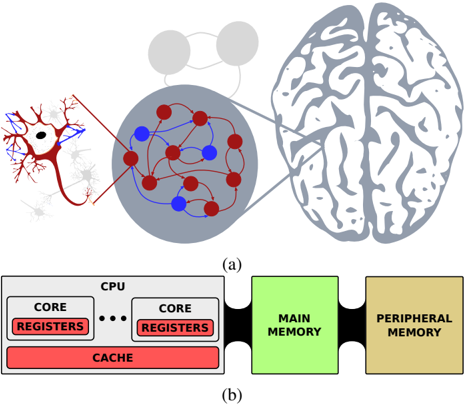
The image is a two-part conceptual diagram labeled (a) and (b). Part (a) illustrates the conceptual link between a biological neuron, an artificial neural network, and the human brain. Part (b) depicts a simplified block diagram of a classical computer architecture. The diagram as a whole appears to draw a parallel between the structure of biological intelligence and the architecture of computational systems.
### Components/Axes
**Part (a) - Biological/Neural Analogy:**
* **Left Element:** A detailed illustration of a biological neuron (nerve cell) with its dendrites, soma (cell body), and axon.
* **Center Element:** A schematic of an artificial neural network contained within a grey circle. It consists of interconnected nodes (circles) of two colors: red and blue. The connections are represented by lines.
* **Right Element:** A stylized illustration of a human brain, showing the cerebral cortex with its characteristic folds (gyri and sulci).
* **Connections:** Red lines connect the biological neuron to the artificial network. Grey lines connect the artificial network to the brain illustration.
* **Label:** The entire sub-diagram is labeled with the identifier **(a)** at the bottom center.
**Part (b) - Computer Architecture:**
* **CPU Block:** A large rectangle labeled **CPU** at the top. Inside it are:
* Two smaller rectangles labeled **CORE**. Inside each core is a red rectangle labeled **REGISTERS**.
* Ellipsis (**...**) between the cores, indicating multiple cores.
* A long red rectangle at the bottom labeled **CACHE**.
* **Main Memory Block:** A green rectangle to the right of the CPU, labeled **MAIN MEMORY**.
* **Peripheral Memory Block:** A tan/yellow rectangle to the right of Main Memory, labeled **PERIPHERAL MEMORY**.
* **Connections:** Thick black lines connect the CPU to Main Memory, and Main Memory to Peripheral Memory, indicating a data bus or pathway.
* **Label:** The entire sub-diagram is labeled with the identifier **(b)** at the bottom center.
### Detailed Analysis
**Part (a) Analysis:**
This section visually maps the hierarchy of neural information processing.
1. **Biological Neuron (Left):** The fundamental cellular unit of the nervous system.
2. **Artificial Neural Network (Center):** A simplified, abstract model inspired by biological neurons. The red and blue nodes likely represent different types of artificial neurons (e.g., excitatory/inhibitory) or layers (e.g., input/hidden/output). The dense, irregular connections mimic synaptic connections.
3. **Human Brain (Right):** The complex organ where billions of biological neurons integrate to produce cognition. The connection from the artificial network to the brain suggests that ANNs are an attempt to model or understand this higher-level system.
**Part (b) Analysis:**
This is a standard von Neumann architecture diagram.
1. **CPU (Left):** The central processing unit contains:
* **CORES:** The processing units that execute instructions.
* **REGISTERS:** Very fast, small memory locations within each core for holding immediate data and instructions.
* **CACHE:** A larger, fast memory layer that stores frequently accessed data to speed up CPU access compared to main memory.
2. **MAIN MEMORY (Center):** Typically RAM (Random Access Memory), which holds data and programs currently in use. It is directly accessible by the CPU.
3. **PERIPHERAL MEMORY (Right):** Refers to secondary storage devices like Hard Disk Drives (HDDs) or Solid-State Drives (SSDs), which provide long-term, non-volatile storage. Data must be loaded into Main Memory before the CPU can process it.
### Key Observations
1. **Conceptual Flow in (a):** The diagram establishes a clear left-to-right conceptual flow: from the basic biological unit (neuron), to an engineered model (ANN), to the complex biological system it seeks to emulate (brain).
2. **Structural Analogy:** There is an implied structural analogy between the two parts. The interconnected network in (a) parallels the interconnected cores and memory units in (b). The "CORE" in (b) could be seen as analogous to a cluster of nodes in the network in (a).
3. **Color Coding in (b):** Color is used functionally: red for high-speed, CPU-internal components (REGISTERS, CACHE), green for primary working memory (MAIN MEMORY), and tan for long-term storage (PERIPHERAL MEMORY).
4. **Spatial Layout:** Both diagrams use a left-to-right layout to imply a sequence or hierarchy. In (a), it's a conceptual hierarchy. In (b), it's a physical/data-access hierarchy (fastest/closest to CPU on the left, slowest/farthest on the right).
### Interpretation
This diagram serves as a high-level educational or conceptual tool, likely from a paper or presentation discussing artificial intelligence, neuromorphic computing, or computer architecture.
* **Core Message:** It juxtaposes two paradigms of information processing: the **biological/neural paradigm** (a) and the **classical digital paradigm** (b). Part (a) represents the inspiration and goal of AI (to mimic brain function), while part (b) represents the traditional hardware substrate on which most AI algorithms are currently implemented.
* **Implied Tension or Relationship:** The diagram highlights a fundamental dichotomy in modern AI. We design software (neural networks in **a**) inspired by biology, but we run them on hardware (the von Neumann architecture in **b**) that is fundamentally different in structure and operation from the brain. The brain is massively parallel and co-locates processing and memory, while the classical computer has a distinct separation between CPU and memory, which can create a "bottleneck."
* **Forward-Looking Implication:** By presenting these two models together, the author may be setting the stage for a discussion on **neuromorphic engineering**—the development of hardware chips that physically mimic the structure of neural networks (like in **a**) to overcome the limitations of the von Neumann architecture (in **b**) for AI tasks. The diagram visually asks: "Can we build hardware that looks more like (a) and less like (b) to create more efficient AI?"