\n
## Diagram: Brain-Computer Analogy
### Overview
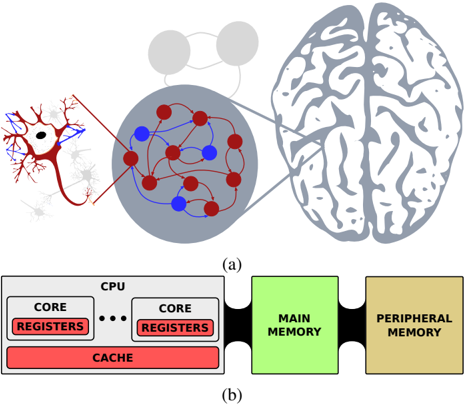
The image presents a conceptual diagram comparing the structure of a human brain to that of a computer. It consists of two main parts, labeled (a) and (b). Part (a) illustrates a brain with a zoomed-in section showing neurons and their connections, alongside a simplified network of nodes. Part (b) depicts a computer architecture with its core components.
### Components/Axes
**Part (a): Brain & Neural Network**
* **Brain:** A gray-scale depiction of a human brain, viewed from above.
* **Neuron:** A detailed illustration of a neuron with dendrites (red) and an axon (blue).
* **Neural Network:** A circular region within the brain illustration, containing interconnected nodes.
* **Red Nodes:** Representing a specific type of neuron or connection.
* **Blue Nodes:** Representing another type of neuron or connection.
* **Other Brain Cells:** Smaller, less detailed gray cells surrounding the neural network.
* **Connections:** Lines connecting the nodes and neurons, indicating signal pathways.
**Part (b): Computer Architecture**
* **CPU:** A rectangular block labeled "CPU" containing:
* **Core Registers:** Multiple rectangular blocks labeled "Registers".
* **Cache:** A larger rectangular block labeled "Cache" (red).
* **Cores:** Multiple instances of "Core Registers" and "Cache" suggesting a multi-core processor.
* **Main Memory:** A rectangular block labeled "Main Memory" (green).
* **Peripheral Memory:** A rectangular block labeled "Peripheral Memory" (yellow).
* **Connections:** Thick black lines connecting the CPU to Main Memory and Main Memory to Peripheral Memory, representing data pathways.
### Detailed Analysis or Content Details
**Part (a): Brain & Neural Network**
The neuron illustration shows a complex branching structure. The dendrites (red) appear to be more numerous and extensive than the axon (blue). The neural network within the brain consists of approximately 15 nodes. The red nodes are more numerous than the blue nodes, with an approximate count of 9 red nodes and 6 blue nodes. The connections between nodes are numerous and appear to be randomly distributed, with both red-to-red, blue-to-blue, and red-to-blue connections. The gray cells surrounding the network are less detailed and appear to represent supporting cells or background noise.
**Part (b): Computer Architecture**
The CPU block contains multiple instances of "Core Registers" and "Cache". There are approximately 5 instances of "Core Registers" visible. The "Cache" is colored red and occupies a significant portion of the CPU block. The "Main Memory" is green and connected to the CPU. The "Peripheral Memory" is yellow and connected to the "Main Memory". The connections between the memory components and the CPU are depicted as thick black lines, indicating high bandwidth data transfer.
### Key Observations
* The diagram draws a direct analogy between the brain's neurons and a computer's processing units.
* The neural network in the brain is simplified, focusing on the connections between nodes.
* The computer architecture highlights the hierarchical memory structure (Cache, Main Memory, Peripheral Memory).
* The color coding (red, blue, green, yellow) is used consistently across both parts of the diagram.
### Interpretation
The diagram illustrates the concept of computational neuroscience, suggesting that the brain can be understood as a complex information processing system analogous to a computer. The neurons and their connections represent the hardware, while the signals transmitted along these connections represent the software. The different types of memory in the computer (Cache, Main Memory, Peripheral Memory) can be seen as analogous to different types of memory in the brain (short-term, long-term, etc.). The diagram simplifies the complexity of both the brain and the computer, but it effectively conveys the core idea of a functional similarity. The use of color coding helps to visually distinguish between different components and their roles. The diagram does not provide quantitative data, but rather a conceptual framework for understanding the relationship between the brain and the computer.