## Diagram: Biological and Computational System Comparison
### Overview
The image presents two interconnected diagrams:
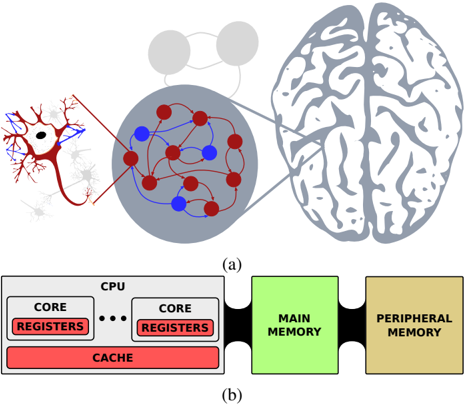
1. **(a)** A biological system featuring a brain with a highlighted hippocampus region and a neuron network.
2. **(b)** A computational system depicting a CPU architecture with memory hierarchy.
### Components/Axes
#### Diagram (a): Biological System
- **Labels**:
- "HIPPOCAMPUS" (highlighted gray region in the brain).
- "neuron network" (red and blue dots connected by lines).
- **Visual Elements**:
- Brain illustration with gray matter and white matter patterns.
- Neuron network with red (likely excitatory) and blue (likely inhibitory) nodes.
#### Diagram (b): Computational System
- **Labels**:
- **CPU**: Contains "CORE REGISTERS" (red) and "CACHE" (red).
- **MAIN MEMORY**: Green block.
- **PERIPHERAL MEMORY**: Beige block.
- **Visual Elements**:
- Rectangular blocks representing memory hierarchy.
- Arrows implied between CPU, main memory, and peripheral memory (not explicitly drawn).
### Detailed Analysis
- **Diagram (a)**:
- The hippocampus is centrally positioned, suggesting its role in memory processing.
- The neuron network (red/blue dots) is connected to the hippocampus, implying synaptic interactions.
- **Diagram (b)**:
- CPU components (registers, cache) are tightly grouped, reflecting fast-access memory.
- Main memory (green) and peripheral memory (beige) are separate, indicating slower but larger storage.
### Key Observations
- No numerical data or trends are present; the image focuses on structural relationships.
- Both diagrams use color coding (red/blue for neurons, red for CPU components) to denote functional categories.
- The hippocampus and neuron network are spatially linked, mirroring the CPU-memory hierarchy’s layered structure.
### Interpretation
This image metaphorically compares biological neural networks to computational architectures:
1. **Hippocampus as Main Memory**: The hippocampus’s role in memory consolidation parallels the "main memory" in a CPU, acting as a central processing hub.
2. **Neuron Network as CPU**: The interconnected red/blue neurons resemble a CPU’s core registers and cache, handling rapid data processing.
3. **Peripheral Memory**: The beige block may represent long-term storage (e.g., cortical regions), analogous to peripheral memory in computing.
The diagram emphasizes hierarchical organization in both systems, with specialized components working in tandem for efficient information processing. No explicit data points or trends are provided, but the structural parallels suggest a focus on efficiency, modularity, and layered processing in biological and artificial systems.