## Schematic Diagram: Simplified Rocket Cross-Section
### Overview
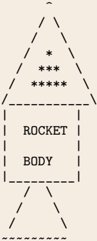
The image is a simplified, stylized technical diagram of a rocket, presented in a vertical, cross-sectional view. It uses basic line art and text to outline the primary structural sections of the vehicle. The aesthetic is reminiscent of a blueprint or educational schematic, using dashed lines for the outline and solid text for labeling.
### Components/Axes
The diagram is segmented into four distinct vertical regions, from top to bottom:
1. **Nose Cone Section:** A triangular shape pointing upwards.
2. **Upper Body Section:** A trapezoidal shape widening downwards.
3. **Main Body Section:** A rectangular section containing the primary label.
4. **Engine Section:** A trapezoidal shape narrowing downwards, ending in a base.
**Textual Elements:**
* **Primary Label:** The text "ROCKET BODY" is centered within the rectangular main body section. The words are stacked, with "ROCKET" above "BODY".
* **Symbolic Markers:** A series of asterisks (`*`) are placed within the upper sections, increasing in number from top to bottom.
### Detailed Analysis
**Spatial Layout and Element Placement:**
* **Top (Nose Cone):** A single asterisk (`*`) is centered near the apex of the triangular nose cone.
* **Upper Body:** Below the nose cone, a row of three asterisks (`***`) is centered within the trapezoidal section.
* **Lower Upper Body:** Just above the main rectangular body, a row of five asterisks (`*****`) is centered.
* **Main Body:** The rectangular section is defined by dashed vertical lines on the left and right. The text "ROCKET" is centered on the first line, and "BODY" is centered directly below it on the second line.
* **Engine Section:** Below the main body, two solid, angled lines converge downward from the corners of the rectangle, forming the engine bell or nozzle shape.
* **Base:** A horizontal dashed line forms the very bottom of the diagram, representing the rocket's base or exhaust plane.
**Line Style:**
* The entire outer silhouette of the rocket (nose cone, body sides, engine section) is drawn with a **dashed line**.
* The two angled lines in the engine section are **solid lines**.
* All text and asterisks are rendered in a solid, dark color against a light background.
### Key Observations
1. **Hierarchical Symbolism:** The number of asterisks increases from 1 to 3 to 5 as one moves down from the nose cone into the upper body. This could symbolically represent increasing structural complexity, internal component density, or simply serve as a visual filler to denote different internal zones.
2. **Clear Sectional Division:** The diagram uses distinct geometric shapes (triangle, trapezoid, rectangle) to unambiguously separate the rocket's functional sections: payload/nose, upper stages/tankage, main fuselage, and propulsion.
3. **Minimalist Labeling:** The only explicit text is the generic label "ROCKET BODY," placed in the largest central section. No specific technical labels (e.g., "payload fairing," "fuel tank," "nozzle") are provided.
4. **Blueprint Aesthetic:** The use of dashed lines for the outline gives the impression of a technical drawing or a cutaway view, suggesting the internal structure is being revealed.
### Interpretation
This diagram serves as a **conceptual or educational illustration** rather than a detailed engineering schematic. Its primary purpose is to communicate the basic, high-level anatomy of a rocket in an easily digestible visual format.
* **What it Demonstrates:** It breaks down a complex vehicle into its fundamental macro-components: a pointed top for aerodynamics, a widening section for transition, a large central volume for structure and payload, and a tapered bottom for propulsion.
* **Relationships Between Elements:** The spatial arrangement is strictly logical and follows real-world rocket design: the smallest section is at the front (nose), the largest volume is in the middle (body), and the thrust structure is at the rear (engine). The increasing asterisks may imply that internal systems become more numerous or complex moving aft from the nose.
* **Notable Anomalies:** The complete lack of specific technical terminology is the most significant feature. This abstraction makes the diagram universally understandable but devoid of specific engineering data. The solid lines for the engine bell versus the dashed outline for the rest of the body might subtly emphasize the engine as a distinct, solid component within the overall structural shell.
* **Underlying Message:** The diagram emphasizes **form and segmentation over function and detail**. It answers the question "What are the main parts of a rocket?" at the most basic level, making it suitable for introductory materials, icons, or as a foundational visual before adding more complex layers of information.