## Diagram: Rocket Structure
### Overview
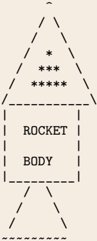
The image depicts a simplified schematic diagram of a rocket. It is composed of three primary sections: a labeled "ROCKET BODY" rectangular section, a triangular top section with a pyramid of stars, and a base formed by two diagonal lines. The diagram uses dashed lines to outline the rocket's structure and solid lines for the base.
### Components/Axes
- **Labels**:
- "ROCKET BODY" (centered within the rectangular section).
- No explicit axis titles, legends, or numerical scales are present.
- **Visual Elements**:
- **Top Section**: A triangular pyramid with three rows of stars:
- Row 1 (top): 1 star.
- Row 2: 3 stars.
- Row 3 (bottom): 5 stars.
- **Body**: A rectangular section labeled "ROCKET BODY" with dashed borders.
- **Base**: Two diagonal lines forming an inverted "V" shape, suggesting stability or support.
### Detailed Analysis
- **Textual Content**:
- The only explicit text is "ROCKET BODY" in uppercase, centered within the rectangular section.
- Stars are symbolic and not labeled with text.
- **Structural Relationships**:
- The rocket body is positioned centrally, with the triangular top section above it and the base below.
- The dashed lines emphasize the rocket's outline, while the solid base lines suggest a grounded or anchored structure.
### Key Observations
- The diagram lacks numerical data, trends, or quantitative values.
- The pyramid of stars may symbolize hierarchical stages, propulsion systems, or payload distribution, though this is speculative without additional context.
- The base lines imply a focus on stability, possibly representing landing gear or structural support.
### Interpretation
This diagram likely serves an educational or conceptual purpose, illustrating the basic components of a rocket. The "ROCKET BODY" label explicitly identifies the central structure, while the star pyramid could represent non-technical elements like mission phases, crew capacity, or symbolic design features. The base lines reinforce the idea of a grounded, functional system. Without additional context (e.g., annotations, legends, or numerical data), the diagram prioritizes visual simplicity over technical specificity. The absence of trends or quantitative analysis suggests it is not intended for data-driven interpretation but rather for conceptual understanding.