## Diagrams: Directional Flow Models (a) and (b)
### Overview
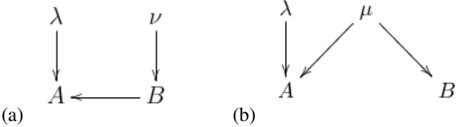
The image contains two directional flow diagrams labeled (a) and (b). Both depict relationships between entities A and B using labeled arrows (λ, ν, μ). Diagram (a) shows a unidirectional flow with two independent downward arrows, while diagram (b) introduces a bidirectional flow with a feedback loop.
### Components/Axes
- **Diagram (a)**:
- **Labels**:
- Vertical arrow from A labeled **λ** (downward).
- Vertical arrow from B labeled **ν** (downward).
- Horizontal arrow from A to B (no label).
- **Flow Direction**:
- A → B (horizontal).
- A ↓ (λ) and B ↓ (ν) as independent downward flows.
- **Diagram (b)**:
- **Labels**:
- Vertical arrow from A labeled **λ** (downward).
- Diagonal arrow from A to B labeled **μ** (downward-right).
- Diagonal arrow from B to A labeled **μ** (upward-left).
- **Flow Direction**:
- A → B (μ).
- B → A (μ, feedback loop).
- A ↓ (λ) as an independent downward flow.
### Detailed Analysis
- **Diagram (a)**:
- Represents a **unidirectional process** where A influences B directly (horizontal arrow) while both A and B independently contribute to separate downstream processes (λ and ν).
- No feedback or cyclical interactions.
- **Diagram (b)**:
- Introduces **bidirectional interaction** between A and B via μ, creating a feedback loop (B → A).
- Maintains the independent downward flow λ from A but adds complexity through mutual influence.
### Key Observations
1. **Directional Symmetry**: Diagram (b) replaces the unidirectional A→B flow in (a) with a symmetric μ flow (A→B and B→A).
2. **Feedback Mechanism**: The B→A arrow in (b) suggests a **cyclical relationship**, contrasting with the linear flow in (a).
3. **Independent Downward Flow**: Both diagrams retain λ as a standalone downward process from A, implying a persistent external dependency.
### Interpretation
- **System Dynamics**:
- Diagram (a) models a **linear system** with no interdependencies between A and B beyond the initial A→B interaction.
- Diagram (b) represents a **feedback-driven system**, where A and B mutually influence each other (via μ), potentially leading to stabilization or oscillation depending on context.
- **Implications**:
- The introduction of μ in (b) could signify **emergent behavior** (e.g., mutual reinforcement or conflict) absent in (a).
- The retained λ in both diagrams suggests a **constant external factor** acting on A, independent of B.
No numerical data or quantitative trends are present; the diagrams focus on qualitative relationships and directional logic.