## Diagram: Reasoning and Knowledge Path Generation
### Overview
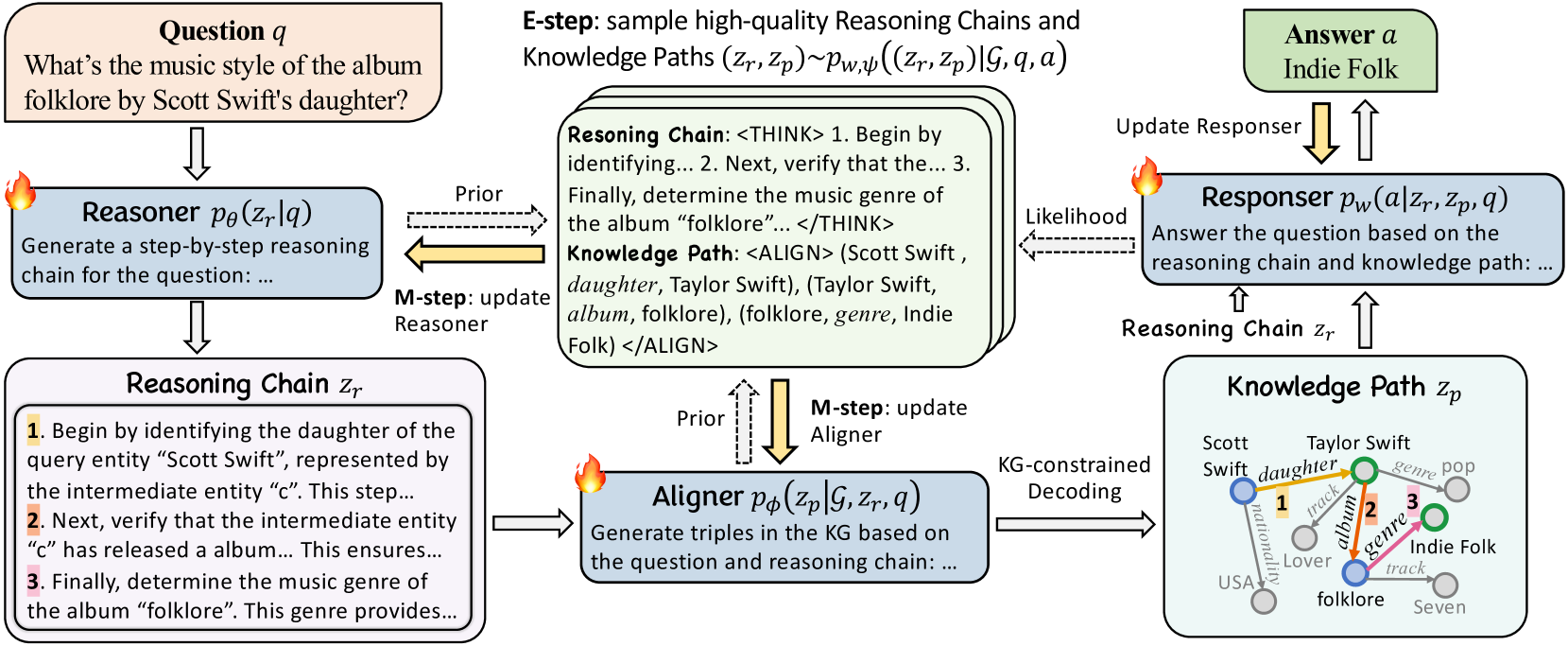
The image is a diagram illustrating a multi-step process for answering a question using reasoning chains and knowledge paths. It involves components like a Reasoner, Aligner, and Responser, with updates occurring in M-steps and sampling in an E-step. The diagram shows the flow of information and dependencies between these components.
### Components/Axes
* **Question q:** (Top-left, in a peach rounded box) "What's the music style of the album folklore by Scott Swift's daughter?"
* **Reasoner pθ(zr|q):** (Left, in a light blue rounded box) "Generate a step-by-step reasoning chain for the question: ..."
* **Reasoning Chain zr:** (Bottom-left, in a light gray rounded box)
* "1. Begin by identifying the daughter of the query entity "Scott Swift", represented by the intermediate entity "c". This step..."
* "2. Next, verify that the intermediate entity "c" has released a album... This ensures..."
* "3. Finally, determine the music genre of the album "folklore". This genre provides..."
* **Aligner pφ(zp|G, zr, q):** (Bottom-center, in a light blue rounded box) "Generate triples in the KG based on the question and reasoning chain: ..."
* **Knowledge Path zp:** (Bottom-right, in a light green rounded box) A graph with nodes and edges representing relationships between entities.
* Nodes: Scott Swift, Taylor Swift, USA, Lover, folklore, Indie Folk, Seven, pop
* Edges: daughter (Scott Swift -> Taylor Swift), nationality (Scott Swift -> USA), album (Taylor Swift -> folklore), genre (Taylor Swift -> pop), genre (folklore -> Indie Folk), track (Lover -> Taylor Swift), track (folklore -> Seven)
* Numbered paths:
* 1: Scott Swift -> Taylor Swift -> folklore
* 2: Taylor Swift -> folklore -> Indie Folk
* 3: Taylor Swift -> pop
* **Responser pw(a|zr, zp, q):** (Right, in a light blue rounded box) "Answer the question based on the reasoning chain and knowledge path: ..."
* **Answer a:** (Top-right, in a light green rounded box) "Indie Folk"
* **E-step:** (Top-center) "sample high-quality Reasoning Chains and Knowledge Paths (zr, zp) ~ pw,ψ((zr, zp)|G, q, a)"
* **M-step:** (Left-center, Bottom-center) "update Reasoner", "update Aligner"
* **Resoning Chain:** (Top-center, in a light gray rounded box) "<THINK> 1. Begin by identifying... 2. Next, verify that the... 3. Finally, determine the music genre of the album "folklore"... </THINK>"
* **Knowledge Path:** (Top-center, in a light gray rounded box) "<ALIGN> (Scott Swift, daughter, Taylor Swift), (Taylor Swift, album, folklore), (folklore, genre, Indie Folk) </ALIGN>"
* **KG-constrained Decoding:** (Right-center)
* **Prior:** (Dashed arrows) Indicates prior knowledge or information flow.
* **Likelihood:** (Dashed arrows) Indicates likelihood or probability.
### Detailed Analysis or Content Details
The diagram illustrates a pipeline:
1. **Question Input:** The process begins with a question (q).
2. **Reasoner:** The Reasoner generates a step-by-step reasoning chain (zr) based on the question.
3. **Reasoning Chain:** The reasoning chain outlines the steps needed to answer the question.
4. **Aligner:** The Aligner generates triples in the Knowledge Graph (KG) based on the question and reasoning chain, resulting in a knowledge path (zp).
5. **Knowledge Path:** The knowledge path represents the relationships between entities in the KG.
6. **Responser:** The Responser answers the question (a) based on the reasoning chain and knowledge path.
7. **Answer Output:** The final answer is provided.
8. **E-step:** High-quality reasoning chains and knowledge paths are sampled.
9. **M-step:** The Reasoner and Aligner are updated based on the sampled chains and paths.
The reasoning chain consists of three steps: identifying Scott Swift's daughter, verifying that the daughter has released an album, and determining the music genre of the album "folklore".
The knowledge path shows the relationships between entities such as Scott Swift, Taylor Swift, folklore, and Indie Folk. It also includes entities like USA, Lover, Seven, and pop.
### Key Observations
* The diagram shows a cyclical process with updates to the Reasoner and Aligner.
* The reasoning chain and knowledge path are used to generate the answer.
* The knowledge path is a graph representation of relationships between entities.
### Interpretation
The diagram illustrates a system for answering questions by generating reasoning chains and knowledge paths. The Reasoner and Aligner work together to create a structured representation of the information needed to answer the question. The Responser then uses this information to generate the final answer. The E-step and M-step indicate a learning or optimization process where the system improves its reasoning and alignment capabilities over time. The use of prior knowledge and likelihood suggests a probabilistic approach to reasoning and knowledge representation. The diagram highlights the importance of both reasoning and knowledge in answering complex questions.