\n
## Diagram: Reasoning Chain for Question Answering
### Overview
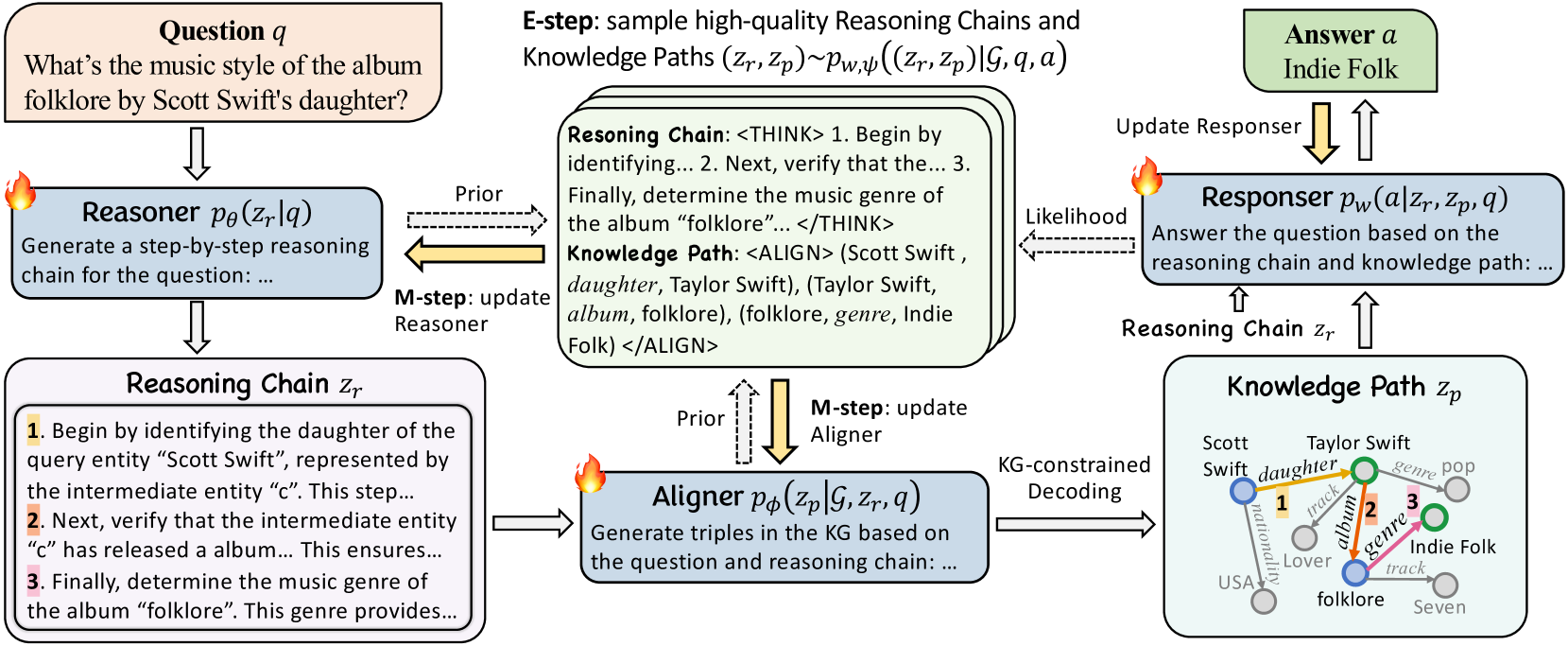
This diagram illustrates a multi-step reasoning process for answering a question about the music style of an album. The process involves a Reasoner, an Aligner, a Responder, and the generation of Reasoning Chains and Knowledge Paths. The diagram depicts a flow of information between these components, with iterative updates based on prior knowledge and likelihood scores.
### Components/Axes
The diagram consists of several key components:
* **Question (q):** "What's the music style of the album folklore by Scott Swift's daughter?" - Located at the top-left.
* **Answer (a):** "Indie Folk" - Located at the top-right.
* **Reasoner:** `pθ(zτ|q)` - Generates a step-by-step reasoning chain for the question. Located on the left side.
* **Aligner:** `pΦ(gp|zτ,q)` - Generates triples in the Knowledge Graph (KG) based on the question and reasoning chain. Located on the bottom-left.
* **Responder:** `pω(a|zτ, zρ, q)` - Answers the question based on the reasoning chain and knowledge path. Located on the top-right.
* **Reasoning Chain (zτ):** A numbered list of steps outlining the reasoning process. Located on the bottom-left.
* **Knowledge Path (zρ):** A graph representing relationships between entities. Located on the bottom-right.
* **E-step:** Sample high-quality Reasoning Chains and Knowledge Paths. Located at the top-center.
* **M-step:** Update Reasoner and Aligner. Arrows indicate iterative updates.
* **Prior & Likelihood:** Represented by dashed and solid arrows, respectively, indicating the flow of information and confidence levels.
* **KG-constrained Decoding:** A process used in the Aligner.
### Detailed Analysis or Content Details
The diagram details the following steps and information:
**Question:** "What's the music style of the album folklore by Scott Swift's daughter?"
**Reasoning Chain (zτ):**
1. Begin by identifying the daughter of the query entity "Scott Swift", represented by the intermediate entity "c". This step…
2. Next verify that the intermediate entity "c" has released an album. This ensures…
3. Finally, determine the music genre of the album "folklore". This genre provides…
**Knowledge Path (zρ):**
The Knowledge Path is a graph with the following nodes and edges:
* Scott Swift
* Daughter (edge to Taylor Swift)
* Taylor Swift
* Album (edge to folklore)
* folklore
* Genre (edge to Indie Folk)
* Indie Folk
* Pop (edge from Indie Folk)
* Track (edge from Taylor Swift to 1, Lover, Seven)
* USA (edge from Scott Swift to 1)
**Aligner:**
* Knowledge Path: `<ALIGN> (Scott Swift, daughter, Taylor Swift), (Taylor Swift, album, folklore), (folklore, genre, Indie Folk) </ALIGN>`
* Reasoning Chain: ``
**Responder:**
The Responder uses the Reasoning Chain and Knowledge Path to answer the question.
**E-step:** `(Zτ, Zρ) ~ Pω,ψ(Zτ, Zρ)|G, q, a`
**M-step:**
* Update Reasoner
* Update Aligner
### Key Observations
* The process is iterative, with the Reasoner and Aligner being updated based on prior knowledge and likelihood scores.
* The Knowledge Path visually represents the relationships between entities, aiding in the reasoning process.
* The diagram highlights the importance of both reasoning chains (step-by-step logic) and knowledge paths (factual relationships) in answering the question.
* The use of `<ALIGN>` and `<THINK>` tags suggests a structured approach to representing reasoning and knowledge.
### Interpretation
This diagram demonstrates a sophisticated approach to question answering that combines symbolic reasoning with knowledge graph traversal. The system doesn't simply retrieve information; it constructs a reasoning chain to justify its answer. The iterative updates (M-step) suggest a learning component, where the system refines its reasoning and alignment processes over time. The Knowledge Path provides a clear visual representation of the relationships used to arrive at the answer, enhancing transparency and explainability. The use of "Prior" and "Likelihood" indicates a probabilistic framework, allowing the system to handle uncertainty and ambiguity. The diagram suggests a system capable of complex inference and knowledge integration, going beyond simple keyword matching to provide a more nuanced and accurate response. The inclusion of "KG-constrained Decoding" suggests the system is grounded in a structured knowledge base, preventing it from generating nonsensical or factually incorrect answers.