TECHNICAL ASSET FINGERPRINT
6044452d1dc904da4e138d70
Click to view fullscreen
Press ESC or click to close
FOUND IN PAPERS
EXPERT: healer-alpha-free VERSION 1
RUNTIME: free/openrouter/healer-alpha
INTEL_VERIFIED
## System Architecture Diagram: Iterative Reasoning and Knowledge Graph Alignment for Question Answering
### Overview
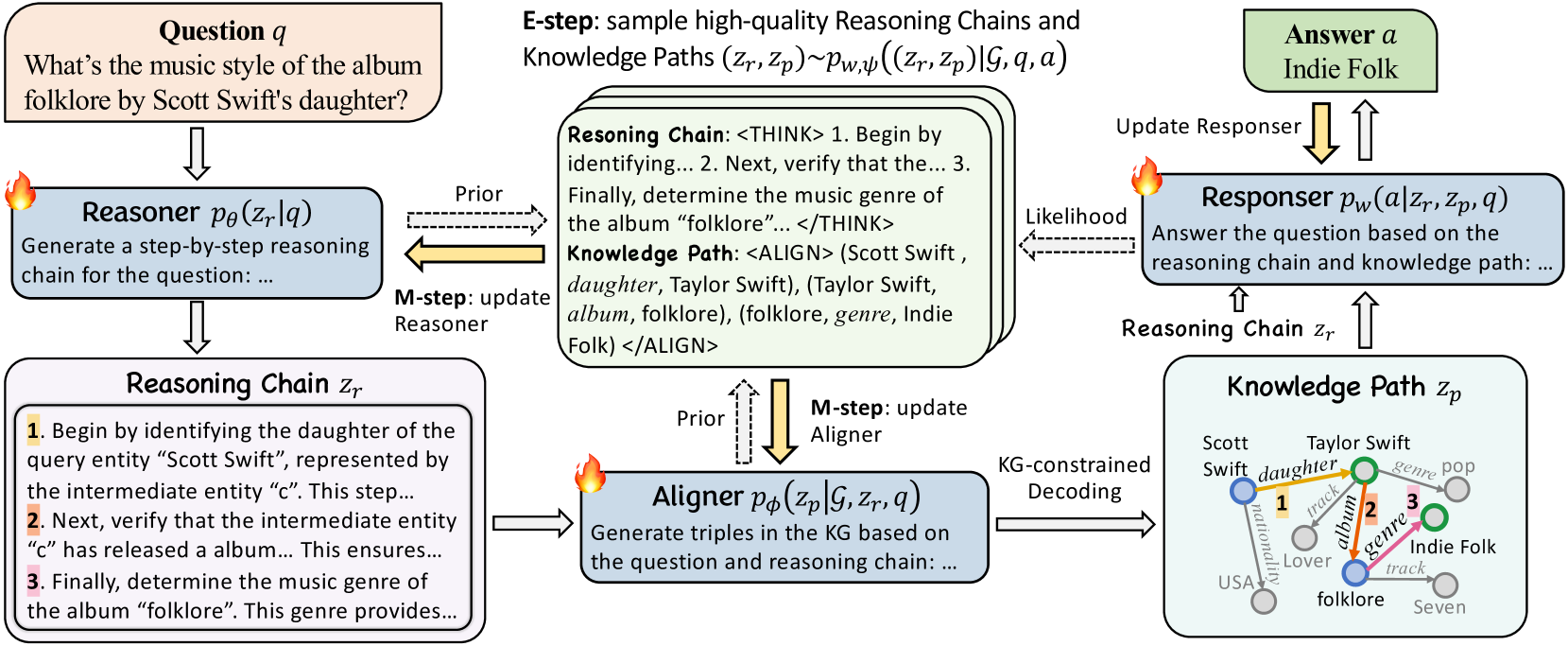
The image is a technical flowchart illustrating a machine learning system designed to answer complex questions by generating and refining reasoning chains and knowledge paths. The system uses an iterative process (E-step and M-step) to update its components. The example question used throughout the diagram is: "What's the music style of the album folklore by Scott Swift's daughter?" The final answer is "Indie Folk."
### Components/Axes
The diagram is organized into several interconnected functional blocks, with arrows indicating data flow and update cycles.
**Primary Components:**
1. **Question q** (Top-left, peach-colored box): The input query.
2. **Reasoner p_θ(z_r|q)** (Left, blue box): A module that generates a step-by-step reasoning chain for the question.
3. **Reasoning Chain z_r** (Bottom-left, pink box): The output of the Reasoner, containing a structured, step-by-step thought process.
4. **Aligner p_φ(z_p|G, z_r, q)** (Center, blue box): A module that generates triples (subject, relation, object) in a Knowledge Graph (KG) based on the question and reasoning chain.
5. **Knowledge Path z_p** (Bottom-right, light blue box): The output of the Aligner, visualized as a subgraph from a larger knowledge graph.
6. **Responser p_w(a|z_r, z_p, q)** (Right, blue box): A module that generates the final answer based on the reasoning chain and knowledge path.
7. **Answer a** (Top-right, green box): The final output answer.
**Process Steps:**
* **E-step** (Top-center): Labeled "sample high-quality Reasoning Chains and Knowledge Paths (z_r, z_p) ~ p_{w,ψ}((z_r, z_p)|G, q, a)". This step involves sampling or generating candidate reasoning and knowledge components.
* **M-step** (Center, with two downward arrows): Labeled "update Reasoner" and "update Aligner". This step involves updating the parameters of the Reasoner and Aligner modules based on the sampled data.
**Connections & Data Flow:**
* **Prior** (Dashed arrows): Flow from the Reasoner to the Aligner and from the Aligner back to the E-step sampling process.
* **Likelihood** (Dashed arrow): Flow from the Responser back to the E-step sampling process.
* **KG-constrained Decoding** (Arrow from Aligner to Knowledge Path): Indicates the Aligner's output is constrained by the structure of a knowledge graph.
* **Update Responser** (Bidirectional arrows between Answer and Responser): The Responser is updated using the final answer.
* **Reasoning Chain z_r** (Arrow from Reasoning Chain to Responser): The generated reasoning chain is fed as input to the Responser.
### Detailed Analysis
**1. Question & Answer Example:**
* **Input Question (q):** "What's the music style of the album folklore by Scott Swift's daughter?"
* **Output Answer (a):** "Indie Folk"
**2. Reasoning Chain (z_r) Content:**
The pink box details a 3-step reasoning process:
1. "Begin by identifying the daughter of the query entity 'Scott Swift', represented by the intermediate entity 'c'. This step..."
2. "Next, verify that the intermediate entity 'c' has released a album... This ensures..."
3. "Finally, determine the music genre of the album 'folklore'. This genre provides..."
**3. Knowledge Path (z_p) Content:**
The light blue box shows a knowledge graph subgraph with nodes and labeled edges:
* **Nodes (Entities):** Scott Swift, Taylor Swift, Lover, folklore, Seven, USA, pop, Indie Folk.
* **Edges (Relations):**
* `daughter` (Scott Swift → Taylor Swift)
* `nationality` (Scott Swift → USA)
* `track` (Lover → Taylor Swift)
* `album` (Taylor Swift → folklore)
* `genre` (folklore → Indie Folk)
* `genre` (folklore → pop)
* `track` (folklore → Seven)
* **Highlighted Path:** A numbered path (1, 2, 3) is overlaid, tracing: Scott Swift --(1:daughter)--> Taylor Swift --(2:album)--> folklore --(3:genre)--> Indie Folk.
**4. Sampled High-Quality Pair (E-step Output):**
The central box shows an example of a sampled reasoning chain and knowledge path pair:
* **Reasoning Chain:** ``
* **Knowledge Path:** `<ALIGN> (Scott Swift, daughter, Taylor Swift), (Taylor Swift, album, folklore), (folklore, genre, Indie Folk) </ALIGN>`
### Key Observations
1. **Iterative Learning Loop:** The system has a clear feedback loop. The E-step samples potential solutions, and the M-step uses them to update the core reasoning (Reasoner) and alignment (Aligner) modules. The Responser is also updated.
2. **Dual-Component Reasoning:** The system explicitly separates *procedural reasoning* (the step-by-step "how to think" in the Reasoning Chain) from *declarative knowledge* (the factual triples in the Knowledge Path).
3. **Knowledge Graph Constraint:** The Aligner's output is not free-form; it is constrained to generate valid triples from a knowledge graph (KG-constrained Decoding), ensuring factual grounding.
4. **Example Specificity:** The entire diagram is illustrated with a single, concrete example about Taylor Swift's album, making the abstract process tangible.
5. **Symbolic Notation:** The modules are defined with probabilistic notation (e.g., p_θ(z_r|q)), indicating they are parameterized models (likely neural networks) trained to perform their specific tasks.
### Interpretation
This diagram depicts a sophisticated neuro-symbolic AI architecture for complex question answering. It moves beyond simple retrieval or language modeling by:
* **Explicit Reasoning:** Forcing the model to articulate its reasoning steps in a structured chain (`z_r`), which improves interpretability and allows for verification.
* **Knowledge Grounding:** Tying the reasoning process to verifiable facts from a knowledge graph (`z_p`), reducing hallucination and improving factual accuracy.
* **Joint Optimization:** Using an Expectation-Maximization (EM) style framework (E-step/M-step) to jointly optimize the reasoning and knowledge alignment components. The system learns not just to answer, but to *reason effectively* and *align its reasoning with external knowledge*.
The "Peircean" investigative reading suggests this system embodies abductive reasoning—it seeks the best explanation (the reasoning chain and knowledge path) that accounts for the question and the available knowledge, ultimately leading to the answer. The outliers or anomalies would be cases where the knowledge graph is incomplete or the reasoning chain leads to a dead end, which the iterative update process aims to correct over time. The core innovation is the tight, iterative coupling of a reasoning module with a knowledge-grounded module, mediated by a response generator, all within a unified probabilistic framework.
DECODING INTELLIGENCE...