## Flowchart: Process for Answering Music Style Questions via Reasoning Chains and Knowledge Paths
### Overview
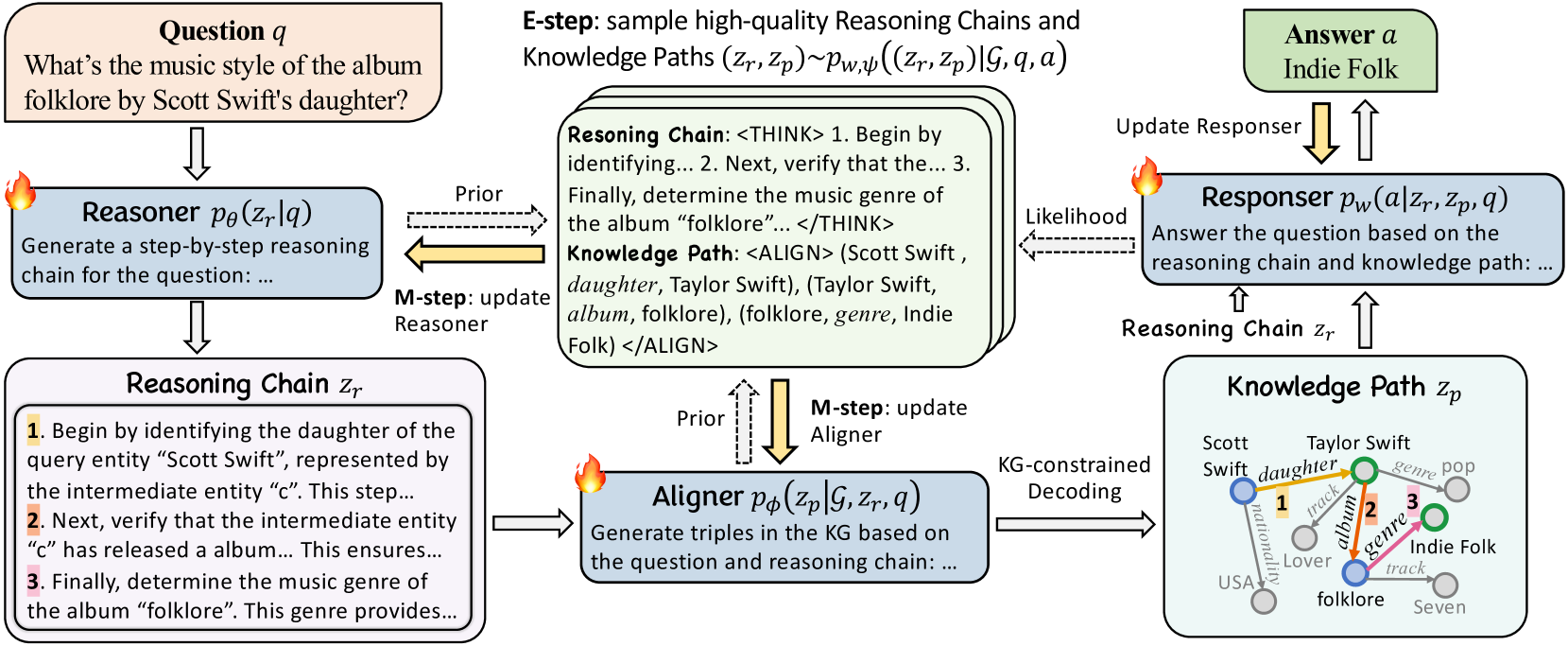
This diagram illustrates a multi-step process for answering complex questions (e.g., "What’s the music style of the album folklore by Scott Swift's daughter?") using reasoning chains, knowledge paths, and a knowledge graph (KG). The process involves iterative updates to reasoning and alignment components, culminating in a KG-constrained response.
---
### Components/Axes
1. **Input Question (q)**
- Example: "What’s the music style of the album folklore by Scott Swift's daughter?"
- Position: Top-left corner.
2. **Reasoner (pθ(zr|q))**
- Generates a step-by-step reasoning chain (zr) for the question.
- Includes a flame icon (likely indicating uncertainty or criticality).
- Position: Below the question.
3. **M-step: Update Reasoner**
- Updates the reasoner using prior knowledge (dashed arrow).
- Position: Left-middle.
4. **E-step: Sample High-Quality Reasoning Chains and Knowledge Paths**
- Generates reasoning chains (zr) and knowledge paths (zp) conditioned on the question and answer (a).
- Includes a green box labeled "Reasoning Chain" and "Knowledge Path."
- Position: Center.
5. **Aligner (pφ(zp|G, zr, q))**
- Generates triples in the KG based on the question, reasoning chain, and KG.
- Includes a flame icon.
- Position: Bottom-middle.
6. **KG-constrained Decoding**
- Uses the aligner’s output to decode answers constrained by the KG.
- Position: Right-middle.
7. **Responder (pw(a|zr, zp, q))**
- Updates the answer (a) based on the reasoning chain (zr) and knowledge path (zp).
- Includes a flame icon.
- Position: Top-right.
8. **Knowledge Path (zp)**
- Visualized as a KG graph with nodes (entities) and edges (relationships).
- Example nodes: "Scott Swift," "Taylor Swift," "folklore," "Indie Folk."
- Position: Bottom-right.
---
### Detailed Analysis
#### Reasoning Chain (zr)
- **Step 1**: Identify the daughter of "Scott Swift" (intermediate entity "c").
- **Step 2**: Verify that "c" released the album "folklore."
- **Step 3**: Determine the music genre of "folklore" (output: "Indie Folk").
- Position: Left-middle box.
#### Knowledge Path (zp)
- **KG Graph**:
- **Nodes**:
- "Scott Swift" (blue), "Taylor Swift" (green), "folklore" (orange), "Indie Folk" (pink).
- **Edges**:
- "daughter" (Scott → Taylor), "album" (Taylor → folklore), "genre" (folklore → Indie Folk).
- **Labels**:
- Numerical annotations (1, 2, 3) on edges, possibly indicating step order or confidence.
- Position: Bottom-right.
#### Aligner Output
- Generates triples like:
`(Scott Swift, daughter, Taylor Swift)`,
`(Taylor Swift, album, folklore)`,
`(folklore, genre, Indie Folk)`.
- Position: Center-right.
---
### Key Observations
1. **Iterative Updates**:
- The reasoner and aligner are updated via M-steps using prior knowledge (dashed arrows).
2. **KG Integration**:
- The knowledge path (zp) directly links entities and relationships from the KG to the final answer.
3. **Uncertainty Indicators**:
- Flame icons appear on critical steps (reasoner, aligner, responder), suggesting confidence scoring or error handling.
4. **Final Answer**:
- The responder outputs "Indie Folk" after synthesizing the reasoning chain and KG-constrained decoding.
---
### Interpretation
This diagram represents a hybrid reasoning framework combining:
1. **Logical Reasoning Chains**: Step-by-step deduction (e.g., identifying familial relationships and album releases).
2. **Knowledge Graph Utilization**: Leveraging structured data (e.g., "folklore" is linked to "Indie Folk" via genre).
3. **Iterative Refinement**: M-steps update components to improve accuracy, likely through feedback loops.
The process emphasizes **KG-constrained decoding**, ensuring answers are grounded in verified relationships (e.g., "folklore" → "Indie Folk"). The flame icons suggest mechanisms to handle uncertainty, such as re-evaluating low-confidence steps. The final answer ("Indie Folk") emerges from aligning the reasoning chain with KG facts, demonstrating a robust approach to complex QA tasks.