## Line Chart: Test Loss vs. Model Parameters for Different Token Configurations
### Overview
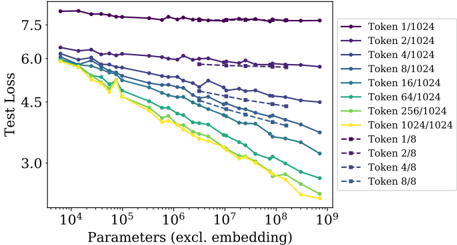
The image is a line chart plotting "Test Loss" against the number of model "Parameters (excl. embedding)" on a logarithmic scale. It displays multiple data series, each representing a different token configuration (e.g., "Token 1/1024", "Token 2/1024"). The chart demonstrates how model performance (measured by loss) changes as model size increases, with different lines showing the effect of varying the token budget or configuration.
### Components/Axes
* **X-Axis:** Labeled "Parameters (excl. embedding)". It uses a logarithmic scale with major tick marks at 10⁴, 10⁵, 10⁶, 10⁷, 10⁸, and 10⁹.
* **Y-Axis:** Labeled "Test Loss". It uses a linear scale with major tick marks at 3.0, 4.5, 6.0, and 7.5.
* **Legend:** Positioned in the top-right quadrant of the chart area. It contains 12 entries, each with a unique color and line style (solid or dashed). The entries are:
1. Token 1/1024 (Solid, dark purple)
2. Token 2/1024 (Solid, purple)
3. Token 4/1024 (Solid, blue-purple)
4. Token 8/1024 (Solid, blue)
5. Token 16/1024 (Solid, teal)
6. Token 64/1024 (Solid, green)
7. Token 256/1024 (Solid, light green)
8. Token 1024/1024 (Solid, yellow)
9. Token 1/8 (Dashed, dark purple)
10. Token 2/8 (Dashed, purple)
11. Token 4/8 (Dashed, blue-purple)
12. Token 8/8 (Dashed, blue)
### Detailed Analysis
The chart shows 12 distinct lines, each corresponding to a token configuration from the legend. The general trend for most lines is a downward slope from left to right, indicating that test loss decreases as the number of parameters increases.
**Trend Verification & Data Point Extraction (Approximate):**
* **Token 1/1024 (Solid, dark purple):** This line is nearly flat at the top of the chart. It starts at a Test Loss of ~7.8 at 10⁴ parameters and ends at ~7.6 at 10⁹ parameters. **Trend:** Very slight downward slope, almost horizontal.
* **Token 2/1024 (Solid, purple):** Starts at ~6.4 at 10⁴ parameters. Slopes gently downward to ~5.8 at 10⁹ parameters.
* **Token 4/1024 (Solid, blue-purple):** Starts at ~6.2 at 10⁴ parameters. Slopes downward to ~4.8 at 10⁹ parameters.
* **Token 8/1024 (Solid, blue):** Starts at ~6.1 at 10⁴ parameters. Slopes downward to ~4.2 at 10⁹ parameters.
* **Token 16/1024 (Solid, teal):** Starts at ~6.0 at 10⁴ parameters. Slopes downward to ~3.6 at 10⁹ parameters.
* **Token 64/1024 (Solid, green):** Starts at ~6.0 at 10⁴ parameters. Slopes downward to ~3.0 at 10⁹ parameters.
* **Token 256/1024 (Solid, light green):** Starts at ~6.0 at 10⁴ parameters. Slopes downward to ~2.7 at 10⁹ parameters.
* **Token 1024/1024 (Solid, yellow):** This is the lowest solid line. Starts at ~6.0 at 10⁴ parameters. Slopes downward most steeply to ~2.4 at 10⁹ parameters.
* **Dashed Lines (Token 1/8, 2/8, 4/8, 8/8):** These four dashed lines are clustered in the middle of the chart, generally between the solid lines for Token 4/1024 and Token 16/1024. They follow similar downward trends as their solid-line counterparts but are positioned at slightly different loss values. For example, the dashed "Token 8/8" line appears to run very close to, but slightly above, the solid "Token 8/1024" line.
**Spatial Grounding:** The legend is placed in the top-right, overlapping the upper portion of the chart grid but not obscuring any data lines. The lines are densely packed on the left side (lower parameter counts) and fan out as they move right (higher parameter counts), with the yellow line (Token 1024/1024) achieving the lowest loss and the dark purple line (Token 1/1024) remaining the highest.
### Key Observations
1. **Inverse Relationship:** For all configurations except "Token 1/1024", there is a clear inverse relationship between model parameters and test loss. Larger models perform better.
2. **Plateau Effect:** The "Token 1/1024" configuration shows a severe performance plateau. Increasing model size from 10,000 to 1,000,000,000 parameters yields almost no improvement in test loss.
3. **Token Budget Impact:** The solid lines show that increasing the token numerator (from 1 to 1024, while denominator is fixed at 1024) dramatically improves performance and the rate of improvement with scale. The yellow line (1024/1024) has the steepest descent.
4. **Consistent Ordering:** The lines maintain a consistent vertical ordering from top (worst) to bottom (best) that corresponds directly to the token configuration's implied "budget" or "ratio": Token 1/1024 > Token 2/1024 > ... > Token 1024/1024.
5. **Dashed vs. Solid:** The dashed lines (denominator 8) generally perform worse (are higher on the chart) than solid lines with the same numerator but a larger denominator (1024). This suggests the denominator (likely representing a total token pool or context window) is a critical factor.
### Interpretation
This chart provides a Peircean insight into the scaling laws of language models, specifically highlighting the critical interaction between **model size (parameters)** and **data exposure (tokens)**.
* **The Data Suggests:** Model performance is not solely a function of parameter count. The token configuration acts as a fundamental constraint. A model with a very limited token budget ("Token 1/1024") cannot leverage additional parameters, hitting a performance ceiling almost immediately. This is the "data bottleneck."
* **Relationship Between Elements:** The fanning out of the lines demonstrates that as the token budget increases (moving from the top purple line to the bottom yellow line), the model's ability to utilize larger parameter counts to reduce loss improves significantly. The slope of each line represents the "scaling efficiency" for that specific token setting.
* **Notable Anomaly/Outlier:** The "Token 1/1024" line is a stark outlier. Its near-horizontal trend indicates a regime where scaling parameters is futile, implying the model has exhausted the useful information available from its extremely limited token exposure.
* **Why It Matters:** This visualization argues that for effective scaling, increases in model capacity must be matched with proportional increases in training data (tokens). It warns against simply building larger models without ensuring they are trained on sufficiently diverse and abundant data. The optimal scaling path involves moving diagonally down and to the right on this chart—increasing both parameters and effective token count simultaneously.