## Abstract Reasoning Tests
### Overview
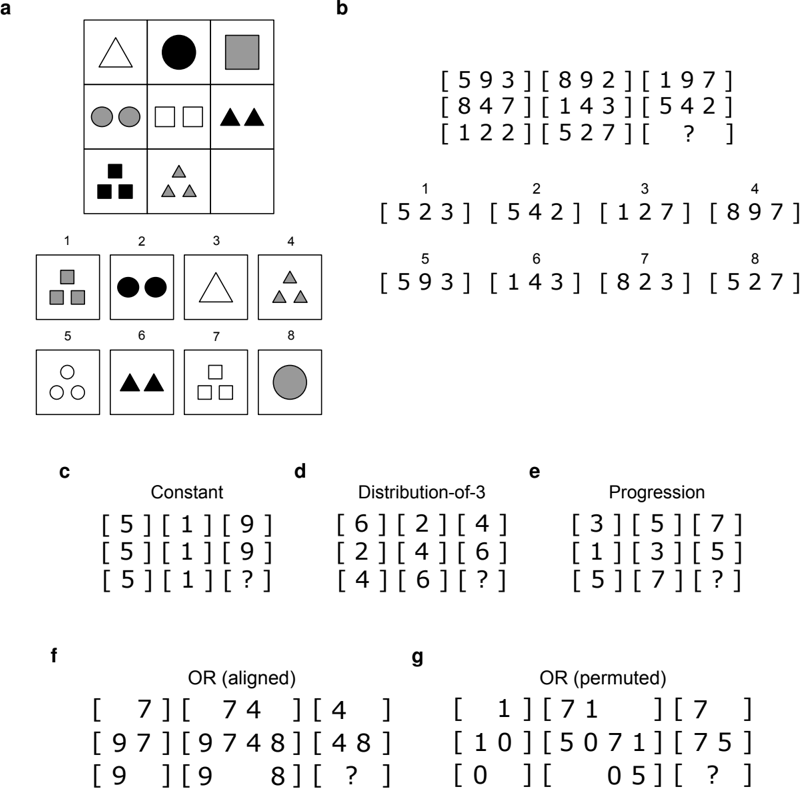
The image presents a series of abstract reasoning tests, each designed to assess different cognitive skills. These tests include pattern recognition, numerical reasoning, and logical deduction. The image is divided into several sections, each presenting a different type of problem.
### Components/Axes
* **Section a:** A 3x3 grid containing abstract shapes. The shapes vary in form (triangle, circle, square), fill (white, black, gray), and number. Below the grid is a series of 8 individual boxes, each containing a different combination of shapes. The boxes are numbered 1 through 8.
* **Section b:** Numerical sequences presented in brackets. The first sequence is a 3x3 grid with the last element missing. The second sequence consists of two rows of four elements each, numbered 1 through 8.
* **Section c:** Labeled "Constant". Numerical sequences presented in brackets. The last element of the third sequence is missing.
* **Section d:** Labeled "Distribution-of-3". Numerical sequences presented in brackets. The last element of the third sequence is missing.
* **Section e:** Labeled "Progression". Numerical sequences presented in brackets. The last element of the third sequence is missing.
* **Section f:** Labeled "OR (aligned)". Numerical sequences presented in brackets. The last element of the third sequence is missing.
* **Section g:** Labeled "OR (permuted)". Numerical sequences presented in brackets. The last element of the third sequence is missing.
### Detailed Analysis
**Section a: Abstract Shapes**
* **Grid:**
* Top-left: White triangle
* Top-middle: Black circle
* Top-right: Gray square
* Middle-left: Two gray circles
* Middle-middle: Two white squares
* Middle-right: Two black triangles
* Bottom-left: Black square and black rectangle
* Bottom-middle: Two gray triangles
* Bottom-right: Empty
* **Individual Boxes:**
* Box 1: Two gray squares and one gray rectangle
* Box 2: Two black circles
* Box 3: One white triangle
* Box 4: Two gray triangles
* Box 5: Three white circles
* Box 6: Two black triangles
* Box 7: Two white squares
* Box 8: One gray circle
**Section b: Numerical Sequences**
* **Sequence 1:**
* \[593] \[892] \[197]
* \[847] \[143] \[542]
* \[122] \[527] \[ ? ]
* **Sequence 2:**
* 1: \[523] 2: \[542] 3: \[127] 4: \[897]
* 5: \[593] 6: \[143] 7: \[823] 8: \[527]
**Section c: Constant**
* \[5] \[1] \[9]
* \[5] \[1] \[9]
* \[5] \[1] \[ ? ]
**Section d: Distribution-of-3**
* \[6] \[2] \[4]
* \[2] \[4] \[6]
* \[4] \[6] \[ ? ]
**Section e: Progression**
* \[3] \[5] \[7]
* \[1] \[3] \[5]
* \[5] \[7] \[ ? ]
**Section f: OR (aligned)**
* \[7] \[74] \[4]
* \[97] \[9748] \[48]
* \[9] \[9 8] \[ ? ]
**Section g: OR (permuted)**
* \[1] \[71] \[7]
* \[10] \[5071] \[75]
* \[0] \[05] \[ ? ]
### Key Observations
* Section a presents a visual pattern recognition task.
* Sections c, d, e, f, and g present numerical reasoning tasks with different underlying rules (constant, distribution, progression, OR).
* Section b presents a numerical sequence task.
### Interpretation
The image presents a variety of abstract reasoning tests designed to assess different cognitive abilities. These tests require pattern recognition, logical deduction, and numerical reasoning skills. The tests vary in complexity and format, providing a comprehensive assessment of cognitive abilities. The missing elements in each sequence or grid require the test-taker to identify the underlying pattern or rule and apply it to determine the correct answer.