\n
## Diagram: Visual Patterns and Logical Reasoning
### Overview
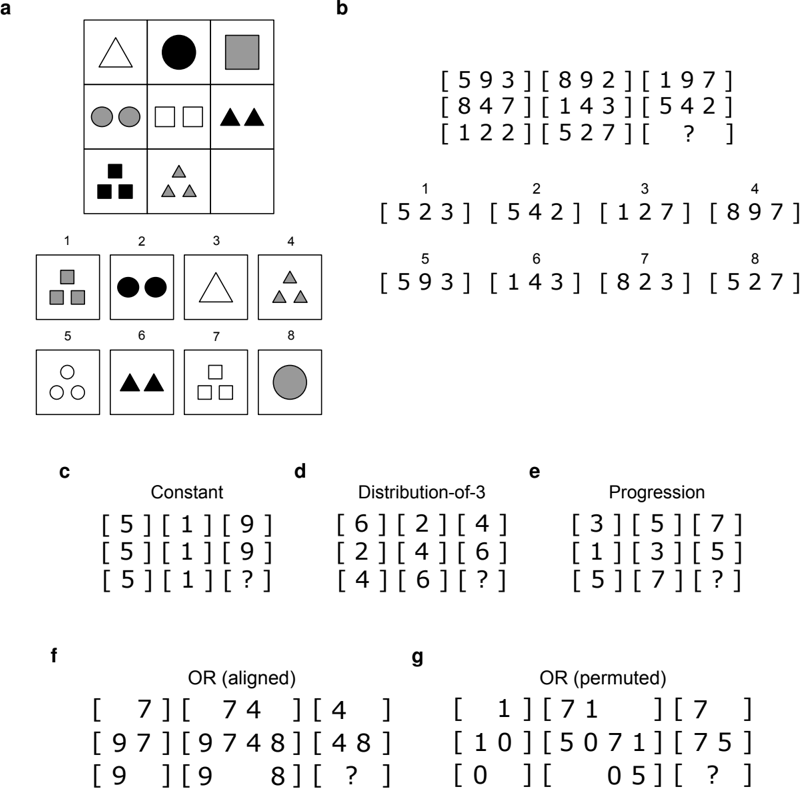
The image presents a series of visual patterns (a) and corresponding logical reasoning problems (b-g). The visual patterns consist of geometric shapes arranged in a 3x3 grid, numbered 1 through 9. The logical problems present a matrix-style reasoning task, where the goal is to identify the missing element ("?") based on the relationships within the given elements.
### Components/Axes
The image is divided into sections:
* **(a):** Visual Patterns - A 3x3 grid of shapes.
* **(b-g):** Logical Reasoning Problems - Each section presents a matrix with numerical values arranged in a grid format. Each grid has a missing element denoted by "?".
* Numbering: Each visual pattern is numbered 1-9. The logical reasoning problems are labeled c, d, e, f, and g.
### Detailed Analysis or Content Details
**Visual Patterns (a):**
* **1:** Four small circles, two dark and two light, and a triangle.
* **2:** Four small squares, three dark and one light, and three small triangles.
* **3:** A large triangle, and a dark circle.
* **4:** A large square, and a dark triangle.
* **5:** Four small squares, two dark and two light.
* **6:** Two dark circles and two light circles.
* **7:** A large triangle, and a dark square.
* **8:** A large triangle, and a dark circle.
* **9:** Two dark circles and two light squares.
**Logical Reasoning Problems (b-g):**
**b:**
```
[593] [892] [197]
[847] [143] [542]
[122] [527] [? ]
[523] [542] [127] [897]
[593] [143] [823] [527]
```
**c (Constant):**
```
[5] [1] [9]
[5] [1] [?]
```
**d (Distribution-of-3):**
```
[6] [2] [4]
[2] [4] [?]
```
**e (Progression):**
```
[3] [5] [7]
[1] [3] [5]
[5] [7] [?]
```
**f (OR (aligned)):**
```
[7] [4] [4]
[9] [748] [48]
[9] [9] [?]
```
**g (OR (permuted)):**
```
[1] [7] [7]
[10] [5071] [75]
[0] [05] [?]
```
### Key Observations
* The visual patterns (a) seem to be a set of stimuli for the logical reasoning problems.
* The logical reasoning problems (b-g) are matrix-style puzzles, requiring the identification of a missing element based on the relationships between the other elements.
* The problems are categorized by the type of reasoning required (Constant, Distribution-of-3, Progression, OR (aligned), OR (permuted)).
* The numerical values within the matrices appear to be arbitrary and do not follow a simple arithmetic progression.
### Interpretation
The image presents a cognitive task designed to assess logical reasoning and pattern recognition abilities. The visual patterns likely serve as a distractor or a secondary element to test the participant's ability to focus on the numerical relationships within the matrices. The different categories of logical problems (c-g) represent different types of reasoning strategies.
The "Constant" problem (c) suggests that the missing element should be identical to the first element in the first row. The "Distribution-of-3" problem (d) implies a pattern involving the distribution of the numbers 2, 4, and 6. The "Progression" problem (e) suggests an arithmetic progression. The "OR" problems (f and g) indicate a logical OR relationship between the elements, where the missing element must satisfy the conditions of at least one of the rows or columns.
The presence of the question mark ("?") in each matrix indicates that the task requires the participant to infer the missing element based on the given information. The complexity of the numerical values and the variety of reasoning strategies suggest that this is a challenging cognitive task. The image is a test of abstract reasoning and problem-solving skills.