## Abstract Reasoning Puzzle Set: Pattern Recognition and Logical Operations
### Overview
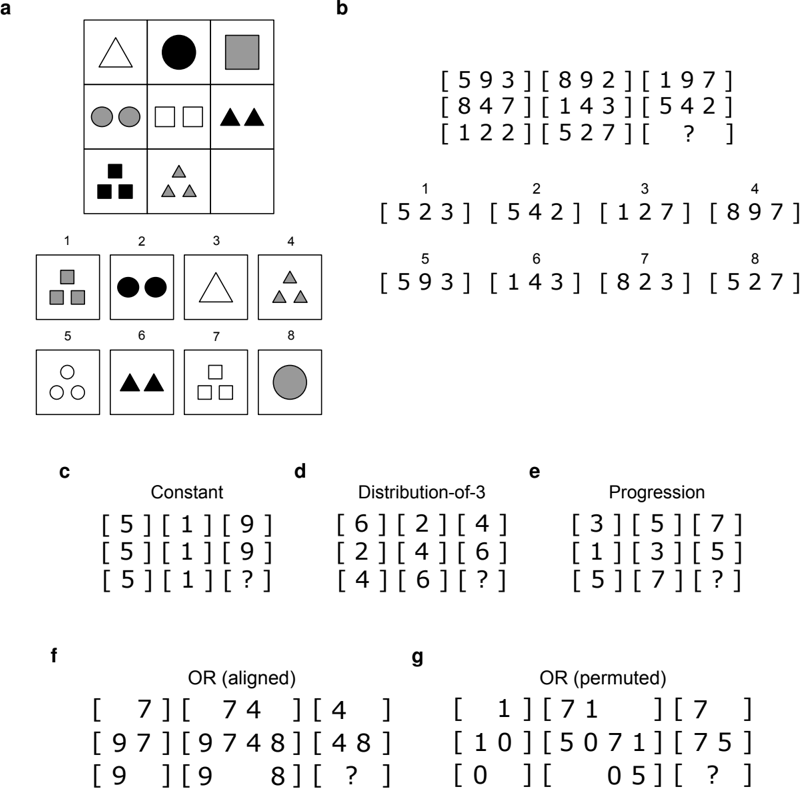
The image displays a composite figure containing seven distinct panels (labeled **a** through **g**) that present abstract reasoning puzzles. These puzzles involve visual pattern completion, numerical matrix completion, and the application of specific logical rules (Constant, Distribution-of-3, Progression, OR operations). The overall purpose appears to be the assessment or demonstration of inductive reasoning and rule discovery.
### Components/Axes
The image is segmented into seven labeled panels:
* **Panel a (Top-Left):** A visual matrix puzzle. It consists of a 3x3 grid with the bottom-right cell empty. Below the grid are eight numbered answer choices (1-8), each containing a different arrangement of shapes.
* **Panel b (Top-Right):** A numerical matrix puzzle. It shows a 3x3 grid of number triplets with the bottom-right cell containing a question mark `[ ? ]`. Below are eight numbered answer choices (1-8), each a set of three number triplets.
* **Panels c, d, e, f, g (Bottom Row):** These panels are labeled with specific logical rule names and each contains a 3x3 grid of number triplets with the bottom-right cell missing (marked `[ ? ]`). They serve as examples or test cases for different rule types.
* **c:** Labeled "Constant"
* **d:** Labeled "Distribution-of-3"
* **e:** Labeled "Progression"
* **f:** Labeled "OR (aligned)"
* **g:** Labeled "OR (permuted)"
### Detailed Analysis
**Panel a: Visual Matrix Puzzle**
* **Grid Content (Row-wise):**
* Row 1: [White Triangle], [Black Circle], [Grey Square]
* Row 2: [Two Grey Circles], [Two White Squares], [Two Black Triangles]
* Row 3: [Three Black Squares], [Three Grey Triangles], [ ? ]
* **Answer Choices (1-8):**
1. [Three Grey Squares]
2. [Two Black Circles]
3. [One White Triangle]
4. [Three Grey Triangles]
5. [Three White Circles]
6. [Two Black Triangles]
7. [Three White Squares]
8. [One Grey Circle]
**Panel b: Numerical Matrix Puzzle**
* **Main Grid Content (Row-wise, each cell is a triplet `[x y z]`):**
* Row 1: `[5 9 3]`, `[8 9 2]`, `[1 9 7]`
* Row 2: `[8 4 7]`, `[1 4 3]`, `[5 4 2]`
* Row 3: `[1 2 2]`, `[5 2 7]`, `[ ? ]`
* **Answer Choices (1-8):**
1. `[5 2 3]`
2. `[5 4 2]`
3. `[1 2 7]`
4. `[8 9 7]`
5. `[5 9 3]`
6. `[1 4 3]`
7. `[8 2 3]`
8. `[5 2 7]`
**Panels c-g: Rule-Specific Matrices**
* **c (Constant):** Grid shows `[5][1][9]` in the first two rows. The third row is `[5][1][?]`. The rule implies the third row should be identical to the first two.
* **d (Distribution-of-3):** Grid shows `[6][2][4]`, `[2][4][6]`, `[4][6][?]`. The numbers 2, 4, 6 are distributed across rows/columns.
* **e (Progression):** Grid shows `[3][5][7]`, `[1][3][5]`, `[5][7][?]`. Each row/column shows an arithmetic progression with a common difference of 2.
* **f (OR (aligned)):** Grid shows `[7][74][4]`, `[97][9748][48]`, `[9][98][?]`. This appears to involve a logical OR operation on digits in aligned positions.
* **g (OR (permuted)):** Grid shows `[1][71][7]`, `[10][5071][75]`, `[0][05][?]`. Similar to (f) but with permuted digit positions.
### Key Observations
1. **Dual Modality:** The puzzle set tests both visual-spatial reasoning (Panel a) and numerical-logical reasoning (Panels b-g).
2. **Rule Diversity:** Panels c-g explicitly name different logical operations, suggesting the overarching task is to identify which rule governs a given matrix.
3. **Structural Consistency:** All numerical matrices (b-g) share a 3x3 structure with triplets, while the visual matrix (a) uses a 3x3 grid of single or grouped shapes.
4. **Answer Format:** Both puzzle types (a and b) provide eight discrete multiple-choice options for the missing cell.
5. **Spatial Layout:** Panel a is positioned top-left, Panel b top-right, and the five rule panels (c-g) are arranged in two rows along the bottom.
### Interpretation
This image is a technical illustration of abstract reasoning test items, likely from a cognitive science or psychometrics context. It demonstrates the variety of inductive reasoning problems used to assess fluid intelligence.
* **What it demonstrates:** The figure catalogs different *types* of logical rules that can underlie a pattern. Solving these puzzles requires the test-taker to induce the rule from the given examples (the completed cells) and apply it to find the missing element.
* **Relationship between elements:** The labeled panels (c-g) serve as a "key" or taxonomy of possible rules. Panel b presents a concrete, unlabeled puzzle that likely requires the solver to first deduce which of these rules (or a combination) applies. Panel a shows a parallel task in the visual domain, where the rule might involve shape, color, and quantity progressions.
* **Notable patterns:** The "OR" rules (f, g) are particularly complex, suggesting operations on digit strings rather than simple arithmetic. The "Distribution-of-3" rule (d) implies a constraint-satisfaction logic. The presence of these varied rules indicates the test is designed to discriminate between different levels or types of logical reasoning ability.
* **Underlying purpose:** The image is not a data chart but a schematic of problem types. Its value lies in clearly presenting the structure and variety of inductive reasoning challenges, making it useful for researchers designing tests, educators, or individuals studying for cognitive assessments. The explicit labeling of rules in c-g is especially informative, as it reveals the "answer logic" that a test-taker must discover implicitly.