## Scatter Plot: Watermarking Method Evaluation (Perceptibility vs. Brittleness)
### Overview
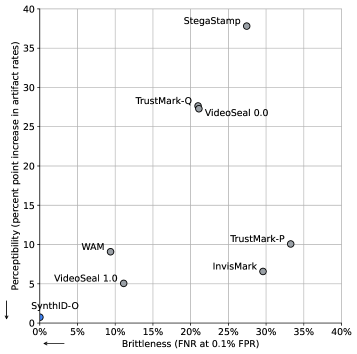
The image is a scatter plot comparing eight different digital watermarking or steganography methods. The plot evaluates each method on two axes: "Perceptibility" (y-axis) and "Brittleness" (x-axis). The data points are plotted as circles, with one method highlighted in blue and the others in gray. A legend is present in the top-left corner.
### Components/Axes
* **Chart Type:** Scatter Plot.
* **Y-Axis:**
* **Label:** "Perceptibility (percent point increase in artifact rates)"
* **Scale:** Linear, from 0 to 40, with major tick marks every 5 units (0, 5, 10, 15, 20, 25, 30, 35, 40).
* **X-Axis:**
* **Label:** "Brittleness (FNR at 0.1% FPR)"
* **Scale:** Linear, from 0% to 40%, with major tick marks every 5% (0%, 5%, 10%, 15%, 20%, 25%, 30%, 35%, 40%).
* **Legend:**
* **Position:** Top-left corner of the plot area.
* **Entries:**
1. A blue circle labeled "SynthID-Q".
2. A gray circle labeled "WAM".
* **Data Points (Labeled Methods):** Each method is represented by a single circle. The approximate coordinates (Brittleness, Perceptibility) are as follows:
* **StegaStamp:** Gray circle at approximately (28%, 38).
* **TrustMark-Q:** Gray circle at approximately (22%, 27).
* **VideoSeal 0.0:** Gray circle at approximately (23%, 26).
* **TrustMark-P:** Gray circle at approximately (34%, 10).
* **InvisiMark:** Gray circle at approximately (30%, 7).
* **WAM:** Gray circle at approximately (10%, 9).
* **VideoSeal 1.0:** Gray circle at approximately (11%, 5).
* **SynthID-Q:** Blue circle at approximately (0%, 0).
### Detailed Analysis
The plot visualizes a trade-off between two undesirable properties of a watermark: how easily it is perceived (Perceptibility) and how easily it is broken or fails (Brittleness, measured as False Negative Rate at a fixed False Positive Rate).
* **Trend Verification:** There is a general positive correlation visible. Methods with higher perceptibility (higher on the y-axis) also tend to have higher brittleness (further right on the x-axis). However, the relationship is not perfectly linear, and there is significant spread.
* **Data Series & Spatial Grounding:**
* **High Perceptibility / High Brittleness Cluster:** `StegaStamp` is the most perceptible and brittle method, positioned in the top-right quadrant. `TrustMark-Q` and `VideoSeal 0.0` form a cluster nearby, with slightly lower values on both axes.
* **Moderate Brittleness / Lower Perceptibility:** `TrustMark-P` and `InvisiMark` are positioned further right on the brittleness axis (30-34%) but have significantly lower perceptibility scores (7-10%).
* **Low Brittleness / Low Perceptibility Cluster:** `WAM` and `VideoSeal 1.0` are grouped in the lower-left area, indicating relatively good performance on both metrics.
* **Ideal Point (Origin):** `SynthID-Q` is plotted at the origin (0%, 0), indicating it has the lowest possible scores for both perceptibility and brittleness according to this chart. It is the only data point colored blue, matching its entry in the legend.
### Key Observations
1. **SynthID-Q is an Outlier:** It occupies the ideal position at (0,0), suggesting it introduces no measurable increase in artifact rates and has a 0% false negative rate at the given threshold. This makes it appear vastly superior to all other methods plotted.
2. **Clear Performance Tiers:** The methods cluster into distinct groups:
* **Tier 1 (Best):** SynthID-Q (blue).
* **Tier 2 (Good):** VideoSeal 1.0 and WAM (low perceptibility <10%, brittleness ~10-11%).
* **Tier 3 (Mixed):** InvisiMark and TrustMark-P (low perceptibility but high brittleness >30%).
* **Tier 4 (Poor):** TrustMark-Q, VideoSeal 0.0, and StegaStamp (high perceptibility >25% and moderate-to-high brittleness >20%).
3. **Version Comparison:** `VideoSeal 1.0` shows a dramatic improvement over `VideoSeal 0.0`, moving from the poor-performance cluster to the good-performance cluster, reducing both perceptibility and brittleness significantly.
4. **Legend Ambiguity:** The legend lists "WAM" with a gray circle, which matches the color of all non-SynthID-Q data points. This could imply that gray circles represent a category or baseline that includes WAM, but since all other methods are also gray, it primarily serves to identify the color for the WAM data point specifically.
### Interpretation
This chart is a performance benchmark for watermarking/steganography techniques, likely from a research paper. The axes define the core challenge: a good watermark should be imperceptible (low perceptibility) and robust (low brittleness/FNR).
* **What the Data Suggests:** The plot demonstrates that achieving both low perceptibility and low brittleness is difficult. Most methods make a trade-off. `SynthID-Q` is presented as a breakthrough that seemingly overcomes this trade-off, achieving near-perfect scores. The significant improvement from `VideoSeal 0.0` to `1.0` highlights successful iterative development.
* **Relationship Between Elements:** The spatial distribution creates a "Pareto front" of sorts. Methods closer to the origin are better. The diagonal spread suggests that as developers try to make watermarks less perceptible (moving down the y-axis), they often become more brittle (moving right on the x-axis), and vice-versa. `SynthID-Q`'s position suggests it uses a fundamentally different or superior approach.
* **Notable Anomalies/Caveats:**
* The perfect (0,0) score for `SynthID-Q` is highly unusual for empirical data and may represent a theoretical best-case, a result under very specific/ideal conditions, or a different measurement baseline. It warrants scrutiny.
* The metric "percent point increase in artifact rates" for perceptibility is specific. It measures how much more often artifacts are detected, not an absolute quality score.
* The brittleness metric is conditional on a 0.1% False Positive Rate (FPR), meaning the threshold is set to be very strict about not misidentifying unwatermarked content. Performance could change at a different FPR.
**Language:** All text in the image is in English.