\n
## Textual Document: Question and Answer with Reasoning
### Overview
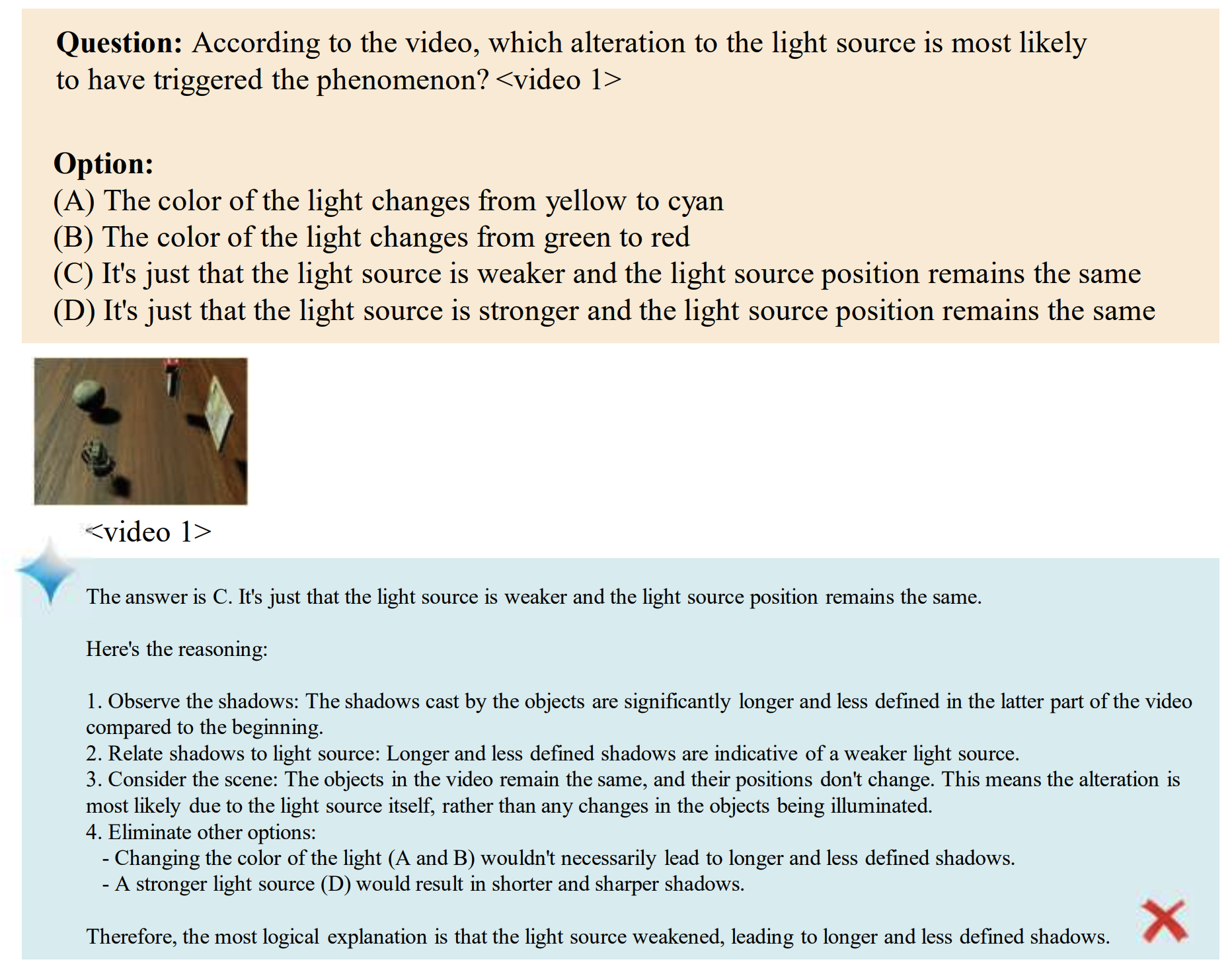
The image presents a question related to a video, followed by multiple-choice options and a detailed answer with reasoning. The question concerns the alteration of a light source that triggered a phenomenon observed in the video. The image also includes a small thumbnail of the video content.
### Components/Axes
The document is structured as follows:
* **Question:** "According to the video, which alteration to the light source is most likely to have triggered the phenomenon? <video 1>"
* **Options:** (A) through (D), each describing a potential change to the light source.
* **Answer:** "The answer is C. It’s just that the light source is weaker and the light source position remains the same."
* **Reasoning:** A numbered list explaining the logic behind the answer.
* **Thumbnail:** A small image depicting several objects (possibly spools of thread or similar items) with shadows.
### Detailed Analysis or Content Details
**Question:** "According to the video, which alteration to the light source is most likely to have triggered the phenomenon? <video 1>"
**Options:**
* (A) The color of the light changes from yellow to cyan
* (B) The color of the light changes from green to red
* (C) It’s just that the light source is weaker and the light source position remains the same
* (D) It’s just that the light source is stronger and the light source position remains the same
**Answer:** "The answer is C. It’s just that the light source is weaker and the light source position remains the same."
**Reasoning:**
1. Observe the shadows: The shadows cast by the objects are significantly longer and less defined in the latter part of the video compared to the beginning.
2. Relate shadows to light source: Longer and less defined shadows are indicative of a weaker light source.
3. Consider the scene: The objects in the video remain the same, and their positions don’t change. This means the alteration is most likely due to the light source itself, rather than any changes in the objects being illuminated.
4. Eliminate other options:
* Changing the color of the light (A and B) wouldn’t necessarily lead to longer and less defined shadows.
* A stronger light source (D) would result in shorter and sharper shadows.
Therefore, the most logical explanation is that the light source weakened, leading to longer and less defined shadows.
**Thumbnail Description:** The thumbnail, located in the center-left of the image, shows a collection of dark-colored objects, possibly spools of thread or similar cylindrical items. Shadows are cast by these objects, indicating a light source from the upper-left. The shadows appear relatively soft and diffused.
### Key Observations
* The reasoning focuses on the relationship between shadow length/definition and light source strength.
* The answer is supported by a logical deduction process, eliminating other possibilities.
* The thumbnail provides visual context, confirming the presence of shadows and objects.
### Interpretation
The document demonstrates a problem-solving approach based on visual observation and logical reasoning. The question requires understanding how changes in light source characteristics affect shadow formation. The provided answer and reasoning correctly identify that a weaker light source would result in longer, less defined shadows, and that changes in color would not necessarily cause this effect. The document highlights the importance of considering all factors and eliminating incorrect options to arrive at the most logical conclusion. The reference to "<video 1>" suggests this is part of a larger learning module or assessment. The red "X" in the bottom right corner is likely a visual indicator of a completed or correct answer.