## Screenshot: Multiple-Choice Question with Answer Explanation
### Overview
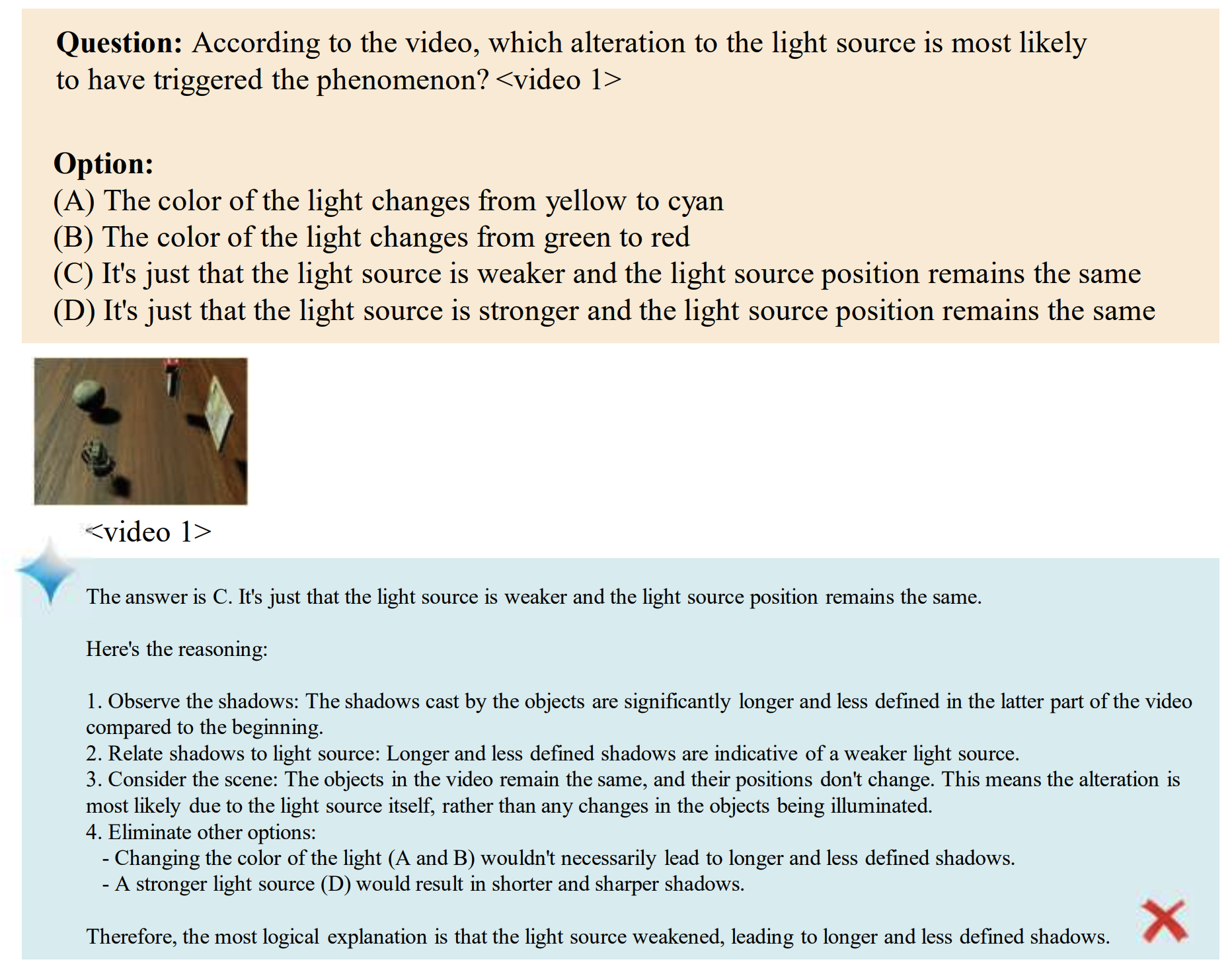
This image is a screenshot of a digital interface, likely from an educational or quiz platform. It presents a multiple-choice question about a physics phenomenon related to light sources and shadows, includes a placeholder for a video, and provides a detailed answer with reasoning. The layout is divided into three distinct horizontal sections.
### Components/Axes
The image is segmented into three primary regions:
1. **Header/Question Section (Top, beige background):** Contains the question text and four multiple-choice options.
2. **Media Section (Middle, white background):** Contains a small video thumbnail and a text placeholder.
3. **Answer/Explanation Section (Bottom, light blue background):** Contains the selected answer, a step-by-step reasoning, and a concluding statement.
### Content Details
#### 1. Header/Question Section
* **Question Text:** "Question: According to the video, which alteration to the light source is most likely to have triggered the phenomenon? <video 1>"
* **Options:**
* (A) The color of the light changes from yellow to cyan
* (B) The color of the light changes from green to red
* (C) It's just that the light source is weaker and the light source position remains the same
* (D) It's just that the light source is stronger and the light source position remains the same
#### 2. Media Section
* **Visual Element:** A small, rectangular video thumbnail is positioned on the left side. It shows a top-down view of a wooden surface (like a floor or table). On this surface, there are several objects: a round, greenish object (possibly a ball or fruit), a small dark object, and a rectangular white object (like a piece of paper or card). Shadows are cast by these objects.
* **Text Label:** Directly below the thumbnail is the text: "<video 1>"
#### 3. Answer/Explanation Section
* **Answer Declaration:** "The answer is C. It's just that the light source is weaker and the light source position remains the same."
* **Reasoning Header:** "Here's the reasoning:"
* **Numbered Reasoning Points:**
1. "Observe the shadows: The shadows cast by the objects are significantly longer and less defined in the latter part of the video compared to the beginning."
2. "Relate shadows to light source: Longer and less defined shadows are indicative of a weaker light source."
3. "Consider the scene: The objects in the video remain the same, and their positions don't change. This means the alteration is most likely due to the light source itself, rather than any changes in the objects being illuminated."
4. "Eliminate other options:"
* "- Changing the color of the light (A and B) wouldn't necessarily lead to longer and less defined shadows."
* "- A stronger light source (D) would result in shorter and sharper shadows."
* **Concluding Statement:** "Therefore, the most logical explanation is that the light source weakened, leading to longer and less defined shadows."
* **Annotation:** A red "X" mark is located in the bottom-right corner of this section.
### Key Observations
* The question is hypothetical, referring to a video not fully visible in the screenshot.
* The reasoning is based on fundamental principles of optics: shadow length and definition are inversely related to light source intensity (weaker light creates longer, softer shadows) and directly related to light source distance/angle (which is stated to be constant here).
* The red "X" mark is ambiguous. It could indicate that the provided answer (C) is incorrect in a broader context, or it could be a UI element marking an incorrect user response that this explanation is correcting.
### Interpretation
This image documents a pedagogical interaction. It presents a cause-and-effect problem in physics (observing shadow changes to infer a change in the light source) and provides a model answer with logical deduction. The structure is designed to teach or assess understanding of how light source properties affect shadow characteristics.
The reasoning explicitly rules out color changes (options A and B) as the primary cause, correctly noting that color alone doesn't dictate shadow geometry. It also correctly contrasts the effects of a weaker versus stronger light source. The core inference—that longer, less defined shadows indicate a weaker light source, assuming constant position—is scientifically sound.
The presence of the red "X" introduces a layer of meta-information. It suggests this screenshot might be from a review screen showing a user's incorrect selection, with the system providing the correct answer (C) and its justification. Therefore, the image serves not just as a question, but as a corrective feedback tool.