## Diagram: Informal Math to Formal Theorem
### Overview
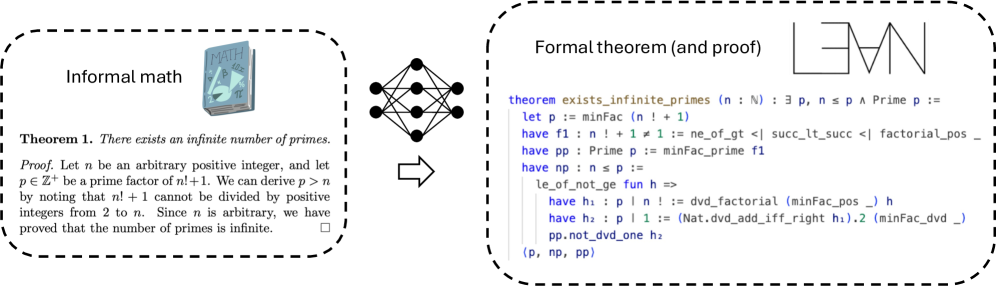
The image presents a transformation from informal mathematical notation and proof to a formal theorem and proof, likely within a proof assistant like Lean. It visually connects the traditional mathematical representation with its formalized counterpart.
### Components/Axes
* **Left Region:** Labeled "Informal math". Contains a textbook graphic and a theorem with its proof written in standard mathematical notation.
* **Middle Region:** Contains a neural network diagram and an arrow pointing from left to right.
* **Right Region:** Labeled "Formal theorem (and proof)". Contains the theorem and its proof written in a formal language, likely Lean, along with the Lean logo.
### Detailed Analysis
**Left Region: Informal Math**
* **Title:** "Informal math"
* **Textbook Graphic:** A closed book with the word "MATH" on the cover. The cover also contains mathematical symbols like a square root, percentage, and pi.
* **Theorem 1:** "There exists an infinite number of primes."
* **Proof:**
* "Let *n* be an arbitrary positive integer, and let *p* ∈ Z+ be a prime factor of *n*! + 1. We can derive *p* > *n* by noting that *n*! + 1 cannot be divided by positive integers from 2 to *n*. Since *n* is arbitrary, we have proved that the number of primes is infinite."
* A small square symbol (□) marks the end of the proof.
**Middle Region**
* **Neural Network Diagram:** A simple diagram of a neural network with three layers of nodes. The top and bottom layers have three nodes each, and the middle layer has four nodes. All nodes are connected to all nodes in the adjacent layers.
* **Arrow:** A right-pointing arrow indicating a transformation or mapping from the informal math to the formal theorem.
**Right Region: Formal Theorem (and proof)**
* **Title:** "Formal theorem (and proof)"
* **Lean Logo:** A stylized representation of the word "LEAN".
* **Formal Theorem and Proof (Lean Code):**
```
theorem exists_infinite_primes (n: N): ∃ p, n ≤ p ∧ Prime p :=
let p := minFac (n + 1)
have f1 : n! + 1 ≠ 1 := ne_of_gt <| succ_lt_succ <| factorial_pos _
have pp : Prime p := minFac_prime f1
have np : n ≤ p :=
le_of_not_ge fun h =>
have h1 : p | n! := dvd_factorial (minFac_pos _) h
have h2 : p | 1 := (Nat.dvd_add_iff_right h₁).2 (minFac_dvd _)
pp.not_dvd_one h2
(p, np, pp)
```
### Key Observations
* The diagram illustrates the process of formalizing a mathematical theorem and its proof.
* The neural network diagram in the middle might symbolize the complexity of the formalization process or the potential use of AI in theorem proving.
* The Lean code represents a formal, machine-verifiable proof of the theorem.
### Interpretation
The image demonstrates the transition from traditional, human-readable mathematical notation to a formal language suitable for automated theorem proving. The informal proof relies on natural language and common mathematical knowledge, while the formal proof is expressed in a precise, unambiguous language that can be checked by a computer. The neural network diagram suggests the potential role of machine learning in bridging the gap between informal and formal mathematics. The image highlights the increasing importance of formalization in ensuring the correctness and reliability of mathematical results, especially in areas like computer science and cryptography.