\n
## Diagram: Geometric Proof Flow
### Overview
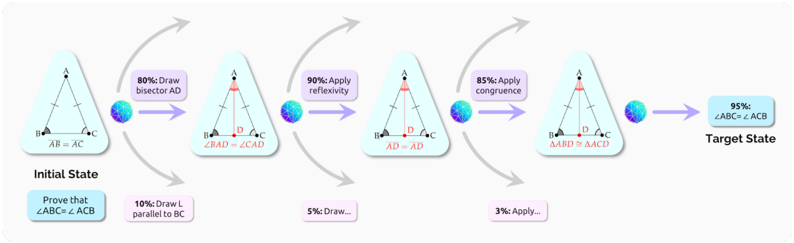
The image depicts a geometric proof process, visualized as a series of transformations applied to a triangle. The diagram shows a sequence of steps, each building upon the previous one, leading from an "Initial State" to a "Target State". Each step is associated with a percentage value, presumably representing the confidence or progress towards the target. The diagram uses arrows to indicate the flow of the proof.
### Components/Axes
The diagram consists of five main stages, arranged horizontally. Each stage contains a triangle diagram and a textual description of the applied step. Below each stage is a smaller text label indicating a percentage and a brief description of the next step. The diagram also includes labels for the initial and target states.
* **Initial State:** A triangle ABC with AB = AC.
* **Step 1:** Draw bisector AD. Associated percentage: 80%. Text: "Draw bisector AD". Angle labels: ∠BAD = ∠CAD.
* **Step 2:** Apply reflexivity. Associated percentage: 90%. Text: "Apply reflexivity". Side label: AD = AD.
* **Step 3:** Apply congruence. Associated percentage: 85%. Text: "Apply congruence". Triangle labels: ΔABD ≅ ΔACD.
* **Target State:** ∠ABC = ∠ACB. Associated percentage: 95%.
* **Bottom Row:** A series of steps leading to the next stage, with associated percentages: 10% "Draw L parallel to BC", 5% "Draw...", 3% "Apply...".
* **Arrows:** Curved arrows connect each stage, indicating the flow of the proof.
* **Text:** "Prove that ∠ABC = ∠ACB" is located below the initial state.
### Detailed Analysis or Content Details
The diagram illustrates a geometric proof to demonstrate that ∠ABC = ∠ACB.
1. **Initial State:** The starting point is a triangle ABC where sides AB and AC are equal (AB = AC).
2. **Step 1 (80%):** A bisector AD is drawn, dividing angle BAC into two equal angles (∠BAD = ∠CAD).
3. **Step 2 (90%):** The reflexive property is applied, stating that AD is equal to itself (AD = AD).
4. **Step 3 (85%):** The congruence of triangles ABD and ACD is applied (ΔABD ≅ ΔACD).
5. **Target State (95%):** The conclusion is reached: ∠ABC = ∠ACB.
The bottom row indicates the steps needed to move to the next stage, with decreasing percentages: 10% to draw a line L parallel to BC, 5% to draw something (unspecified), and 3% to apply something (unspecified).
### Key Observations
* The percentages associated with each step suggest a level of confidence or the amount of work remaining. The percentage increases with each step, peaking at 95% in the target state.
* The diagram visually represents the logical flow of a geometric proof.
* The bottom row of steps seems to indicate the remaining work to complete the proof, but the descriptions are incomplete.
* The diagram uses standard geometric notation (e.g., ∠ for angles, Δ for triangles, ≅ for congruence).
### Interpretation
The diagram demonstrates a proof by construction approach to show that if AB = AC in triangle ABC, then ∠ABC = ∠ACB. The steps involve bisecting the angle at A, applying the reflexive property, and then using congruence to establish the equality of the base angles. The percentages likely represent the confidence level in each step or the remaining effort to complete the proof. The diagram is a visual aid for understanding the logical sequence of steps in a geometric proof. The incomplete descriptions in the bottom row suggest that the proof might be more complex than initially presented, or that the diagram is a simplified representation of a larger proof. The diagram is a clear and concise way to illustrate the process of deductive reasoning in geometry.