## Diagram: Geometric Proof Workflow
### Overview
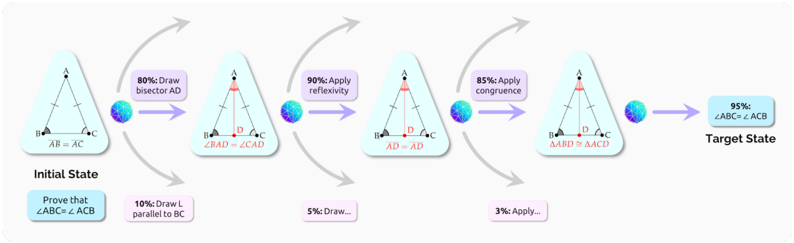
The image depicts a flowchart illustrating the logical steps and probabilistic confidence levels in a geometric proof. It begins with an initial state (triangle ABC with AB=AC) and progresses through a series of actions (drawing bisectors, applying reflexivity/congruence) to reach a target state (proving ∠ABC=∠ACB). Percentages indicate confidence levels or likelihoods associated with each step.
### Components/Axes
- **Initial State**: Triangle ABC with AB=AC (isosceles triangle).
- **Target State**: Proof that ∠ABC=∠ACB (conclusion).
- **Steps**:
1. **Draw bisector AD** (80% confidence).
2. **Apply reflexivity** (90% confidence).
3. **Apply congruence** (85% confidence).
4. **Draw L parallel to BC** (10% confidence).
5. **Apply...** (3% confidence, truncated).
- **Arrows**: Connect steps sequentially from left to right.
- **Text Boxes**: Contain step descriptions and confidence percentages.
### Detailed Analysis
- **Step 1**: "Draw bisector AD" (80% confidence) is the first action, splitting ∠BAC into two equal angles.
- **Step 2**: "Apply reflexivity" (90% confidence) likely refers to the reflexive property (e.g., AD=AD).
- **Step 3**: "Apply congruence" (85% confidence) suggests using congruence criteria (e.g., SAS) to establish triangle ABD ≅ ACD.
- **Step 4**: "Draw L parallel to BC" (10% confidence) introduces a parallel line, possibly for auxiliary reasoning.
- **Step 5**: "Apply..." (3% confidence) is incomplete, indicating uncertainty or a minor step.
- **Final Confidence**: 95% for the conclusion ∠ABC=∠ACB, derived from the cumulative steps.
### Key Observations
- Confidence decreases slightly at each step (80% → 90% → 85% → 10% → 3%), suggesting increasing complexity or uncertainty.
- The final 95% confidence in the conclusion implies strong logical validity despite intermediate uncertainties.
- The truncated "Apply..." step (3%) may represent an overlooked or low-priority action.
### Interpretation
The diagram models a geometric proof as a probabilistic process, where each step’s confidence reflects its role in the logical chain. The high final confidence (95%) underscores the robustness of the proof, even with lower confidence in intermediate steps (e.g., drawing parallel lines). The workflow emphasizes the importance of foundational steps (bisector, reflexivity, congruence) in establishing geometric truths. The truncated step highlights potential gaps in reasoning or areas requiring further validation.