## 3D Floor Plan Diagram: Robot Navigation & Question Answering System
### Overview
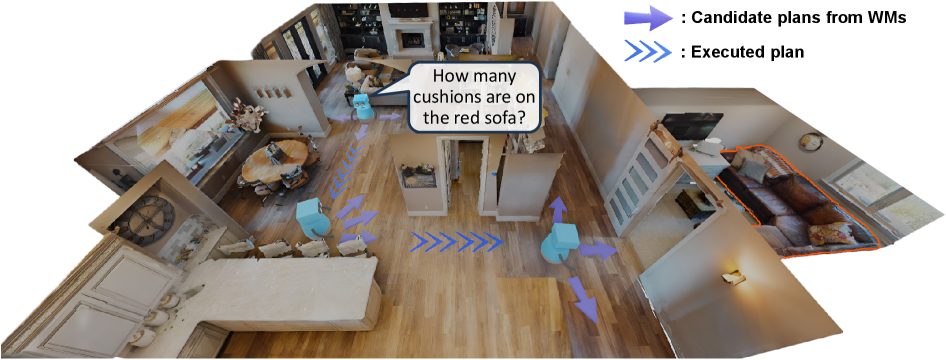
The image depicts a 3D-rendered floor plan of a modern home interior, overlaid with directional arrows and annotations. A speech bubble poses the question: "How many cushions are on the red sofa?" The diagram illustrates a robot's path planning process, with arrows representing candidate and executed plans. The red sofa is highlighted in orange, serving as the focal point for the query.
### Components/Axes
- **Speech Bubble**: Contains the question "How many cushions are on the red sofa?" positioned near the red sofa in the top-right section of the image.
- **Legend**: Located in the top-right corner, defining:
- **Purple Arrows**: "Candidate plans from WMs" (World Models)
- **Blue Arrows**: "Executed plan"
- **Highlighted Sofa**: Red sofa outlined in orange, located in the top-right room near a window.
- **Arrows**:
- Purple arrows (candidate plans) originate from the bottom-left and spread toward the sofa.
- Blue arrows (executed plan) converge on the sofa from the center-right.
### Detailed Analysis
- **Speech Bubble Text**: "How many cushions are on the red sofa?" (English, no translation required).
- **Legend Text**:
- Purple Arrows: "Candidate plans from WMs"
- Blue Arrows: "Executed plan"
- **Spatial Relationships**:
- The red sofa is positioned in the top-right quadrant, adjacent to a window and a bookshelf.
- Purple arrows (candidate plans) originate from the bottom-left kitchen area and diverge toward the sofa.
- Blue arrows (executed plan) originate from the center-right hallway and converge directly on the sofa.
- The orange outline around the sofa emphasizes its importance as the target object.
### Key Observations
1. **Path Planning Visualization**: The diagram contrasts candidate paths (purple) with the final executed path (blue), suggesting a decision-making process in robotics.
2. **Target Focus**: The red sofa is the sole object highlighted, indicating it is the primary subject of the query.
3. **Arrow Density**: More purple arrows (candidate plans) are present than blue arrows (executed plan), implying exploration before execution.
4. **Spatial Layout**: The kitchen (bottom-left) and living area (top-right) are connected via a central hallway, with the robot navigating between these zones.
### Interpretation
This diagram demonstrates a robot's navigation and reasoning process to answer a spatial question. The purple arrows represent exploratory paths generated by world models (WMs), while the blue arrows show the optimized path taken to reach the red sofa. The question in the speech bubble suggests the robot is tasked with object recognition and counting (cushions on the sofa). The orange outline around the sofa emphasizes its role as the target, while the contrasting arrow colors illustrate the transition from hypothesis generation to action execution. The layout implies a multi-room environment where the robot must navigate efficiently to complete its task.