## Diagram: Robot Navigation Plan
### Overview
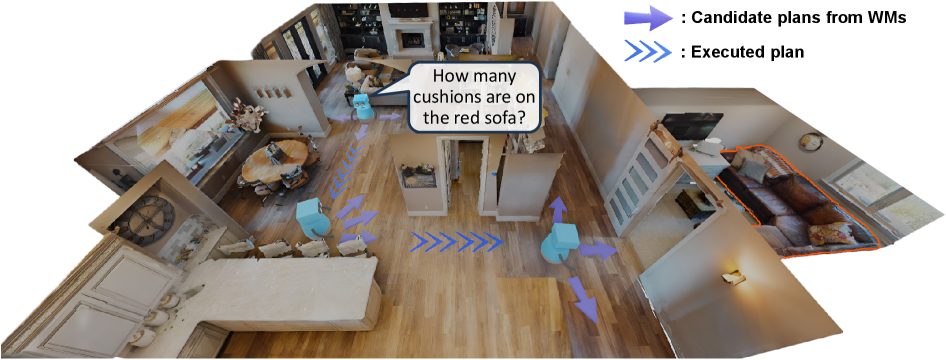
The image depicts a top-down view of a house interior, illustrating a robot's navigation plan. The robot's potential paths ("Candidate plans from WMs") and the actual path taken ("Executed plan") are overlaid on the image of the house. The robot is tasked with answering a question about the number of cushions on a red sofa.
### Components/Axes
* **Legend (Top-Right)**:
* Purple Arrow: Candidate plans from WMs (World Models)
* Blue Chevron: Executed plan
* **Environment**: The image shows a house interior including a kitchen, dining area, living room, and hallway.
* **Robot**: A light blue robot is shown at multiple locations, representing its potential and actual positions.
* **Question Bubble**: A speech bubble near the robot states: "How many cushions are on the red sofa?"
* **Red Sofa**: A sofa is outlined in orange in the living room.
### Detailed Analysis
* **Candidate Plans**: Purple arrows indicate the robot's potential paths. These paths originate from different locations in the house.
* One set of candidate plans originates from the kitchen area.
* Another set originates from the dining area.
* A third set originates from the hallway.
* **Executed Plan**: Blue chevrons show the actual path taken by the robot. The robot moves from the kitchen, through the dining area and hallway, and into the living room.
* **Robot Positions**: The robot is shown at the starting point in the kitchen, in the dining area, in the hallway, and near the sofa in the living room.
* **Sofa**: The sofa in the living room is outlined in orange. It appears to have multiple cushions on it.
### Key Observations
* The robot explores multiple potential paths before executing a specific plan.
* The executed plan takes the robot from the kitchen to the living room.
* The robot's task is to answer a question about the sofa in the living room.
### Interpretation
The diagram illustrates a robot's navigation and planning process within a home environment. The robot uses world models (WMs) to generate candidate plans, and then executes one of these plans to reach a specific location (the sofa) to answer a question. The multiple candidate plans suggest that the robot is capable of considering different routes and making decisions based on its understanding of the environment. The orange outline around the sofa highlights the object of interest for the robot's task.