## Diagram: GEMM Workload and Optimization Strategies
### Overview
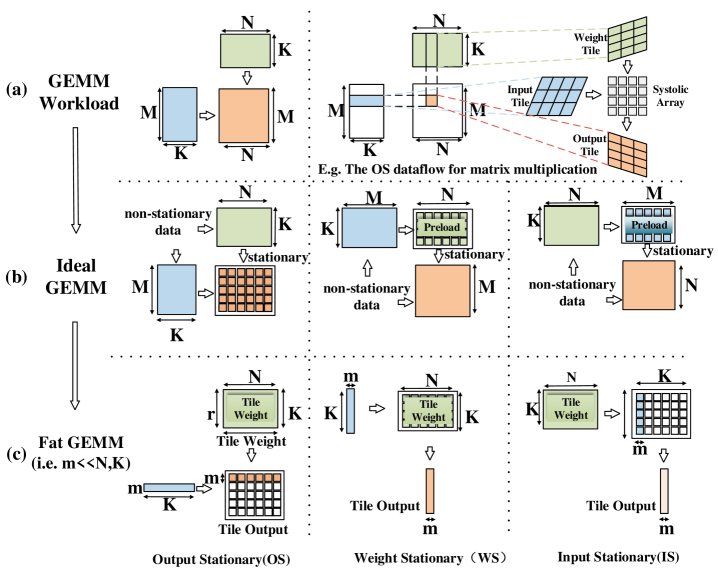
The diagram illustrates three GEMM (General Matrix Multiply) workload configurations: (a) Standard GEMM Workload, (b) Ideal GEMM, and (c) Fat GEMM. It emphasizes dataflow optimization, memory access patterns, and tile-based computation strategies. Key components include matrix dimensions (M, N, K), stationary/non-stationary data, and systolic array operations.
### Components/Axes
- **Labels**:
- **Section (a)**: GEMM Workload, M, N, K, Input Tile, Weight Tile, Systolic Array, Output Tile.
- **Section (b)**: Ideal GEMM, non-stationary data, stationary data, Tile Weight, Preload, Tile Output.
- **Section (c)**: Fat GEMM (m < N, K), Tile Weight, Tile Output, Output Stationary (OS), Weight Stationary (WS), Input Stationary (IS).
- **Colors**:
- Green: Non-stationary data/Weight Tile.
- Blue: Stationary data/Input Tile.
- Orange: Output Tile/Stationary data.
- Red: Dashed lines indicating dataflow paths.
- **Flow Direction**:
- Left-to-right for dataflow (e.g., Input Tile → Weight Tile → Systolic Array → Output Tile).
- Vertical arrows denote stationary/non-stationary data separation.
### Detailed Analysis
1. **Section (a): GEMM Workload**
- Matrices M (blue), N (green), and K (orange) are multiplied via a systolic array.
- Non-stationary data (green) flows into the systolic array, while stationary data (orange) is preloaded.
- Output Tile (orange) is generated after matrix multiplication.
2. **Section (b): Ideal GEMM**
- Separates data into non-stationary (green) and stationary (blue/orange) streams.
- Non-stationary data is tiled into Weight Tiles (green), while stationary data is preloaded into the systolic array.
- Tile Output (orange) is produced after processing.
3. **Section (c): Fat GEMM (m < N, K)**
- Smaller tile size (m) reduces memory bandwidth.
- Three stationary types:
- **Output Stationary (OS)**: Processes Tile Output (orange) with dimensions m×K.
- **Weight Stationary (WS)**: Handles Tile Weight (green) with dimensions K×m.
- **Input Stationary (IS)**: Manages Input Tile (blue) with dimensions N×m.
### Key Observations
- **Dataflow Optimization**:
- Ideal GEMM reduces non-stationary data movement by tiling weights and preloading stationary data.
- Fat GEMM minimizes tile size (m) to balance compute and memory constraints.
- **Systolic Array Role**:
- Central to matrix multiplication in all configurations, enabling parallel computation.
- **Tile Size Tradeoffs**:
- Fat GEMM’s smaller tiles (m) may improve cache efficiency but increase tile count.
### Interpretation
The diagram highlights strategies to optimize GEMM operations for hardware efficiency:
1. **Ideal GEMM** balances non-stationary and stationary data to minimize memory access latency.
2. **Fat GEMM** adapts to memory bandwidth limitations by reducing tile dimensions, critical for large matrices (M, N, K).
3. **Systolic Array** acts as a computational engine, with dataflow paths (red dashed lines) emphasizing parallelism.
The progression from (a) to (c) suggests a tradeoff between computational complexity and memory efficiency, with Fat GEMM prioritizing memory constraints over tile size. This aligns with hardware-aware algorithm design for deep learning accelerators.