## Histogram: Betweenness Centrality Distribution Across Iterations
### Overview
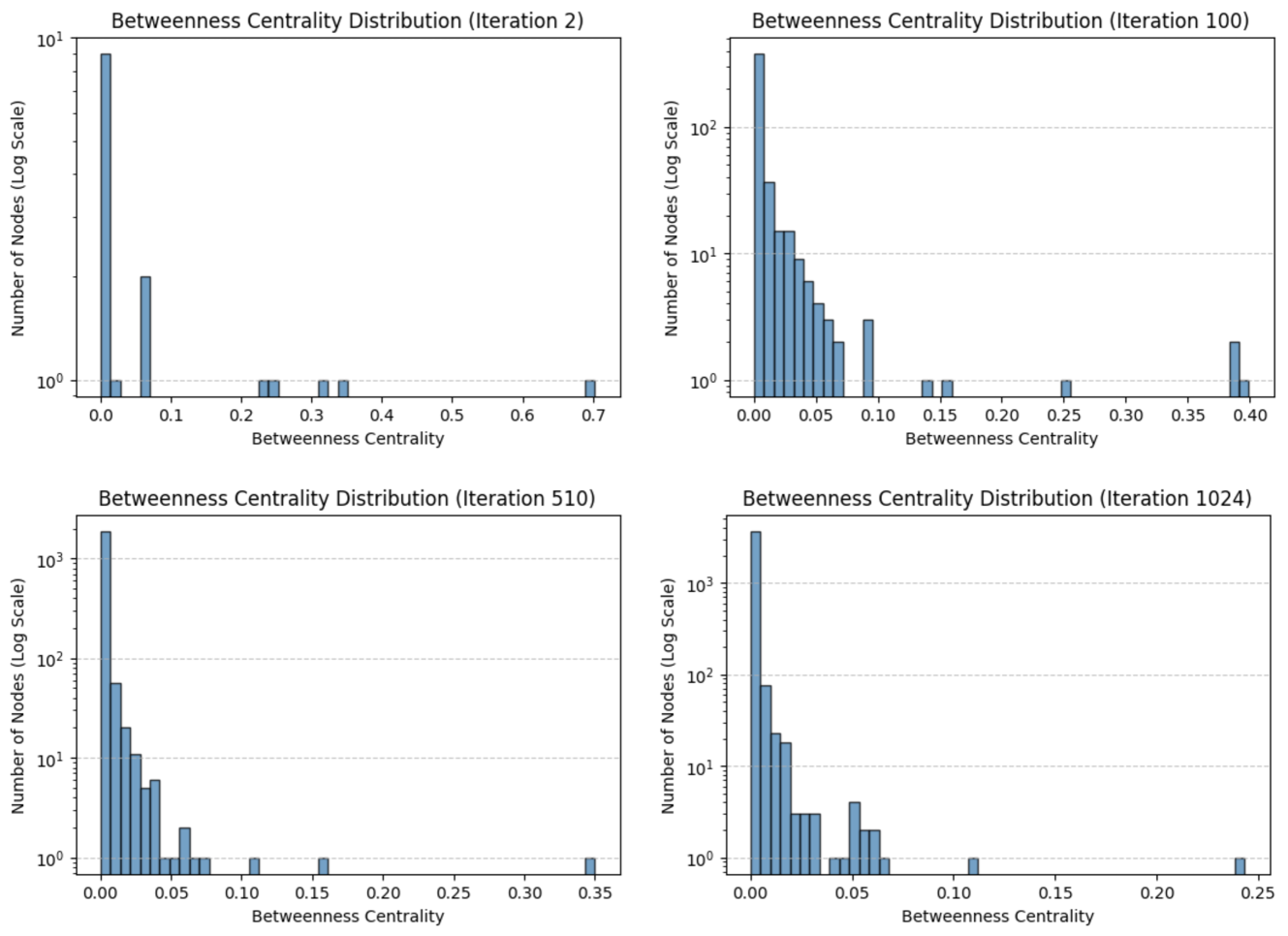
The image presents four histograms displaying the distribution of betweenness centrality of nodes at different iterations (2, 100, 510, and 1024). The x-axis represents betweenness centrality, and the y-axis represents the number of nodes on a logarithmic scale. The histograms show how the distribution changes as the iterations progress.
### Components/Axes
* **Titles:**
* Top-Left: "Betweenness Centrality Distribution (Iteration 2)"
* Top-Right: "Betweenness Centrality Distribution (Iteration 100)"
* Bottom-Left: "Betweenness Centrality Distribution (Iteration 510)"
* Bottom-Right: "Betweenness Centrality Distribution (Iteration 1024)"
* **X-axis:** "Betweenness Centrality"
* Top-Left: Scale from 0.0 to 0.7, with ticks at 0.0, 0.1, 0.2, 0.3, 0.4, 0.5, 0.6, 0.7
* Top-Right: Scale from 0.00 to 0.40, with ticks at 0.00, 0.05, 0.10, 0.15, 0.20, 0.25, 0.30, 0.35, 0.40
* Bottom-Left: Scale from 0.00 to 0.35, with ticks at 0.00, 0.05, 0.10, 0.15, 0.20, 0.25, 0.30, 0.35
* Bottom-Right: Scale from 0.00 to 0.25, with ticks at 0.00, 0.05, 0.10, 0.15, 0.20, 0.25
* **Y-axis:** "Number of Nodes (Log Scale)"
* All plots: Logarithmic scale from 10<sup>0</sup> (1) to 10<sup>3</sup> (1000), with ticks at 10<sup>0</sup>, 10<sup>1</sup>, 10<sup>2</sup>, 10<sup>3</sup>. The top-right plot only goes to 10<sup>2</sup>.
* **Bars:** The histograms are represented by blue bars.
### Detailed Analysis
* **Iteration 2 (Top-Left):**
* A very high peak at approximately 0.0 betweenness centrality, reaching nearly 10<sup>1</sup> (10) nodes.
* A smaller peak at approximately 0.08 betweenness centrality, reaching approximately 3 nodes.
* Sparse nodes with betweenness centrality values around 0.2, 0.3, 0.4, 0.6, and 0.7, each with approximately 1 node.
* **Iteration 100 (Top-Right):**
* A high peak at approximately 0.00 betweenness centrality, reaching nearly 10<sup>3</sup> (1000) nodes.
* The number of nodes decreases rapidly as betweenness centrality increases.
* A small number of nodes with betweenness centrality values around 0.10, 0.17, 0.25, and 0.40, each with approximately 1 node.
* **Iteration 510 (Bottom-Left):**
* A very high peak at approximately 0.00 betweenness centrality, exceeding 10<sup>3</sup> (1000) nodes.
* The number of nodes decreases rapidly as betweenness centrality increases.
* A small number of nodes with betweenness centrality values around 0.06, 0.15, and 0.34, each with approximately 1 node.
* **Iteration 1024 (Bottom-Right):**
* A very high peak at approximately 0.00 betweenness centrality, exceeding 10<sup>3</sup> (1000) nodes.
* The number of nodes decreases rapidly as betweenness centrality increases.
* A small number of nodes with betweenness centrality values around 0.06 and 0.22, each with approximately 1 node.
### Key Observations
* The distribution of betweenness centrality is highly skewed towards 0.0 in all iterations.
* As the iteration number increases, the peak at 0.0 becomes more pronounced.
* The number of nodes with higher betweenness centrality values decreases significantly as the iteration number increases.
* The x-axis scale decreases as the iteration number increases.
### Interpretation
The histograms suggest that as the iterations progress, the network becomes increasingly centralized, with a large number of nodes having very low betweenness centrality. This indicates that a small number of nodes are becoming increasingly important in mediating connections between other nodes in the network. The decreasing x-axis scale and the increasing peak at 0.0 further support this interpretation. The network is evolving such that most nodes have very few connections to other nodes, while a few nodes act as hubs, connecting many other nodes.