## Line Chart: P(q) vs. q for T = 0.31, Instance 2
### Overview
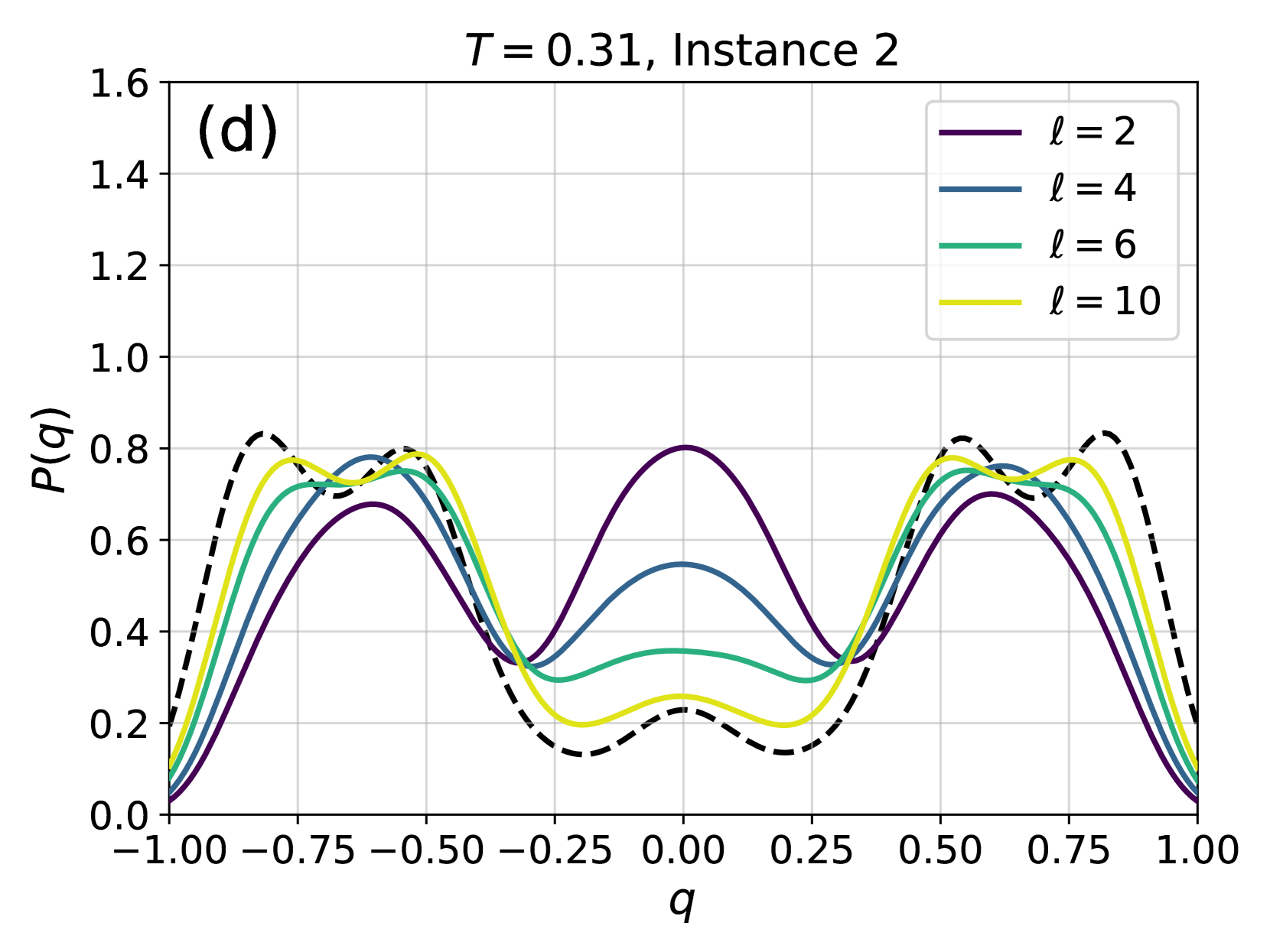
The image is a line chart displaying the relationship between P(q) and q for different values of 'l' at a constant temperature T = 0.31, Instance 2. The chart includes four distinct lines representing l = 2, l = 4, l = 6, and l = 10, along with a dashed black line. The x-axis represents 'q', and the y-axis represents 'P(q)'.
### Components/Axes
* **Title:** T = 0.31, Instance 2
* **X-axis:**
* Label: q
* Scale: -1.00 to 1.00, with increments of 0.25 (-1.00, -0.75, -0.50, -0.25, 0.00, 0.25, 0.50, 0.75, 1.00)
* **Y-axis:**
* Label: P(q)
* Scale: 0.0 to 1.6, with increments of 0.2 (0.0, 0.2, 0.4, 0.6, 0.8, 1.0, 1.2, 1.4, 1.6)
* **Legend:** Located in the top-right corner.
* Purple line: l = 2
* Blue line: l = 4
* Green line: l = 6
* Yellow line: l = 10
* Black dashed line: Unspecified
### Detailed Analysis
* **Purple line (l = 2):** This line starts at approximately 0.0 at q = -1.00, rises to a peak of approximately 0.78 at q = -0.50, dips to approximately 0.35 at q = -0.25, rises again to a peak of approximately 0.82 at q = 0.00, dips to approximately 0.35 at q = 0.25, rises to a peak of approximately 0.78 at q = 0.50, and falls back to approximately 0.0 at q = 1.00.
* **Blue line (l = 4):** This line starts at approximately 0.0 at q = -1.00, rises to a peak of approximately 0.75 at q = -0.60, dips to approximately 0.30 at q = -0.25, rises again to a peak of approximately 0.55 at q = 0.00, dips to approximately 0.30 at q = 0.25, rises to a peak of approximately 0.75 at q = 0.60, and falls back to approximately 0.0 at q = 1.00.
* **Green line (l = 6):** This line starts at approximately 0.0 at q = -1.00, rises to a peak of approximately 0.78 at q = -0.70, dips to approximately 0.28 at q = -0.25, rises again to a peak of approximately 0.35 at q = 0.00, dips to approximately 0.28 at q = 0.25, rises to a peak of approximately 0.78 at q = 0.70, and falls back to approximately 0.0 at q = 1.00.
* **Yellow line (l = 10):** This line starts at approximately 0.0 at q = -1.00, rises to a peak of approximately 0.80 at q = -0.75, dips to approximately 0.20 at q = -0.25, rises again to a peak of approximately 0.22 at q = 0.00, dips to approximately 0.20 at q = 0.25, rises to a peak of approximately 0.80 at q = 0.75, and falls back to approximately 0.0 at q = 1.00.
* **Black dashed line:** This line starts at approximately 0.0 at q = -1.00, rises to a peak of approximately 0.85 at q = -0.75, dips to approximately 0.30 at q = -0.25, rises again to a peak of approximately 0.20 at q = 0.00, dips to approximately 0.30 at q = 0.25, rises to a peak of approximately 0.85 at q = 0.75, and falls back to approximately 0.0 at q = 1.00.
### Key Observations
* All lines start and end at approximately P(q) = 0.0 at q = -1.00 and q = 1.00, respectively.
* The peaks of the lines shift slightly towards the center (q = 0.00) as 'l' increases.
* The height of the central peak at q = 0.00 decreases as 'l' increases.
* The black dashed line has the highest peaks at q = -0.75 and q = 0.75.
### Interpretation
The chart illustrates how the probability distribution P(q) changes with different values of 'l' at a fixed temperature. As 'l' increases, the central peak at q = 0.00 becomes less pronounced, suggesting a shift in the distribution. The black dashed line, which is not explicitly defined in the legend, exhibits the highest probability peaks at q = -0.75 and q = 0.75, indicating a different behavior compared to the other lines. The data suggests that the system's behavior is influenced by the parameter 'l', potentially related to a characteristic length scale or interaction range within the system.