## Line Chart: RMSE vs. n for Change Detection Algorithms
### Overview
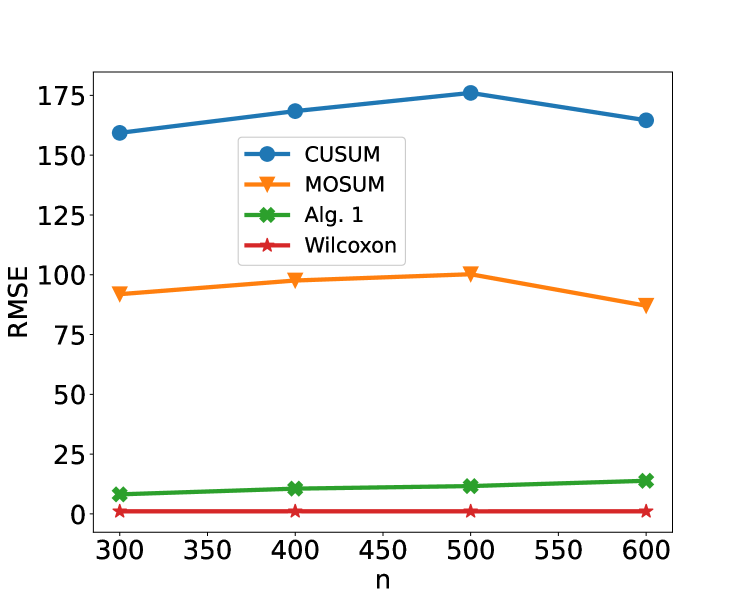
This image presents a line chart comparing the Root Mean Squared Error (RMSE) performance of four change detection algorithms (CUSUM, MOSUM, Alg. 1, and Wilcoxon) as a function of the sample size 'n'. The chart visually assesses how the accuracy of each algorithm changes with increasing data points.
### Components/Axes
* **X-axis:** 'n' - Sample Size, ranging from approximately 300 to 600. The axis is labeled "n".
* **Y-axis:** 'RMSE' - Root Mean Squared Error, ranging from 0 to 175. The axis is labeled "RMSE".
* **Data Series:**
* CUSUM (Blue line with circle markers)
* MOSUM (Orange line with triangle markers)
* Alg. 1 (Green line with plus markers)
* Wilcoxon (Red line with star markers)
* **Legend:** Located in the top-right corner of the chart, clearly identifying each line with its corresponding algorithm name and marker.
### Detailed Analysis
* **CUSUM (Blue):** The line starts at approximately 162 RMSE at n=300, decreases to a minimum of approximately 160 at n=350, then increases to a maximum of approximately 175 at n=500, and finally decreases to approximately 165 at n=600. The trend is generally flat with some fluctuation.
* n=300: RMSE ≈ 162
* n=350: RMSE ≈ 160
* n=400: RMSE ≈ 168
* n=450: RMSE ≈ 172
* n=500: RMSE ≈ 175
* n=550: RMSE ≈ 170
* n=600: RMSE ≈ 165
* **MOSUM (Orange):** The line starts at approximately 95 RMSE at n=300, increases to a maximum of approximately 102 at n=450, and then decreases to approximately 82 at n=600. The trend is generally decreasing.
* n=300: RMSE ≈ 95
* n=350: RMSE ≈ 98
* n=400: RMSE ≈ 100
* n=450: RMSE ≈ 102
* n=500: RMSE ≈ 98
* n=550: RMSE ≈ 90
* n=600: RMSE ≈ 82
* **Alg. 1 (Green):** The line remains relatively flat throughout the entire range of 'n', starting at approximately 12 RMSE at n=300 and ending at approximately 15 RMSE at n=600.
* n=300: RMSE ≈ 12
* n=350: RMSE ≈ 12
* n=400: RMSE ≈ 12
* n=450: RMSE ≈ 13
* n=500: RMSE ≈ 13
* n=550: RMSE ≈ 14
* n=600: RMSE ≈ 15
* **Wilcoxon (Red):** The line is consistently very close to zero, starting at approximately 2 RMSE at n=300 and ending at approximately 5 RMSE at n=600.
* n=300: RMSE ≈ 2
* n=350: RMSE ≈ 3
* n=400: RMSE ≈ 3
* n=450: RMSE ≈ 3
* n=500: RMSE ≈ 4
* n=550: RMSE ≈ 4
* n=600: RMSE ≈ 5
### Key Observations
* Alg. 1 and Wilcoxon consistently exhibit significantly lower RMSE values compared to CUSUM and MOSUM across all sample sizes.
* CUSUM shows the highest RMSE values, indicating the lowest accuracy among the four algorithms.
* MOSUM's RMSE decreases as 'n' increases, suggesting improved performance with larger sample sizes.
* CUSUM's RMSE fluctuates with increasing 'n', showing no clear trend.
### Interpretation
The chart demonstrates the performance characteristics of different change detection algorithms as the sample size increases. Alg. 1 and Wilcoxon are clearly superior in terms of RMSE, indicating higher accuracy in detecting changes. The decreasing RMSE of MOSUM with increasing 'n' suggests that it benefits from more data, while CUSUM's performance remains relatively unstable. The consistent low RMSE of Alg. 1 and Wilcoxon suggests they are robust to sample size variations. This data could be used to select the most appropriate algorithm for a given application, considering the expected sample size and the desired level of accuracy. The large difference in RMSE values between the algorithms suggests that the choice of algorithm can have a substantial impact on the reliability of change detection results.