## Diagram: Rainfall Prediction Model
### Overview
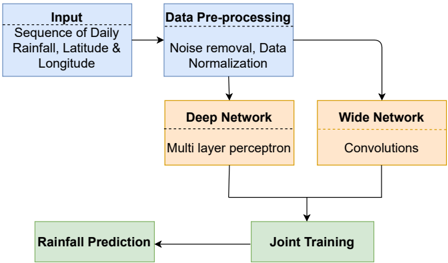
The image is a flowchart illustrating a rainfall prediction model. It outlines the steps from input data to the final rainfall prediction, incorporating data pre-processing, deep and wide networks, and joint training.
### Components/Axes
The diagram consists of several rectangular blocks representing different stages of the model. The blocks are connected by arrows indicating the flow of data. The blocks are colored in blue, orange, and green.
* **Input (Top-Left, Blue):** "Input" and "Sequence of Daily Rainfall, Latitude & Longitude"
* **Data Pre-processing (Top-Center, Blue):** "Data Pre-processing" and "Noise removal, Data Normalization"
* **Deep Network (Center-Left, Orange):** "Deep Network" and "Multi layer perceptron"
* **Wide Network (Center-Right, Orange):** "Wide Network" and "Convolutions"
* **Joint Training (Bottom-Center, Green):** "Joint Training"
* **Rainfall Prediction (Bottom-Left, Green):** "Rainfall Prediction"
### Detailed Analysis or Content Details
1. **Input:** The process begins with input data, which includes a sequence of daily rainfall, latitude, and longitude.
2. **Data Pre-processing:** The input data is then pre-processed. This involves noise removal and data normalization.
3. **Deep Network:** One branch of the model utilizes a deep network, specifically a multi-layer perceptron.
4. **Wide Network:** Another branch employs a wide network using convolutions.
5. **Joint Training:** The outputs from both the deep and wide networks are combined in a joint training stage.
6. **Rainfall Prediction:** Finally, the model produces a rainfall prediction based on the joint training.
The flow of data is as follows:
* Input -> Data Pre-processing
* Data Pre-processing -> Deep Network
* Data Pre-processing -> Wide Network
* Deep Network -> Joint Training
* Wide Network -> Joint Training
* Joint Training -> Rainfall Prediction
* Rainfall Prediction -> Joint Training (Feedback Loop)
### Key Observations
* The model uses both deep and wide networks, suggesting a hybrid approach to capture different aspects of the data.
* The joint training stage indicates that the outputs of the two networks are combined to improve prediction accuracy.
* There is a feedback loop from Rainfall Prediction to Joint Training.
### Interpretation
The diagram illustrates a machine learning model designed for rainfall prediction. The model leverages both deep learning (multi-layer perceptron) and wide learning (convolutions) techniques. The pre-processing step is crucial for cleaning and normalizing the input data, ensuring the model receives high-quality information. The joint training phase likely aims to integrate the strengths of both network types, potentially improving the overall accuracy and robustness of the rainfall prediction. The feedback loop from Rainfall Prediction to Joint Training suggests that the model is continuously learning and refining its predictions based on past results.