\n
## Diagram: Rainfall Prediction System Architecture
### Overview
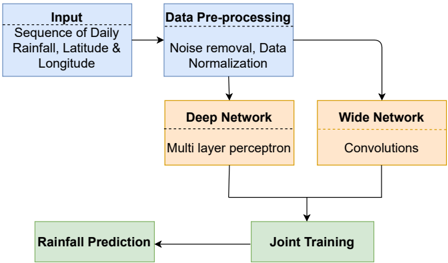
The image depicts a flowchart illustrating the architecture of a rainfall prediction system. The system takes daily rainfall, latitude, and longitude as input, processes the data, and outputs a rainfall prediction. It utilizes both a deep network and a wide network, trained jointly.
### Components/Axes
The diagram consists of the following components, connected by arrows indicating data flow:
* **Input:** "Sequence of Daily Rainfall, Latitude & Longitude" (Light Blue Rectangle)
* **Data Pre-processing:** "Noise removal, Data Normalization" (Light Blue Rectangle)
* **Deep Network:** "Multi layer perceptron" (Orange Rectangle)
* **Wide Network:** "Convolutions" (Orange Rectangle)
* **Joint Training:** (Light Green Rectangle)
* **Rainfall Prediction:** (Light Green Rectangle)
Arrows indicate the flow of data between these components.
### Detailed Analysis or Content Details
The system begins with an "Input" stage, receiving a "Sequence of Daily Rainfall, Latitude & Longitude". This data is then fed into a "Data Pre-processing" stage, which performs "Noise removal" and "Data Normalization".
The pre-processed data is then split into two parallel paths:
1. A "Deep Network" utilizing a "Multi layer perceptron".
2. A "Wide Network" employing "Convolutions".
The outputs of both the "Deep Network" and the "Wide Network" are then fed into a "Joint Training" stage. Finally, the output of the "Joint Training" stage is used to generate a "Rainfall Prediction".
The diagram shows a feedback loop from the "Data Pre-processing" stage to the "Wide Network".
### Key Observations
The architecture employs a dual-network approach, combining the strengths of deep learning (Multi layer perceptron) and wide learning (Convolutions). The "Joint Training" stage suggests that the two networks are trained simultaneously to optimize performance. The feedback loop from the "Data Pre-processing" stage to the "Wide Network" indicates that the pre-processing steps may be iteratively refined during training.
### Interpretation
This diagram illustrates a hybrid machine learning approach to rainfall prediction. The use of both deep and wide networks suggests an attempt to capture both complex non-linear relationships (deep network) and local patterns (wide network) in the data. The joint training approach is likely intended to leverage the complementary strengths of the two networks, leading to more accurate and robust predictions. The data pre-processing stage is crucial for ensuring data quality and improving model performance. The feedback loop suggests a dynamic system where the pre-processing steps are optimized alongside the network training. This architecture is likely designed to handle large datasets and complex spatial-temporal patterns in rainfall data.