## Diagram: Machine Learning Pipeline for Rainfall Prediction
### Overview
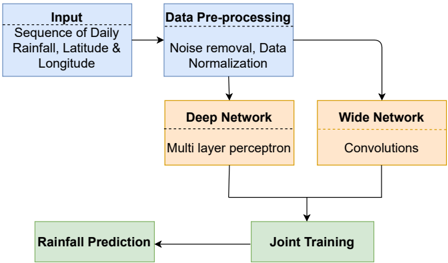
The image displays a technical flowchart illustrating a machine learning pipeline designed for rainfall prediction. The diagram outlines a sequential and parallel process, starting from raw input data, moving through pre-processing, then branching into two distinct neural network architectures, followed by joint training, and culminating in a final prediction output. The flow is indicated by directional arrows connecting the blocks.
### Components/Axes
The diagram is composed of six primary rectangular blocks, color-coded by function, connected by black arrows. The spatial layout is as follows:
* **Top-Left (Blue Block):** Input Stage.
* **Top-Center (Blue Block):** Data Pre-processing Stage.
* **Center (Two Orange Blocks):** Parallel Neural Network Architectures.
* **Bottom-Center (Green Block):** Joint Training Stage.
* **Bottom-Left (Green Block):** Output Stage.
**Legend/Color Key (Implicit):**
* **Blue:** Data input and preparation stages.
* **Orange:** Core neural network model components.
* **Green:** Training and output stages.
### Detailed Analysis
**1. Input Block (Top-Left, Blue):**
* **Primary Label:** `Input`
* **Sub-label/Description:** `Sequence of Daily Rainfall, Latitude & Longitude`
* **Function:** This block represents the ingestion of raw, sequential geospatial and meteorological data.
**2. Data Pre-processing Block (Top-Center, Blue):**
* **Primary Label:** `Data Pre-processing`
* **Sub-label/Description:** `Noise removal, Data Normalization`
* **Function:** The raw input data is cleaned and standardized here. An arrow points from the Input block to this block.
**3. Deep Network Block (Center-Left, Orange):**
* **Primary Label:** `Deep Network`
* **Sub-label/Description:** `Multi layer perceptron`
* **Function:** One branch of the model architecture, utilizing a standard deep neural network (MLP). An arrow from the Pre-processing block feeds into this block.
**4. Wide Network Block (Center-Right, Orange):**
* **Primary Label:** `Wide Network`
* **Sub-label/Description:** `Convolutions`
* **Function:** The parallel branch of the model architecture, utilizing convolutional layers, likely to capture spatial patterns. An arrow from the Pre-processing block also feeds into this block.
**5. Joint Training Block (Bottom-Center, Green):**
* **Primary Label:** `Joint Training`
* **Function:** The outputs from both the Deep Network and Wide Network are combined and trained together in this stage. Arrows from both orange network blocks converge into this block.
**6. Rainfall Prediction Block (Bottom-Left, Green):**
* **Primary Label:** `Rainfall Prediction`
* **Function:** The final output of the entire pipeline. An arrow points from the Joint Training block to this block.
**Flow Summary:** `Input` -> `Data Pre-processing` -> (Splits to) `Deep Network` & `Wide Network` -> (Both feed into) `Joint Training` -> `Rainfall Prediction`.
### Key Observations
1. **Hybrid Architecture:** The model employs a "wide and deep" learning design, combining a Multi-Layer Perceptron (deep part) with Convolutions (wide part). This is a known architecture pattern for learning both deep, complex patterns and direct, shallow feature interactions.
2. **Parallel Processing:** The data pre-processing output is fed simultaneously into two different network types, suggesting the model is designed to extract different kinds of features (e.g., abstract temporal patterns via MLP and local spatial patterns via CNNs) from the same dataset.
3. **End-to-End Pipeline:** The diagram depicts a complete workflow from raw data ingestion to final prediction, emphasizing the importance of the pre-processing and joint training steps in the overall system.
4. **Spatial Data Inclusion:** The input explicitly includes `Latitude & Longitude`, indicating the model is geospatially aware and likely aims to make predictions conditioned on location.
### Interpretation
This diagram represents a sophisticated approach to a complex forecasting problem. Rainfall prediction is challenging due to its non-linear, spatiotemporal nature. The pipeline's design suggests the following investigative reasoning:
* **Problem Decomposition:** The system breaks the problem into manageable stages: data cleaning, feature extraction via dual pathways, and integrated learning.
* **Architectural Rationale:** The "Wide & Deep" design is a strategic choice. The **Deep Network (MLP)** is likely tasked with learning high-level, non-linear interactions between variables over time (the "sequence" aspect). The **Wide Network (Convolutions)** is ideally suited to process the gridded spatial data (latitude/longitude) to capture local weather patterns and regional correlations.
* **Joint Training Significance:** The `Joint Training` block is critical. It implies the features learned by the deep and wide components are not used independently but are optimized together. This allows the model to find a synergistic balance, where the MLP's understanding of temporal dynamics informs the CNN's spatial processing, and vice-versa, leading to a more robust final prediction.
* **Underlying Assumption:** The pipeline operates on the assumption that rainfall is a function of both historical sequences (temporal) and geographic context (spatial), and that a hybrid model can capture this relationship more effectively than a single architecture.
**Conclusion:** The diagram outlines a purpose-built, hybrid neural network system for spatiotemporal forecasting. It moves beyond a simple monolithic model by explicitly separating and then reintegrating spatial and temporal feature learning pathways, which is a principled approach to modeling complex environmental phenomena.