## Conceptual Diagram: Causal vs. Anticausal Learning Processes
### Overview
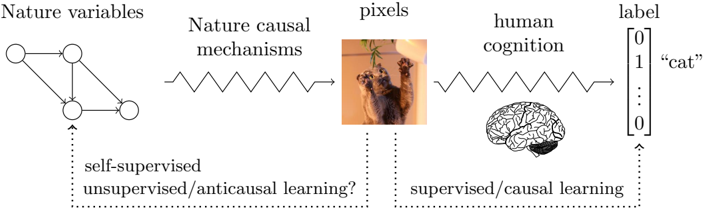
This diagram illustrates the conceptual flow of data generation and the corresponding learning paradigms. It maps the progression from underlying "Nature variables" to observed "pixels" and finally to a classification "label," while contrasting two distinct learning directions: "supervised/causal learning" and "self-supervised/unsupervised/anticausal learning."
### Components
The diagram is organized into two horizontal tiers:
**Top Tier (Generative Flow):**
* **Nature variables:** Represented on the far left by a directed acyclic graph (DAG) consisting of four circular nodes connected by directional arrows.
* **Nature causal mechanisms:** Represented by a zig-zag arrow pointing from the "Nature variables" graph to the "pixels" image.
* **pixels:** Represented by a photograph of a cat reaching for a plant.
* **human cognition:** Represented by a zig-zag arrow pointing from the "pixels" image to the "label" vector.
* **label:** Represented on the far right by a vertical vector notation:
$$
\begin{bmatrix} 0 \\ 1 \\ \vdots \\ 0 \end{bmatrix}
$$
with the text "cat" written to the right of the vector.
**Bottom Tier (Learning Feedback Loops):**
* **self-supervised/unsupervised/anticausal learning?:** A dotted arrow originating from the "label" area, looping back to the left, and pointing to the "Nature variables" graph.
* **supervised/causal learning:** A dotted arrow originating from the "pixels" area and pointing to the "label" area.
### Detailed Analysis
* **Generative Direction (Left to Right):** The diagram posits that nature generates data through causal mechanisms. The "Nature variables" (the root cause) are transformed via "Nature causal mechanisms" into observable "pixels." Subsequently, "human cognition" processes these pixels to produce a classification "label."
* **Learning Direction (Bottom Loops):**
* **Supervised/Causal Learning:** This loop connects the input ("pixels") to the output ("label"). It follows the same direction as the generative process (Nature -> Pixels -> Label), hence the term "causal."
* **Self-supervised/Unsupervised/Anticausal Learning:** This loop connects the output ("label") back to the root cause ("Nature variables"). This implies an "anticausal" direction, where the system attempts to infer the underlying causal structure from the observed labels or data, effectively reversing the generative flow.
### Key Observations
* **Zig-Zag Arrows:** The use of zig-zag lines for "Nature causal mechanisms" and "human cognition" implies complex, non-linear transformations between the states.
* **Question Mark:** The label "anticausal learning?" includes a question mark, suggesting that this specific terminology or the feasibility of this learning direction is a subject of theoretical inquiry or debate.
* **Vector Representation:** The "label" is represented as a one-hot encoded vector, standard in machine learning classification tasks.
### Interpretation
This diagram serves as a conceptual framework for understanding the difference between standard supervised learning and more advanced representation learning.
1. **Causal vs. Anticausal:** The diagram highlights a fundamental distinction in machine learning. Standard supervised learning is "causal" because it models the mapping $P(Y|X)$ (Label given Pixels), which aligns with the generative direction of the data.
2. **Inverting the Process:** The "anticausal" loop suggests that unsupervised or self-supervised learning aims to recover the latent "Nature variables" (the causal structure) from the observed data. This is often considered a harder problem because it requires inverting the generative process, which is typically a many-to-one mapping (many different causal configurations could potentially result in similar pixel observations).
3. **Cognitive Parallel:** By labeling the transformation from pixels to labels as "human cognition," the diagram suggests that human intelligence is essentially a causal inference engine that maps sensory input (pixels) to semantic understanding (labels).