## Diagram: Automated Bug Detection and Resolution Workflow
### Overview
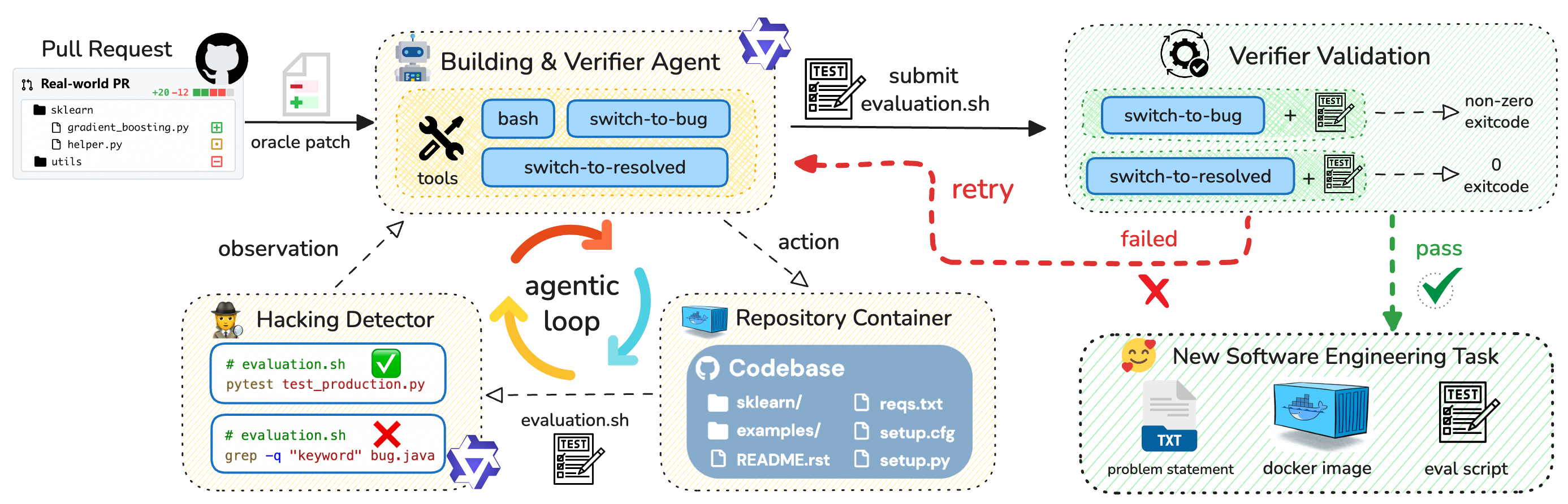
The image illustrates an automated workflow for detecting and resolving bugs in a software repository using a pull request system. The process involves a building and verifier agent, a hacking detector, and a verifier validation step, with a feedback loop for retrying failed validations.
### Components/Axes
The diagram consists of the following key components:
1. **Pull Request:** Represents an incoming code change request.
* "Real-world PR"
* Files: sklearn, gradient\_boosting.py, helper.py, utils
* "+20 -12" (Indicates lines added and removed)
* Github logo
2. **Oracle Patch:** Represents a potential fix or modification to the code.
3. **Building & Verifier Agent:** Builds and prepares the code for verification.
* Tools: bash, switch-to-bug, switch-to-resolved
4. **Repository Container:** Contains the codebase.
* Codebase: sklearn/, examples/, README.rst, reqs.txt, setup.cfg, setup.py
5. **Hacking Detector:** Detects potential security vulnerabilities or bugs.
* Checks:
* `# evaluation.sh; pytest test_production.py` (Pass)
* `# evaluation.sh; grep -q "keyword" bug.java` (Fail)
6. **Verifier Validation:** Validates the code changes.
* switch-to-bug + TEST -> non-zero exitcode
* switch-to-resolved + TEST -> 0 exitcode
7. **New Software Engineering Task:** Represents the final outcome of the process.
* Components: problem statement (TXT), docker image, eval script (TEST)
### Detailed Analysis
The workflow proceeds as follows:
1. A pull request is submitted.
2. An oracle patch is applied.
3. The Building & Verifier Agent builds the code using tools like bash and switches between bug and resolved versions.
4. The agent submits an evaluation script (`evaluation.sh`).
5. The Hacking Detector observes the code and runs checks.
6. The Verifier Validation step checks the code.
* If the validation fails (non-zero exitcode), a retry mechanism is triggered.
* If the validation passes (0 exitcode), the process moves to the New Software Engineering Task.
7. The agentic loop represents the iterative process of evaluation and refinement.
8. The Repository Container holds the codebase and related files.
### Key Observations
* The diagram highlights the importance of automated testing and validation in software development.
* The feedback loop ensures that failed validations are retried, improving the reliability of the process.
* The Hacking Detector plays a crucial role in identifying potential security vulnerabilities.
### Interpretation
The diagram illustrates a robust and automated system for bug detection and resolution. The system uses a combination of building, verification, and hacking detection to ensure the quality and security of the codebase. The iterative nature of the process, with the agentic loop and retry mechanism, allows for continuous improvement and refinement of the code. The ultimate goal is to produce a new software engineering task that is free of bugs and vulnerabilities.