\n
## Line Chart: Training Performance Metrics
### Overview
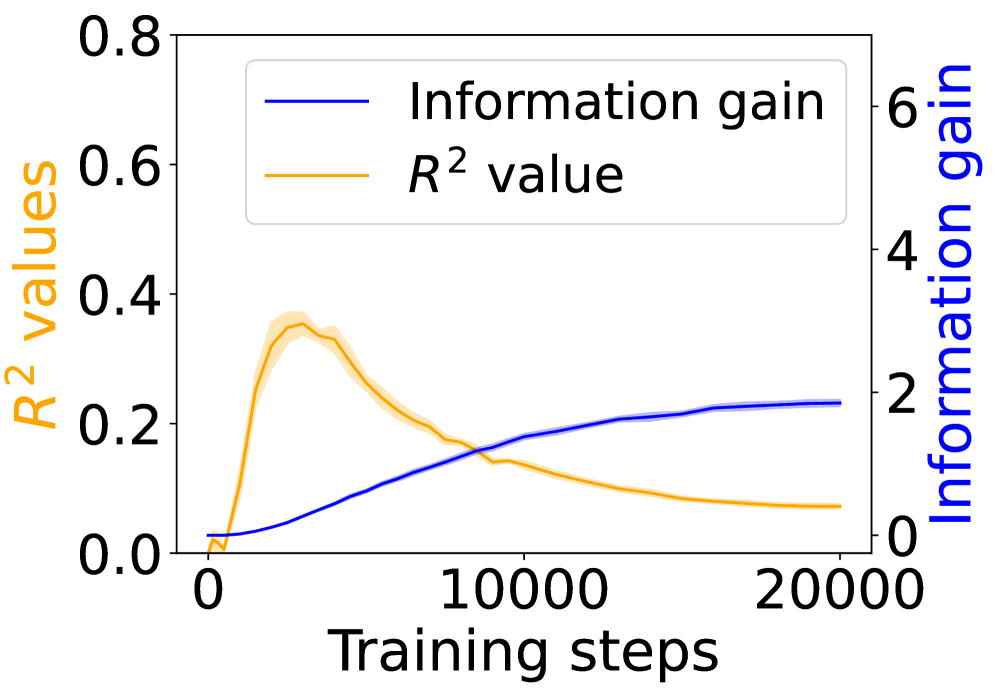
The image presents a line chart illustrating the relationship between training steps and two performance metrics: Information Gain and R² value. The chart displays how these metrics evolve during the training process, likely of a machine learning model. The chart uses a dual y-axis to accommodate the different scales of the two metrics.
### Components/Axes
* **X-axis:** "Training steps" ranging from approximately 0 to 20000.
* **Left Y-axis:** "R² values" ranging from 0 to 0.8.
* **Right Y-axis:** "Information gain" ranging from 0 to 6.
* **Legend:** Located in the top-left corner, identifying two lines:
* "Information gain" (dark blue line)
* "R² value" (orange line)
### Detailed Analysis
**Information Gain (Dark Blue Line):**
The Information Gain line starts at approximately 0 at 0 training steps. It exhibits a generally upward trend, increasing at a decreasing rate, and plateaus around a value of approximately 2.3 at 20000 training steps. The line is relatively smooth with no significant oscillations.
* At 0 training steps: ~0
* At 2000 training steps: ~0.6
* At 5000 training steps: ~1.3
* At 10000 training steps: ~1.8
* At 15000 training steps: ~2.1
* At 20000 training steps: ~2.3
**R² Value (Orange Line):**
The R² value line begins at approximately 0 at 0 training steps. It rapidly increases to a peak of approximately 0.4 at around 2000-3000 training steps. After the peak, it declines, oscillating between approximately 0.15 and 0.25, and ends at approximately 0.15 at 20000 training steps.
* At 0 training steps: ~0
* At 2000 training steps: ~0.38
* At 4000 training steps: ~0.3
* At 6000 training steps: ~0.25
* At 8000 training steps: ~0.2
* At 10000 training steps: ~0.18
* At 12000 training steps: ~0.22
* At 14000 training steps: ~0.17
* At 16000 training steps: ~0.19
* At 20000 training steps: ~0.15
### Key Observations
* The R² value initially increases rapidly but then decreases and stabilizes at a relatively low value. This suggests that the model's ability to explain the variance in the data improves initially but then plateaus or even degrades.
* The Information Gain consistently increases throughout the training process, indicating that the model is continuously learning and gaining information from the data.
* The two metrics exhibit contrasting trends. While Information Gain continues to rise, R² value plateaus and declines, suggesting a potential trade-off between model complexity and its ability to generalize.
### Interpretation
The chart suggests that the training process leads to increasing information gain, but the model's ability to fit the training data (as measured by R²) plateaus and eventually declines. This could indicate overfitting, where the model learns the training data too well and loses its ability to generalize to unseen data. The initial rapid increase in R² suggests a period of rapid learning, followed by a period where the model's performance on the training data plateaus. The continued increase in Information Gain suggests that the model is still learning, but this learning may not be translating into improved performance on the training data. Further investigation would be needed to determine the cause of the decline in R² value and to assess the model's generalization performance on a validation set. The divergence between the two metrics is a key observation, hinting at a potential issue with the training process or model architecture.